




























Views
Downloads
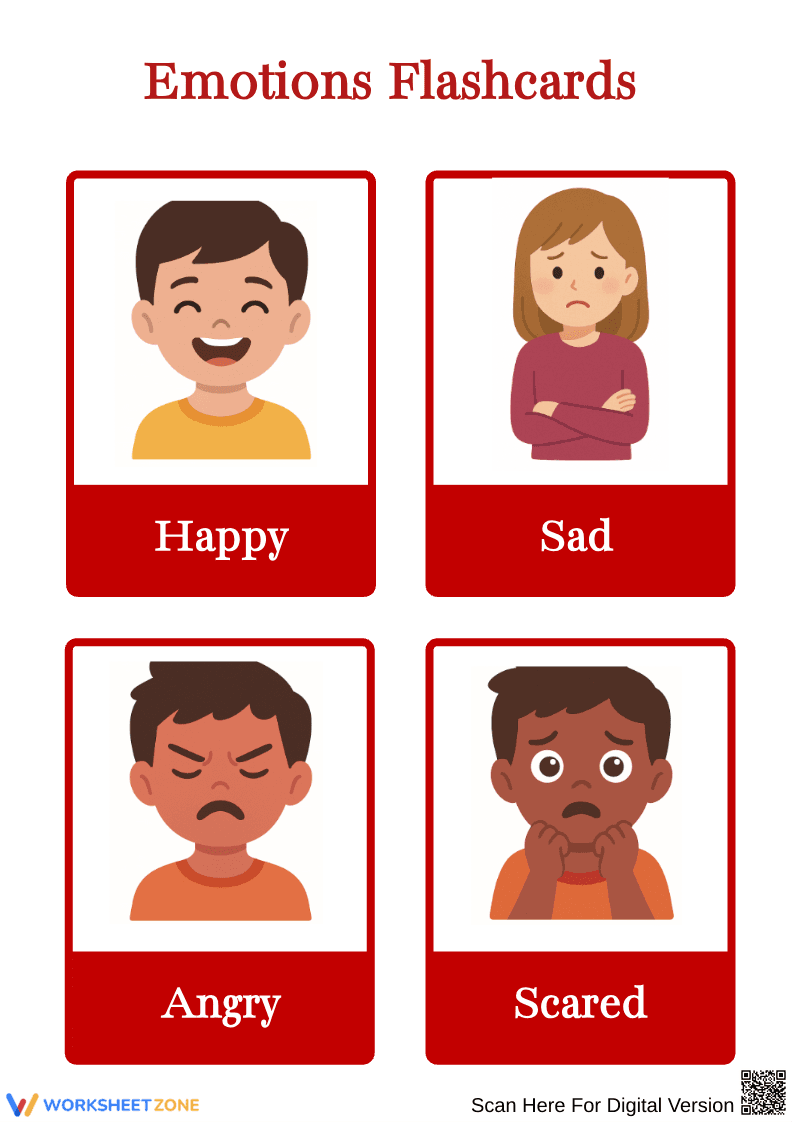

Printable Emotions Flashcards | Grade 3 Vocabulary

Paste this activity's link or code into your existing LMS (Google Classroom, Canvas, Teams, Schoology, Moodle, etc.).
Students can open and work on the activity right away, with no student login required.
You'll still be able to track student progress and results from your teacher account.
This printable emotions flashcards worksheet helps Grade 3 and 4 students identify, label, and discuss core feelings to build essential social-emotional vocabulary. By connecting visual expressions to specific emotion words, students develop the language skills needed to describe internal states and improve interpersonal communication.
At a Glance
- Grade: Grade 3 · Subject: ELA & Vocabulary
- Standard:
CCSS.ELA-LITERACY.L.3.5— Distinguish shades of meaning among related words describing states of mind- Skill Focus: Identifying and labeling basic emotions
- Format: 1 page · 4 problems · No answer key · PDF
- Best For: Morning meetings, English language learning, and small group SEL activities
- Time: 10–15 minutes
This single-page resource features 4 distinct, high-quality visual flashcards representing primary emotional states: happy, sad, angry, and scared. Each card displays a clear, colorful illustration of a child expressing the emotion alongside a bold, easy-to-read text label. The clean layout ensures that students can easily cut out the cards for hands-on sorting, matching, or speaking activities without any visual distractions.
This resource is designed for immediate classroom integration with a simple three-step workflow. First, print the single-page PDF document, which takes less than 1 minute. Second, distribute the sheet directly to students or small groups, requiring zero teacher setup or preparation. Third, review the vocabulary terms together as a class or have students cut out the cards for immediate partner practice. The entire setup takes under 2 minutes, making it an ideal tool for morning warm-ups, sudden schedule changes, or quick substitute teacher lesson plans.
Standards Alignment
This worksheet aligns directly with the primary standard CCSS.ELA-LITERACY.L.3.5, which requires students to demonstrate understanding of word relationships and nuances in word meanings. By exploring the specific vocabulary of feelings, students learn to distinguish between different emotional states and select precise words to describe human experiences. Both standard codes can be copied directly into lesson plans, IEP goals, or district curriculum mapping tools.
How to Use It
Use this resource during direct instruction as a visual anchor to introduce emotional vocabulary, or after a reading lesson to help students analyze a character's feelings. For a quick formative assessment, observe students as they match the flashcards to short scenarios read aloud, noting their ability to correctly identify the target emotion within 10 minutes.
Who It's For
This worksheet is ideal for general education elementary students, English language learners (ELL) building basic vocabulary, and students receiving special education services focused on social-emotional development. Pair this resource with a short narrative passage or a classroom anchor chart to reinforce the connection between textual descriptions and visual emotional cues.
According to the Fisher & Frey (2014) framework for gradual release of responsibility, visual scaffolds like these flashcards are critical for helping students transition from guided vocabulary acquisition to independent language application. Research indicates that explicit instruction in emotional labeling directly supports reading comprehension by enabling students to decode character motivations and complex narrative arcs. By aligning this resource with CCSS.ELA-LITERACY.L.3.5, educators ensure that vocabulary acquisition is grounded in structured, standards-based practice. The inclusion of 4 distinct visual representations allows teachers to gather immediate formative data on student comprehension. This structured approach to vocabulary development helps bridge the gap between basic word recognition and deeper contextual understanding, making it a valuable addition to any early elementary literacy curriculum.


