




























Views
Downloads
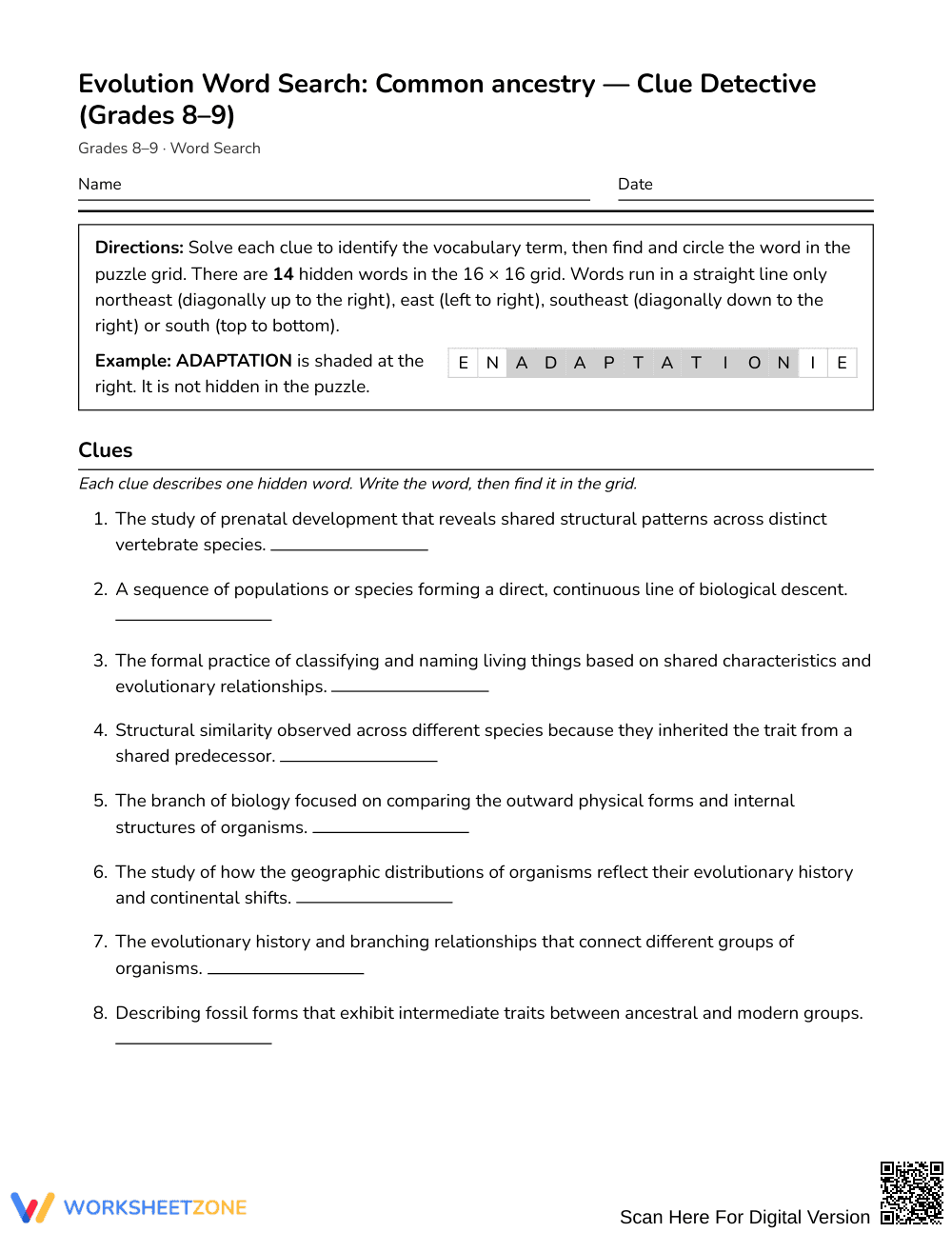


Printable Common Ancestry Word Search | Grades 8–9 Science

Paste this activity's link or code into your existing LMS (Google Classroom, Canvas, Teams, Schoology, Moodle, etc.).
Students can open and work on the activity right away, with no student login required.
You'll still be able to track student progress and results from your teacher account.
This science word search reinforces foundational concepts of common ancestry and evolutionary biology for Grades 8–9. Students decipher biological definitions to uncover fourteen essential vocabulary terms hidden within a puzzle grid. By connecting evidence-based clues to key scientific terminology, learners solidify their conceptual understanding and retention of evolutionary mechanisms.
At a Glance
- Grade: Grades 8–9 · Subject: Science
- Standard: Not standards-assessed — vocabulary enrichment
- Skill Focus: Common ancestry
- Format: 3 pages · 14 words · Answer key included · PDF
- Best For: Vocabulary review and concept reinforcement
- Time: 20–30 minutes
What's Inside: This 3-page printable resource includes a vocabulary puzzle sheet paired with comprehensive teacher answer keys. Students engage with 14 content-rich clues defining critical evolutionary biology terms, including homology, vestigial structures, cladograms, and speciation. Rather than relying on a passive word list, the activity tasks learners with solving conceptual clues before locating each target term, deepening cognitive engagement.
Puzzle Mechanics and Structure
- Grid Layout: The puzzle features a challenging 16 by 16 grid containing all 14 hidden vocabulary terms.
- Word Orientations: Terms run across four distinct directional paths: northeast, east, southeast, and south.
- Clue-Based Search: A clue detective format replaces a simple word list, requiring students to match definitions to terms before searching the grid, with a shuffled word bank providing support.
Standards Alignment
This learning activity serves as vocabulary enrichment and is not aligned to a formal academic content standard. It supports core life science curricula by strengthening the domain-specific vocabulary required to understand macroevolution, comparative anatomy, and phylogenetic relationships across middle and early high school science units.
How to Use It
Deploy this activity after direct instruction on evolutionary evidence to reinforce domain vocabulary, or assign it as an independent station task during review rotations. Formative assessment tip: observe whether students deduce terms directly from the anatomical descriptions or require reference to the shuffled word bank. Typical completion time ranges between 20 and 30 minutes.
Who It's For
Designed for Grades 8–9 science students studying biological evolution and common descent, this activity provides low-stress vocabulary practice. Teachers can differentiate by allowing emerging readers to reference the shuffled word bank while advanced learners solve clues entirely unassisted. Pair this puzzle with a comparative embryology diagram or cladogram analysis lesson.
According to Fisher & Frey (2014), intentional domain-specific vocabulary acquisition is vital for secondary students comprehending complex scientific texts and evolutionary models. Scientific literacy in evolutionary biology requires mastery of specialized concepts such as common ancestry, homology, cladograms, and transitional lineages. When students engage in clue-based vocabulary retrieval, they actively process conceptual definitions rather than engaging in rote, passive memorization. This cognitive retrieval strengthens neural pathways and bridges the gap between basic recall and deep conceptual synthesis in life science. Integrating clue-driven vocabulary tasks into regular unit instruction provides repeated exposure to rigorous academic language, enabling eighth and ninth graders to articulate biological relationships with precision during classroom discourse and structured inquiries.


