





























Paste this activity's link or code into your existing LMS (Google Classroom, Canvas, Teams, Schoology, Moodle, etc.).
Students can open and work on the activity right away, with no student login required.
You'll still be able to track student progress and results from your teacher account.


Printable Cider and Cranberry Kitchen Conversions

Paste this activity's link or code into your existing LMS (Google Classroom, Canvas, Teams, Schoology, Moodle, etc.).
Students can open and work on the activity right away, with no student login required.
You'll still be able to track student progress and results from your teacher account.
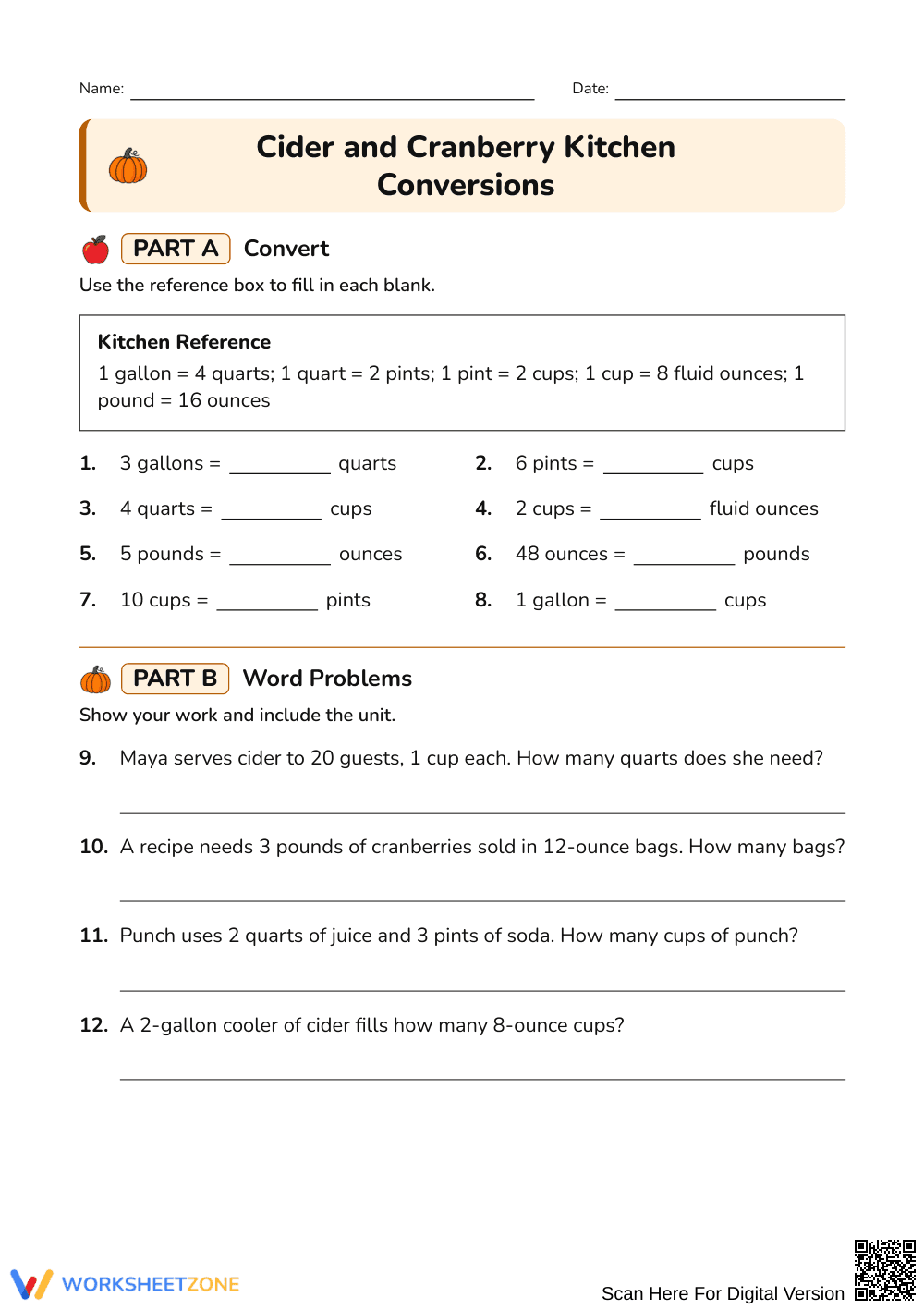
This Grade 5 customary measurement worksheet equips students to convert units of capacity and weight through kitchen scenarios. Learners apply conversion rules across gallons, quarts, pints, cups, fluid ounces, pounds, and ounces, moving from baseline calculations to multi-step word problems.
At a Glance
- Grade: 5 · Subject: Math
- Standard:
5.MD.A.1— Convert different-sized standard measurement units within a given measurement system to solve problems.- Skill Focus: Customary capacity and weight conversions in multi-step problems
- Format: 1 printable page · 12 structured problems · Full answer key included · PDF
- Best For: Independent skills practice and substitute teacher folders
- Time: 20–30 minutes
What's Inside
This single-page worksheet contains 12 problems across two sections. Part A presents 8 conversion blanks supported by an on-page Kitchen Reference key with capacity and weight equivalencies. Part B delivers 4 multi-step word problems requiring students to calculate liquid volume and cranberry weights while showing work. A complete answer key provides worked calculation steps.
Zero-Prep Classroom Workflow
- Print (30 seconds): Send the single-page worksheet and one-page answer key directly to your printer.
- Distribute (30 seconds): Hand sheets to students; the on-page reference box eliminates formula lookups or board prep.
- Review (1 minute): Grade student calculations using the complete numerical solutions key.
Total prep takes under two minutes, making this an ideal emergency sub plan resource.
Standards Alignment
Primary alignment is to `5.MD.A.1`: Convert among different-sized standard measurement units within a given measurement system, and use conversions in solving multi-step, real-world problems. Tasks also reinforce `5.NBT.B.7` by applying operations on multi-digit numbers. Both standard codes can be copied directly into lesson plans, IEP goals, or district curriculum mapping tools.
How to Use It
Use during independent practice immediately after direct instruction on customary units, or assign as a mid-unit quiz. For formative assessment, check Part B problem 2 to see if students convert 3 pounds to 48 ounces before dividing by 12. Expected completion time is 20 to 30 minutes.
Who It's For
This worksheet fits Grade 5 math classes and Grade 6 intervention groups needing customary conversion practice. Struggling learners benefit from the reference guide, which reduces cognitive strain. Pair this activity with a customary capacity anchor chart or measurement manipulatives for extra reinforcement.
According to findings from the RAND AIRS 2024 report on elementary mathematics interventions, structured measurement tasks that combine reference scaffolding with real-world application significantly strengthen procedural fluency and conceptual transfer. This Grade 5 math worksheet directly targets standard 5.MD.A.1 by guiding students to convert customary units of capacity and weight in multi-step problems. Students first utilize an on-page reference tool to convert between gallons, quarts, pints, cups, pounds, and ounces, establishing accurate computational pathways before tackling situational word problems. Integrating visual conversion references directly on the student worksheet reduces extraneous cognitive load, enabling learners to focus their mental effort on multi-step operational logic rather than rote formula memorization. Empirical classroom analyses highlighted by RAND indicate that instructional materials pairing explicit formula keys with authentic narrative contexts produce measurable gains in standardized mathematical problem-solving performance across diverse student cohorts.


