































Printable Action Verbs Word Search | Grades 3–4 ELA

Paste this activity's link or code into your existing LMS (Google Classroom, Canvas, Teams, Schoology, Moodle, etc.).
Students can open and work on the activity right away, with no student login required.
You'll still be able to track student progress and results from your teacher account.
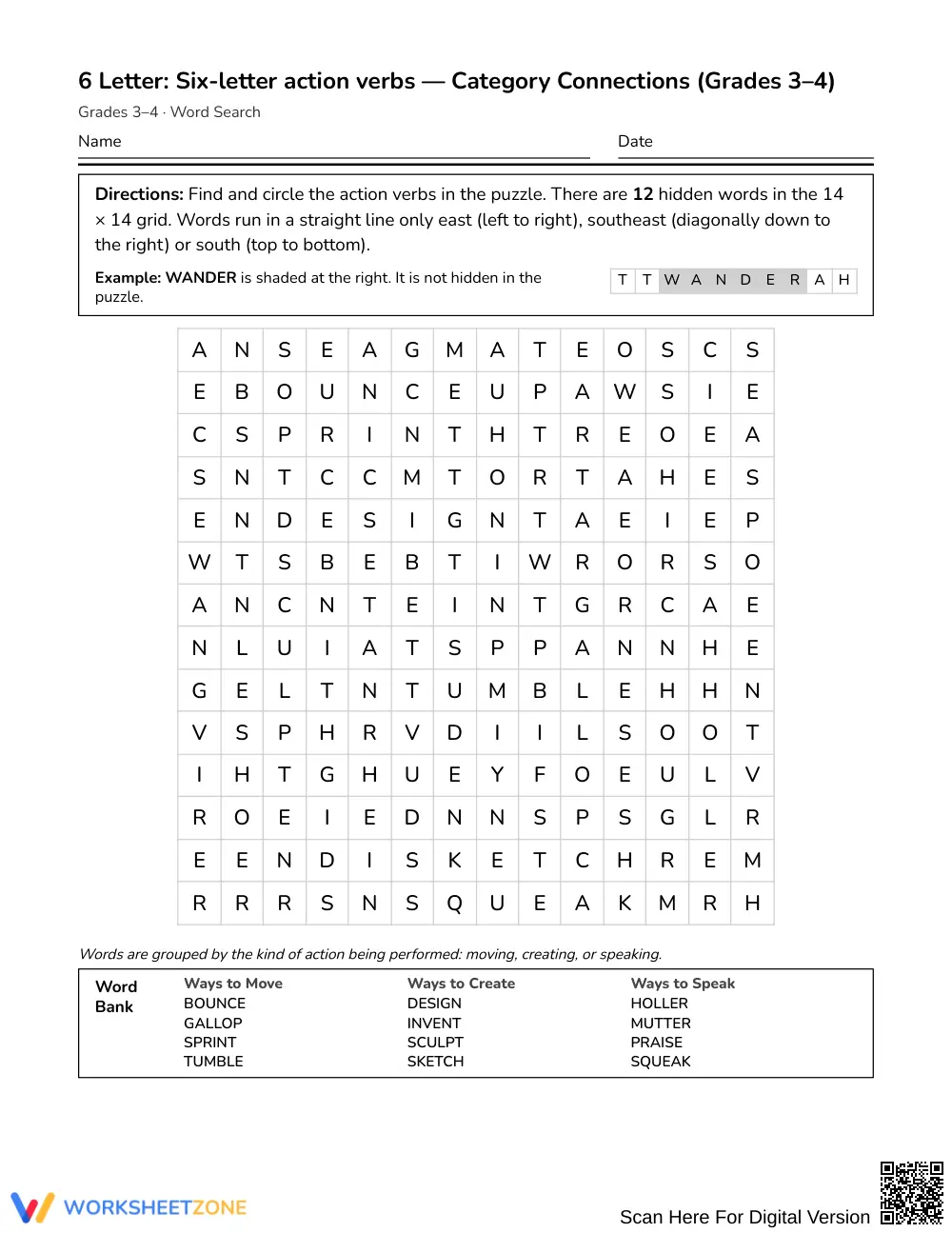
This Grades 3–4 action verbs word search strengthens vocabulary recognition by challenging learners to locate 12 targeted six-letter verbs. Students analyze precise language across three thematic categories—moving, creating, and speaking—deepening word comprehension while practicing pattern recognition and orthographic scanning. It provides focused, engaging language reinforcement for elementary literacy blocks.
At a Glance
- Grade: Grades 3–4 · Subject: English Language Arts (ELA)
- Standard: Not standards-assessed — vocabulary enrichment
- Skill Focus: Six-letter action verbs
- Format: 1 page · 12 words · Answer key included · PDF
- Best For: Independent literacy centers and vocabulary review
- Time: 15–20 minutes
This printable activity features a clean, single-page puzzle layout paired with a comprehensive three-page answer key for straightforward verification. Students search for 12 six-letter action verbs organized into semantic categories: Ways to Move, Ways to Create, and Ways to Speak. Each category contains four distinct verbs accompanied by concise student-friendly definitions, helping learners connect word meanings directly to orthographic search targets.
Puzzle Structure and Mechanics
The activity is built on a 14 by 14 letter grid designed specifically for developing readers in Grades 3–4. Hidden vocabulary words run in three accessible directions: horizontally east (E), diagonally southeast (SE), and vertically south (S). This intentional directional setup eliminates reverse-spelling frustration while maintaining appropriate spatial challenge. Rather than an unstructured list, the categorized word bank groups related concepts together, prompting students to evaluate meaning alongside letter sequences as they locate each term.
Standards Alignment
This resource is designed strictly for vocabulary enrichment and is not aligned to a formal academic standard. It supports core language acquisition by reinforcing verb knowledge, semantic categorizing, and spelling pattern awareness in an accessible supplemental format.
How to Use It
Deploy this puzzle during independent literacy rotations after direct instruction on vivid verbs, or assign it as an engaging warm-up before descriptive writing tasks. During seatwork, circulate to observe student scanning habits; notice whether learners search alphabetically by initial letter clusters or cross-reference the semantic categories to verify target definitions. Expect completion within 15 to 20 minutes.
Who It's For
This word search is ideal for general education students in Grades 3–4, early finishers, and English language learners needing concrete semantic associations for tier-two verbs. Teachers can pair this activity with an action verb anchor chart or a mentor text highlighting vivid descriptive language to extend vocabulary retention into expressive writing.
Developing morphological and orthographic familiarity with specific action verbs directly reinforces elementary reading fluency and expressive vocabulary. According to Fisher & Frey (2014), intentional word study that organizes vocabulary around semantic relationships enables learners to consolidate conceptual understanding and retrieve precise language during independent composition. By analyzing 12 targeted six-letter action verbs grouped by movement, creation, and vocal expression, students in Grades 3–4 connect spelling sequences directly to contextual meaning. Structured puzzle activities offer meaningful orthographic repetition, strengthening spatial scanning and lexical recall without cognitive fatigue. When supported by category-based word banks, these focused tasks bridge the gap between receptive word recognition and productive language application. This self-contained word search reinforces foundational vocabulary architecture, equipping elementary learners with the lexical confidence required for successful text comprehension and descriptive written expression across core literacy environments.


