


























Views
Downloads


Prefix Practice Worksheet: Dis, Non, Un | Grade 4 Printable
Paste this activity's link or code into your existing LMS (Google Classroom, Canvas, Teams, Schoology, Moodle, etc.).
Students can open and work on the activity right away, with no student login required.
You'll still be able to track student progress and results from your teacher account.
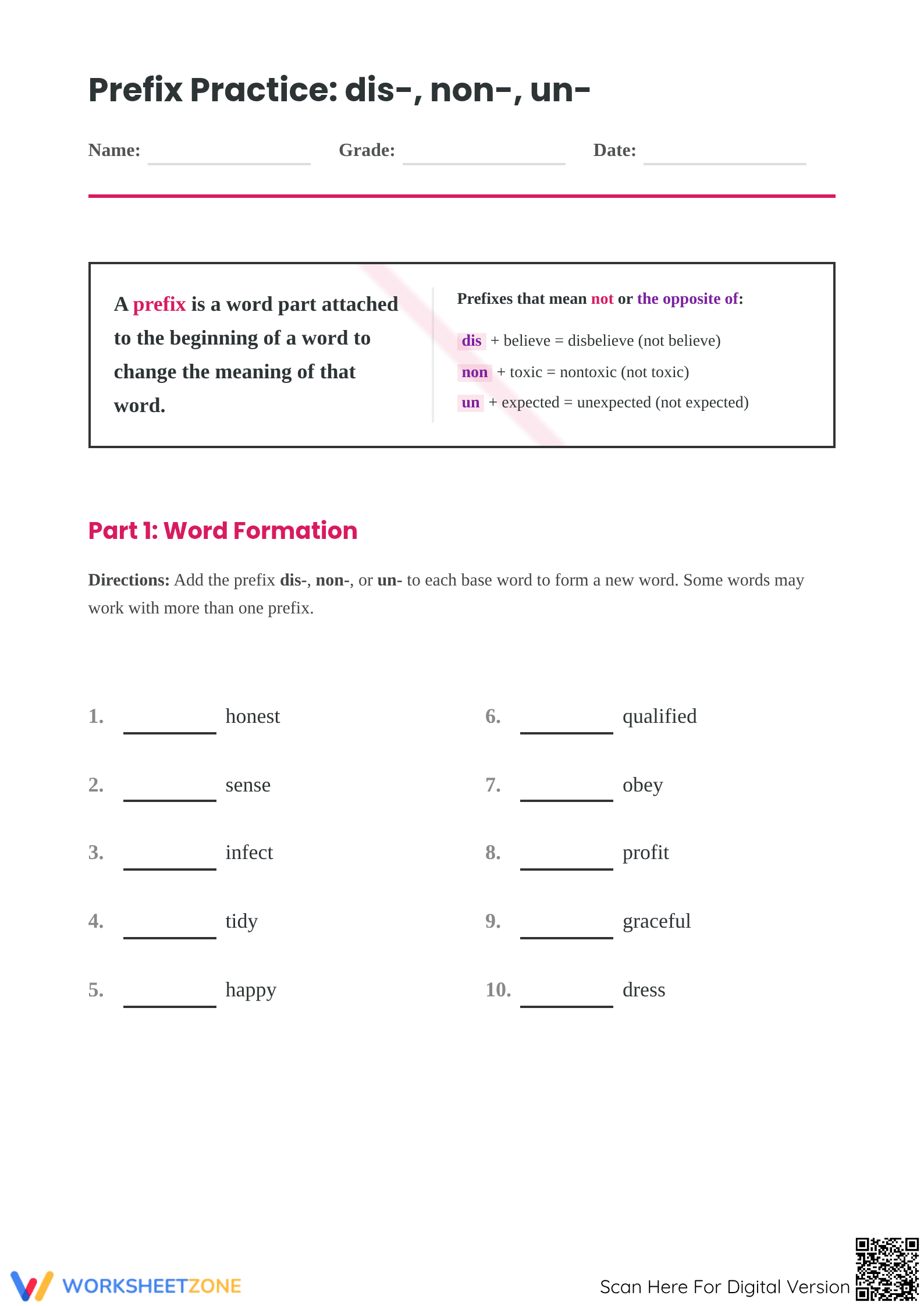
This focused prefix practice worksheet helps third and fourth-grade students master the negative prefixes dis-, non-, and un-. By applying these common affixes to base words, students will expand their vocabulary and improve reading comprehension. The structured activities guide learners from basic word formation to creative application in context.
At a Glance
- Grade: 4 · Subject: ELA
- Standard:
CCSS.ELA-LITERACY.L.4.4.B— Determine the meaning of a new word formed when a known affix is added.- Skill Focus: Prefixes (dis-, non-, un-)
- Format: 2 pages · 16 problems · Answer key included · PDF
- Best For: Independent practice and vocabulary building
- Time: 15–20 minutes
This two-page resource features a helpful reference box at the top, defining each prefix and providing clear examples. The worksheet is divided into three distinct sections: ten word-formation fill-in-the-blank questions, a creative writing prompt requiring the use of five newly formed words, and five sentence completion challenges. A complete answer key is provided to make grading quick and accurate.
Skill Progression
- Guided practice: The reference box provides explicit definitions and examples for dis-, non-, and un-, setting a strong foundation.
- Supported practice: Part 1 asks students to attach the correct prefix to ten base words, focusing purely on structural word formation.
- Independent practice: Parts 2 and 3 require students to apply their new vocabulary by writing a silly paragraph and completing context-clue sentences.
This gradual-release approach ensures students confidently transition from the "I Do" instructional phase to the "You Do" independent application.
Standards Alignment
This resource is directly aligned to CCSS.ELA-LITERACY.L.4.4.B: Use common, grade-appropriate Greek and Latin affixes and roots as clues to the meaning of a word. It also supports foundational reading skills by reinforcing decoding strategies for multi-syllable words. Both standard codes can be copied directly into lesson plans, IEP goals, or district curriculum mapping tools.
How to Use It
Deploy this worksheet during your vocabulary block after direct instruction on negative prefixes. It works beautifully as an independent center activity or a targeted homework assignment. As a formative assessment tip, review the creative writing paragraph to check if students truly grasp the nuanced meanings of the words they formed, rather than just memorizing the spelling. Expect students to complete the full activity in 15 to 20 minutes.
Who It's For
This resource is designed for third and fourth-grade general education students, but it serves as an excellent intervention tool for fifth graders needing foundational vocabulary review. English Language Learners will particularly benefit from the clear reference box and structured sentence frames. Pair this worksheet with a classroom anchor chart on prefixes or a short reading passage that heavily features words with dis-, non-, and un-.
Mastering morphological awareness is a critical component of reading comprehension and vocabulary acquisition in the upper elementary grades. According to Fisher & Frey (2014), explicit instruction in word parts, including prefixes and suffixes, significantly improves students' ability to decode unfamiliar texts and infer meaning independently. This resource specifically targets CCSS.ELA-LITERACY.L.4.4.B, helping students determine the meaning of a new word formed when a known affix is added. By isolating the negative prefixes dis-, non-, and un-, learners can systematically observe how these morphemes alter base words. Providing structured opportunities to manipulate these word parts—from simple formation to contextual application—solidifies their understanding and promotes long-term retention. Integrating targeted morphological practice into daily literacy routines ensures students build the robust vocabulary networks necessary for tackling complex, grade-level texts with confidence and accuracy.


