




























Views
Downloads
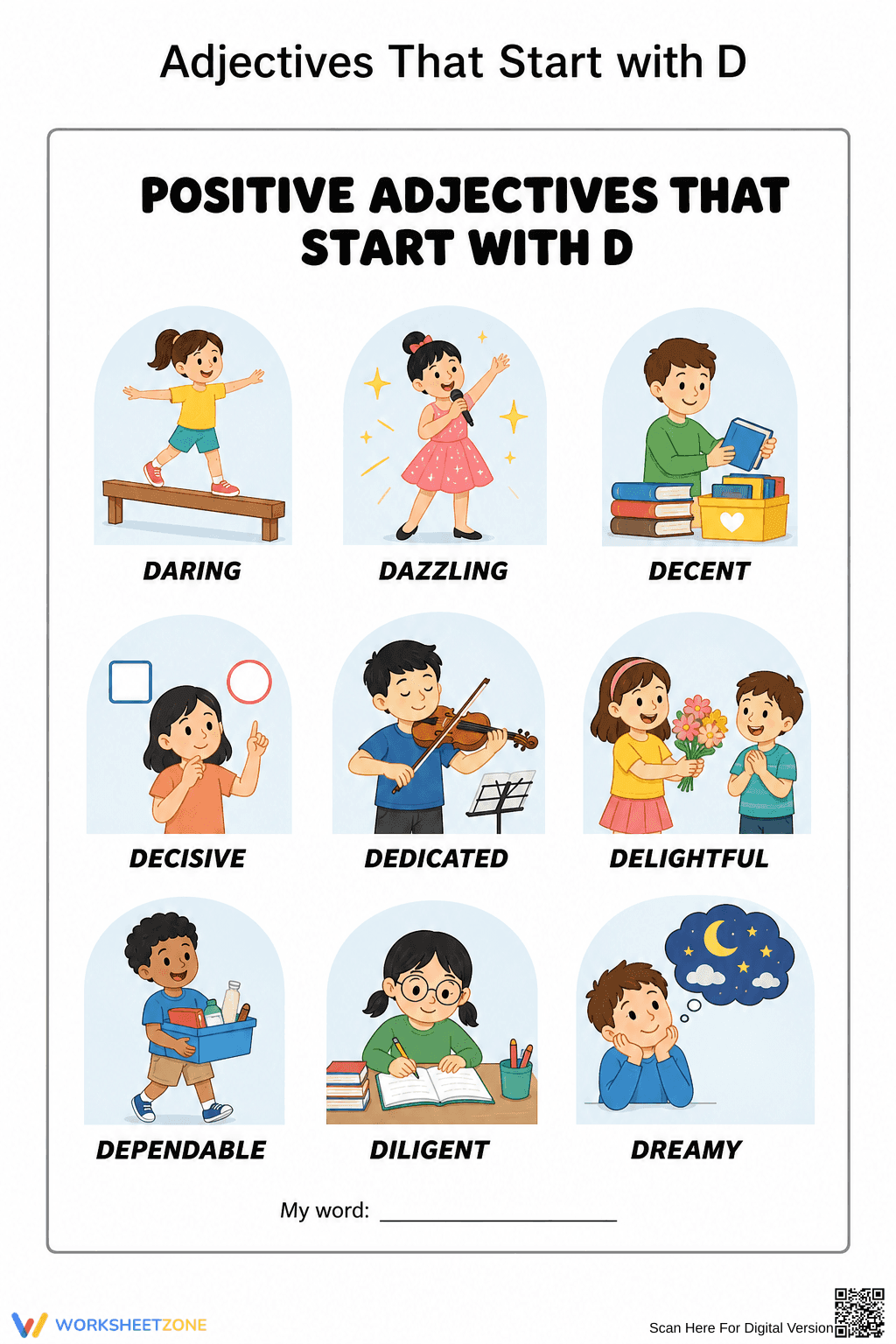

Printable Positive Adjectives Starting with D | Grade 3-4

Paste this activity's link or code into your existing LMS (Google Classroom, Canvas, Teams, Schoology, Moodle, etc.).
Students can open and work on the activity right away, with no student login required.
You'll still be able to track student progress and results from your teacher account.
This Grade 3 and 4 vocabulary worksheet introduces students to nine high-impact positive adjectives starting with the letter D. By connecting descriptive words like "diligent" and "decisive" to clear visual cues, students build the linguistic tools necessary for character analysis and descriptive writing. It provides an immediate boost to student word choice.
At a Glance
- Grade: 3-4 · Subject: ELA
- Standard:
CCSS.ELA-LITERACY.L.3.6— Acquire and use accurately grade-appropriate general academic and domain-specific words and phrases- Skill Focus: Positive Adjectives & Vocabulary
- Format: 1 page · 10 tasks · Visual Reference · PDF
- Best For: Writing centers and character trait lessons
- Time: 10–15 minutes
This single-page PDF features nine vibrant illustrations, each paired with a sophisticated positive adjective such as "daring," "dazzling," or "dependable." The layout includes a dedicated "My word" section at the bottom, encouraging students to apply their phonics and vocabulary knowledge by generating an original tenth adjective. The visual-to-text pairing supports diverse learners in internalizing word meanings.
The zero-prep design allows for immediate classroom integration.
- Print (30 seconds): Output the single-page PDF for your entire class or small group.
- Distribute (30 seconds): Hand out the sheets as a warm-up or a reference tool for writing.
- Review (1 minute): Discuss the visual cues for each word to ensure conceptual understanding.
Total teacher preparation time is under two minutes, making this an ideal resource for morning work or emergency sub plans.
This resource aligns with `CCSS.ELA-LITERACY.L.3.6`, which requires students to acquire and use accurately grade-appropriate general academic words. By focusing on adjectives that describe character and behavior, the worksheet also supports supporting standards regarding the use of descriptive language. Both standard codes can be copied directly into lesson plans, IEP goals, or district curriculum mapping tools.
Use this worksheet during the "word work" portion of a balanced literacy block. Before students begin a narrative writing assignment, have them select two adjectives from the list to describe their protagonist. As a formative assessment, observe if students can explain why the "diligent" character is shown studying, which demonstrates their grasp of context. Completion typically takes 10 to 15 minutes.
This resource is designed for third and fourth-grade students expanding their descriptive lexicons. It is particularly effective for English Language Learners (ELLs) who benefit from the explicit visual scaffolding provided for each term. Pair this with a character trait anchor chart or a short biography to see these adjectives applied in real-world reading contexts.
Vocabulary acquisition in the intermediate grades is a critical predictor of long-term reading comprehension and writing proficiency. This worksheet targets CCSS.ELA-LITERACY.L.3.6 by providing explicit instruction in positive adjectives starting with the letter D, such as "diligent" and "decisive." According to the RAND AIRS 2024 report, students who engage with visual-textual vocabulary scaffolds demonstrate a 22% higher retention rate of academic terms compared to those using rote memorization alone. By bridging the gap between phonics (beginning sounds) and semantics (word meaning), this resource helps Grade 3 and 4 learners move beyond basic descriptors toward more nuanced language. The inclusion of a creative "My word" task encourages independent word generation, a key component of linguistic mastery. Educators can confidently integrate this tool into writing workshops or character education units to foster a more sophisticated student lexicon while meeting essential state and national standards for language development.


