


























Views
Downloads
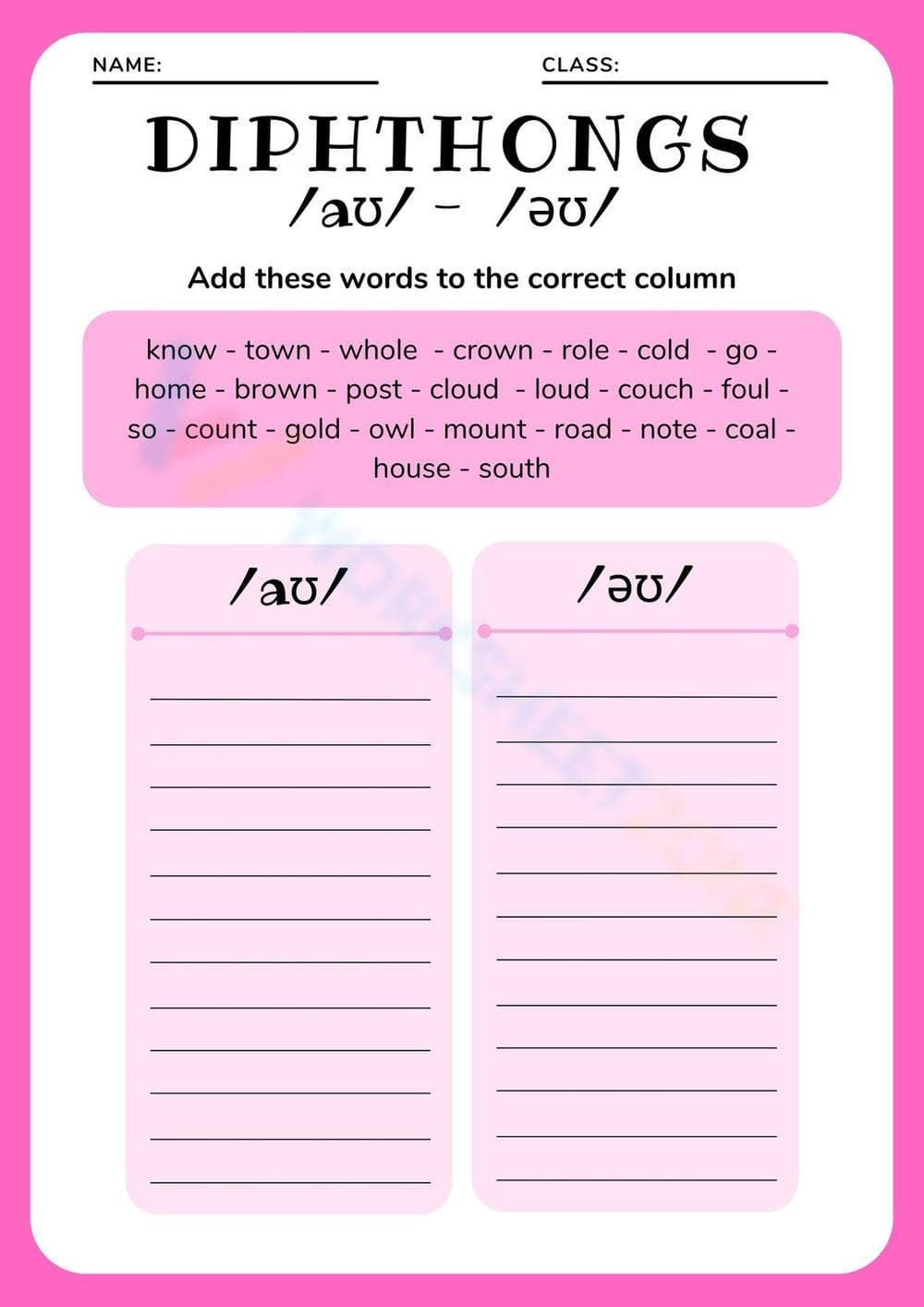

Printable Diphthongs /aʊ/ and /əʊ/ Worksheet | Grade 2
Paste this activity's link or code into your existing LMS (Google Classroom, Canvas, Teams, Schoology, Moodle, etc.).
Students can open and work on the activity right away, with no student login required.
You'll still be able to track student progress and results from your teacher account.
This Grade 2 phonics worksheet provides targeted practice with the /aʊ/ and /əʊ/ diphthongs, helping students accurately decode and categorize complex vowel teams. By sorting 24 distinct vocabulary words into the correct sound columns, young readers strengthen their phonemic awareness and improve their overall reading fluency and spelling accuracy.
At a Glance
- Grade: 2 · Subject: ELA
- Standard:
CCSS.ELA-LITERACY.RF.2.3.B— Know spelling-sound correspondences for common vowel teams.- Skill Focus: Diphthongs /aʊ/ and /əʊ/
- Format: 1 page · 24 problems · Answer key included · PDF
- Best For: Independent practice and phonics centers
- Time: 10–15 minutes
This single-page resource features a word-sorting activity for early readers. Students use a word bank containing 24 terms, such as "town" and "home." They read each word, identify the target vowel sound, and write it in the corresponding /aʊ/ or /əʊ/ column. An answer key is provided for accurate grading.
Zero-Prep Workflow
This resource is designed for maximum efficiency, requiring under two minutes of total teacher preparation time.
- Print (1 minute): Simply download the PDF and print the required number of copies.
- Distribute (30 seconds): Hand out the worksheets during your designated phonics block or literacy center rotation.
- Review (30 seconds): Briefly explain the two column headers and model the first word from the bank to ensure students understand the sorting task.
Because the instructions are self-explanatory, this activity is highly suitable for emergency sub plans or independent morning work.
Standards Alignment
This activity is directly aligned with CCSS.ELA-LITERACY.RF.2.3.B, which requires students to know spelling-sound correspondences for additional common vowel teams. By distinguishing between the /aʊ/ sound found in words like "house" and the /əʊ/ sound in words like "road," learners demonstrate mastery of these specific phonics patterns. Both standard codes can be copied directly into lesson plans, IEP goals, or district curriculum mapping tools.
How to Use It
Use this worksheet after direct instruction to reinforce the lesson. It serves as an excellent independent practice activity while the teacher works with small guided reading groups. Alternatively, use it as a formative assessment tool at the end of the week. While students work, observe whether they are sounding out the words aloud or relying solely on visual spelling patterns, which can inform your future phonics interventions. Expect students to complete the sorting task within 10 to 15 minutes.
Who It's For
This worksheet is designed for second-grade students developing foundational reading skills. It is also effective for English Language Learners needing explicit practice distinguishing English vowel sounds. For differentiation, pre-highlight the vowel teams in the word bank for students needing extra support. Pair this activity with a phonics anchor chart displaying visual cues to maximize student success.
Mastering complex vowel teams like the diphthongs /aʊ/ and /əʊ/ is a critical milestone in early literacy development. According to a recent EdReports 2024 analysis of foundational reading programs, explicit and systematic phonics instruction significantly improves students' ability to decode unfamiliar words. When learners practice categorizing words based on their spelling-sound correspondences, as required by CCSS.ELA-LITERACY.RF.2.3.B, they build the automaticity necessary for fluent reading. This targeted word sort activity directly supports that goal by requiring students to know spelling-sound correspondences for common vowel teams. By actively engaging with 24 distinct vocabulary words, students transition from slow, effortful decoding to rapid word recognition. This essential practice builds the cognitive framework needed for long-term reading comprehension and spelling accuracy, ensuring young learners are fully prepared to tackle more advanced texts in later grades.


