


























Views
Plays
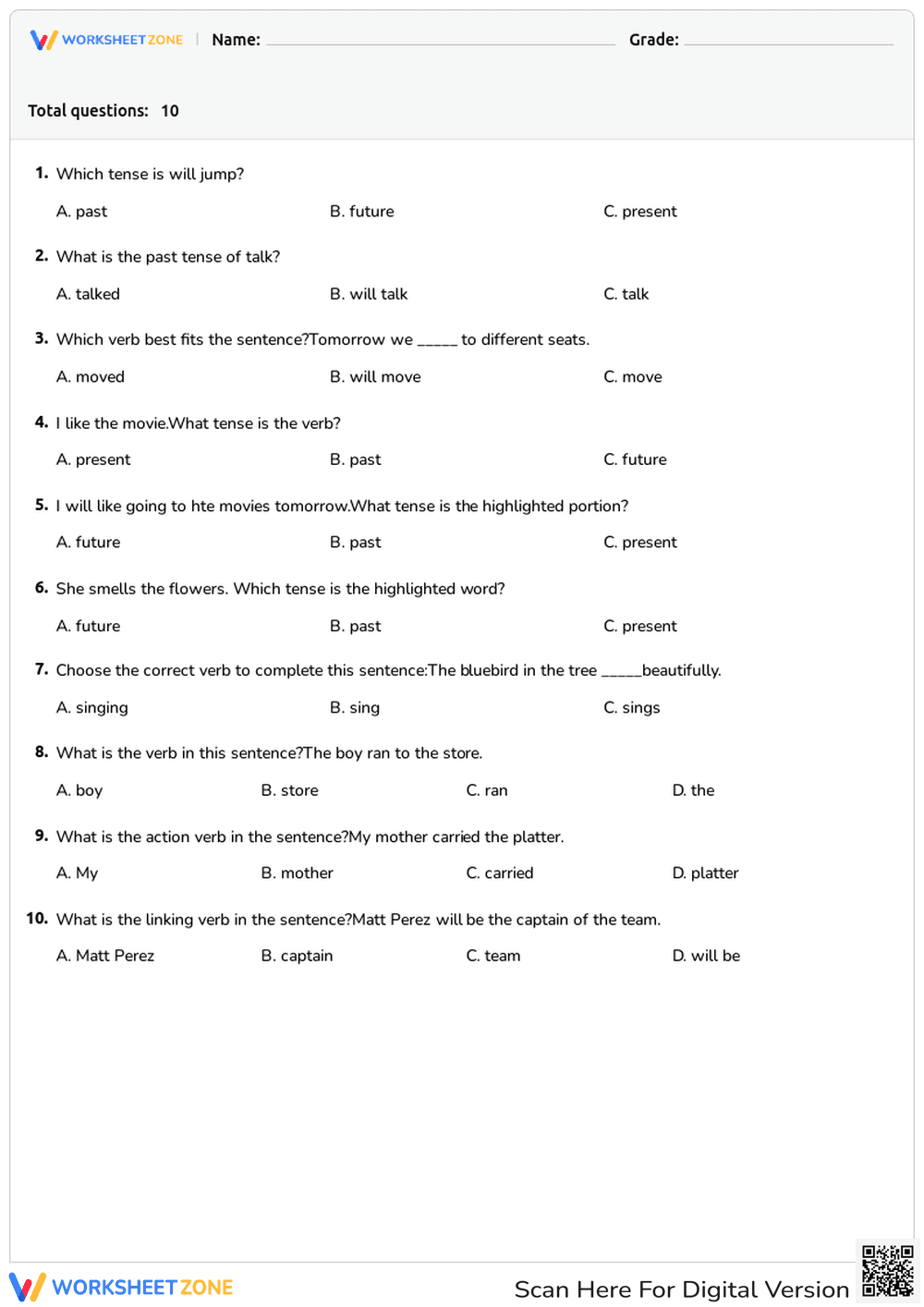

Past, Present, Future Tense Verbs | Essential Grade 3
Paste this activity's link or code into your existing LMS (Google Classroom, Canvas, Teams, Schoology, Moodle, etc.).
Students can open and work on the activity right away, with no student login required.
You'll still be able to track student progress and results from your teacher account.
This Grade 3 grammar worksheet provides a focused assessment of verb tense mastery. Students analyze ten specific sentences to identify past, present, and future actions, ensuring they can distinguish between temporal markers and verb endings. By completing these exercises, learners solidify their understanding of how time is expressed through language mechanics and sentence structure.
At a Glance
- Grade: 3 · Subject: ELA Grammar
- Standard:
CCSS.ELA-LITERACY.L.3.1.E— Form and use the simple verb tenses (past, present, future)- Skill Focus: Verb Tense Identification
- Format: 1 page · 10 problems · Answer key included · PDF
- Best For: Formative assessment or quick grammar review
- Time: 10–15 minutes
The worksheet features a clean, single-page layout containing 10 multiple-choice questions. Each question presents a sentence or a specific verb phrase, asking the student to categorize it as past, present, or future tense. Additionally, the tasks include identifying action verbs and linking verbs within a sentence context. A clear header for name and grade is provided, and the PDF format ensures high-quality printing for classroom distribution.
This resource is designed for a zero-prep classroom workflow. Teachers can print the single-page PDF in seconds. Distribution is fast, and because the format is multiple-choice, students can complete the 10 tasks independently within a 15-minute window. Reviewing answers as a group takes only five minutes, making this an ideal bell ringer or exit ticket activity that requires no prior setup.
The primary focus is CCSS.ELA-LITERACY.L.3.1.E, which requires students to form and use simple verb tenses. The worksheet also supports CCSS.ELA-LITERACY.L.1.1.E by reinforcing the use of verbs to convey a sense of past, present, and future. Both standard codes can be copied directly into lesson plans, IEP goals, or district curriculum mapping tools.
Use this worksheet as a formative assessment after direct instruction on verb endings and helping verbs. It serves as an excellent check for understanding before moving to complex tenses. Assign it as a quick homework task to reinforce the lesson. Teachers should observe if students struggle with future tense markers to guide small-group intervention and targeted support.
This resource is tailored for third-grade students but is highly effective for second-grade enrichment or fourth-grade remediation. It is particularly useful for English Language Learners (ELLs) who are practicing the structural differences between English tenses. Pair this worksheet with a verb tense anchor chart or a short reading passage to provide students with additional context for the verbs they are identifying.
According to the RAND AIRS 2024 report on instructional materials, structured grammar practice that isolates specific parts of speech is essential for developing syntactic fluency in elementary learners. This worksheet targets CCSS.ELA-LITERACY.L.3.1.E by providing 10 discrete opportunities for students to identify and apply past, present, and future verb tenses. Research from Fisher & Frey (2014) emphasizes that short, focused assessments allow teachers to identify misconceptions in real-time, preventing the fossilization of grammatical errors. By using a multiple-choice format, this resource reduces the cognitive load on writing, allowing students to focus entirely on the linguistic skill of tense recognition. This alignment ensures that students meet the foundational requirements for Grade 3 language standards while building the necessary skills for more complex narrative writing in later grades.


