


























Views
Downloads

Parts of a Shirt Vocabulary Worksheet | Grade 1 Printable
Paste this activity's link or code into your existing LMS (Google Classroom, Canvas, Teams, Schoology, Moodle, etc.).
Students can open and work on the activity right away, with no student login required.
You'll still be able to track student progress and results from your teacher account.
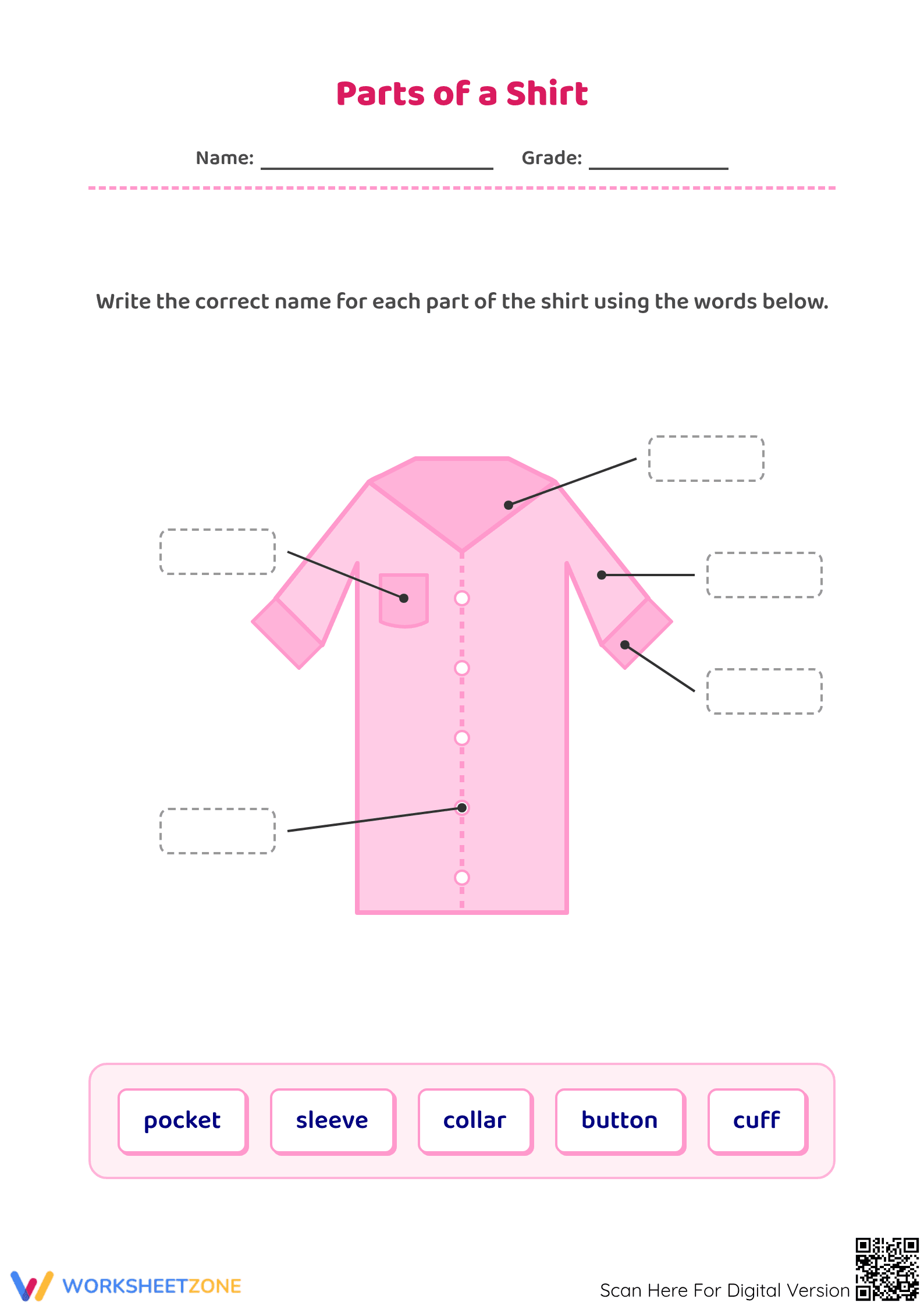
This Grade 1 vocabulary worksheet helps students build foundational language skills by identifying and labeling the parts of a shirt. Young learners practice reading sight words and matching them to visual cues, strengthening their everyday vocabulary and reading comprehension in a highly visual, accessible format.
At a Glance
- Grade: 1 · Subject: English
- Standard:
CCSS.ELA-LITERACY.L.1.6— Use acquired words and phrases in context- Skill Focus: Clothing vocabulary and diagram labeling
- Format: 1 page · 5 problems · Answer key included · PDF
- Best For: Independent practice and vocabulary building
- Time: 10–15 minutes
This single-page resource features a clear, colorful diagram of a shirt with five distinct parts to identify. Students use a provided word bank containing the terms pocket, sleeve, collar, button, and cuff to complete the labeling activity. The dashed boxes guide students on where to write each word, providing structural support for early writers. A complete answer key is included to ensure accurate grading and immediate feedback.
Zero-Prep Workflow
This worksheet is designed for maximum efficiency, requiring under two minutes of total teacher preparation.
- Print (1 minute): Download the PDF and print. The layout works perfectly in color or grayscale.
- Distribute (30 seconds): Hand out the worksheets. The self-explanatory instructions let students begin immediately.
- Review (30 seconds): Use the included answer key to quickly check work or project it for self-correction.
This activity is highly suitable for emergency sub plans or morning work.
Standards Alignment
This resource is directly aligned to CCSS.ELA-LITERACY.L.1.6, which requires students to use words and phrases acquired through conversations, reading and being read to, and responding to texts. By matching specific vocabulary words to their corresponding visual representations, students demonstrate practical comprehension of everyday terms. Both standard codes can be copied directly into lesson plans, IEP goals, or district curriculum mapping tools.
How to Use It
This labeling activity works exceptionally well as an independent practice station during literacy centers. After a brief whole-group discussion about clothing and everyday objects, teachers can assign this worksheet to reinforce the new vocabulary. As a formative assessment observation tip, watch how students utilize the word bank; note whether they cross out words as they use them, which indicates developing test-taking and process-of-elimination skills. Expected completion time ranges from 10 to 15 minutes.
Who It's For
This resource is primarily designed for first-grade students developing their sight word recognition and functional vocabulary. It also serves as an excellent tool for English Language Learners (ELLs) who benefit from strong visual supports when acquiring new English nouns. For differentiation, teachers can pre-teach the vocabulary using physical clothing items. This worksheet pairs naturally with a direct instruction lesson on everyday objects or a read-aloud book featuring getting dressed.
Aligning instructional materials to specific vocabulary acquisition goals, such as CCSS.ELA-LITERACY.L.1.6 (Use acquired words and phrases in context), is essential for early literacy development. According to Fisher & Frey (2014), integrating visual aids with targeted vocabulary instruction significantly improves word retention and comprehension in young learners. When students actively engage in labeling diagrams, they bridge the gap between abstract text and concrete visual representation. This process reinforces spelling and sight word recognition while building the foundational background knowledge required for future reading success. By utilizing structured word banks and clear visual cues, educators can effectively reduce cognitive load, allowing students to focus entirely on meaning-making and vocabulary application. Providing these targeted, multimodal learning opportunities ensures that all students can successfully expand their expressive and receptive language skills in a supportive academic environment.


