


























Views
Downloads
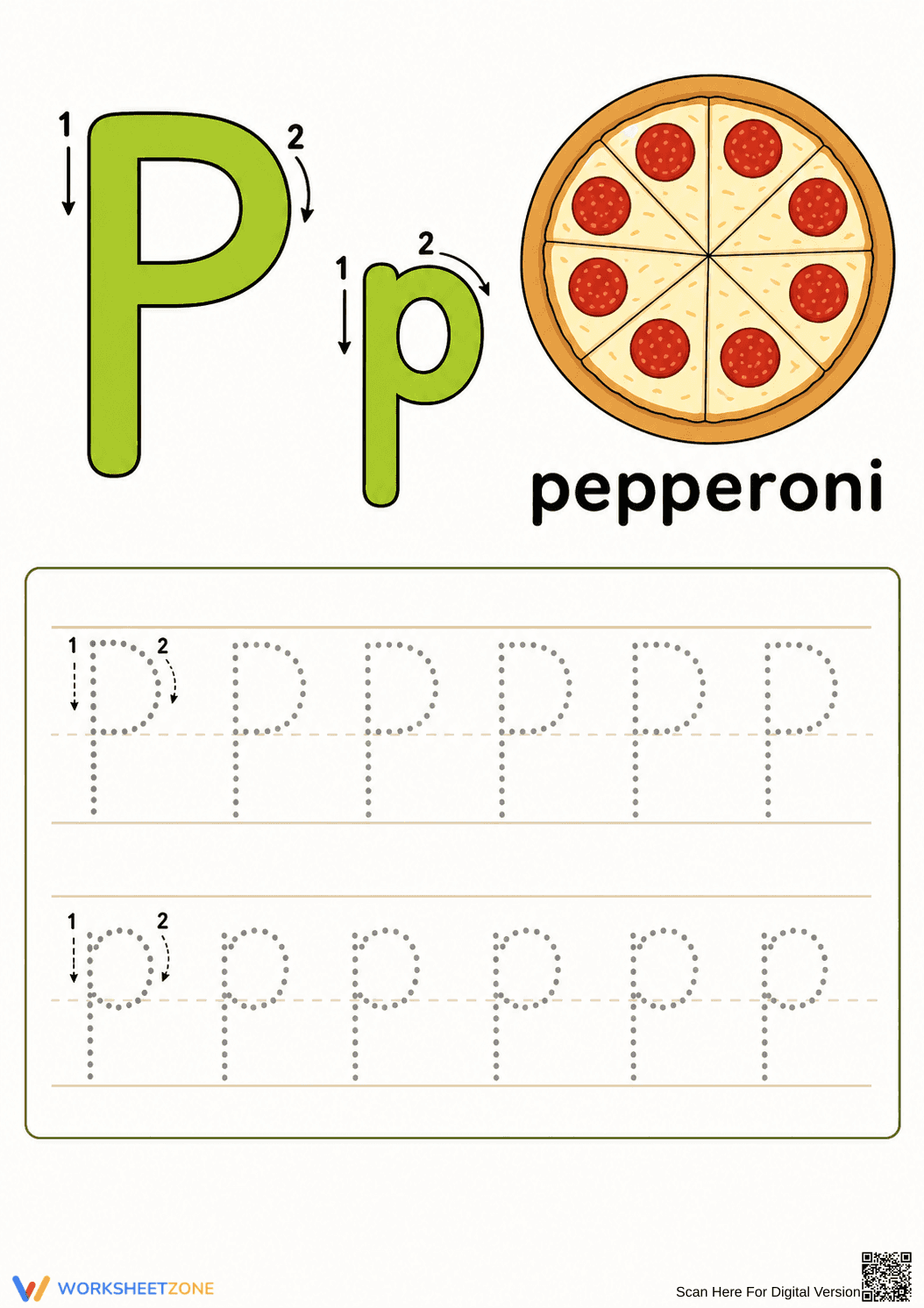

Letter P Tracing Worksheet | Grade K-1 Printable
Paste this activity's link or code into your existing LMS (Google Classroom, Canvas, Teams, Schoology, Moodle, etc.).
Students can open and work on the activity right away, with no student login required.
You'll still be able to track student progress and results from your teacher account.
This Grade K-1 Letter P tracing worksheet helps students master uppercase and lowercase letter formation through guided motor practice. By providing numbered stroke guides and a relatable pepperoni anchor image, the resource ensures students develop the fine motor control necessary for legible handwriting. This printable activity bridges the gap between letter recognition and independent writing.
At a Glance
- Grade: K-1 · Subject: ELA Phonics
- Standard:
CCSS.ELA-LITERACY.L.K.1.A— Print upper- and lowercase letters with correct stroke order and form- Skill Focus: Letter P formation
- Format: 1 page · 12 problems · Answer key included · PDF
- Best For: Independent morning work or literacy centers
- Time: 5–10 minutes
The worksheet features a clear, high-contrast layout designed for young learners. It includes one large visual anchor of a pepperoni pizza to reinforce the beginning sound of the letter P. Below the visual, students find 6 uppercase P and 6 lowercase p tracing tasks. Each letter includes numbered arrows indicating the correct starting point and direction for every stroke, preventing the development of poor handwriting habits.
The zero-prep design allows for an immediate classroom workflow. First, print the single-page PDF in less than 30 seconds. Second, distribute the sheets to students during your phonics block or as a transition activity. Finally, review the letter formation by having students air-write the letter P following the numbered guides. This total teacher prep time of under 2 minutes makes it an ideal resource for busy mornings or unexpected substitute plans.
This resource is primarily aligned with `CCSS.ELA-LITERACY.L.K.1.A`, which requires students to print many upper- and lowercase letters. It also supports `CCSS.ELA-LITERACY.RF.K.1.D` by reinforcing the recognition and naming of specific alphabet characters. Both standard codes can be copied directly into lesson plans, IEP goals, or district curriculum mapping tools to ensure instructional compliance and tracking.
Use this worksheet during the independent practice phase of a direct instruction lesson on the letter P. It serves as an excellent formative assessment tool; teachers can circulate and observe pencil grip and stroke direction as students complete the 12 tasks. Expected completion time ranges from 5 to 10 minutes, making it a perfect fit for literacy rotations or as a quiet-time activity.
This activity is designed for Kindergarten and Grade 1 students who are beginning their journey into phonics and handwriting. It is particularly helpful for students requiring additional fine motor support or English Language Learners who benefit from the visual pepperoni association. Pair this worksheet with a letter P anchor chart or a read-aloud book focusing on the /p/ sound for a complete lesson.
According to research from Fisher & Frey (2014), the gradual release of responsibility begins with clear modeling of foundational skills like letter formation. This Letter P worksheet utilizes explicit stroke-order numbering to guide early learners through the motor movements required for handwriting mastery. By connecting the grapheme P with the high-frequency phoneme found in pepperoni, the resource reinforces the alphabetic principle essential for early literacy. Studies from the NAEP suggest that early proficiency in letter recognition and printing is a strong predictor of later reading success. This resource aligns with CCSS.ELA-LITERACY.L.K.1.A, ensuring students practice printing both upper- and lowercase letters with precision. The 12 structured tracing tasks provide the repetitive practice necessary for developing muscle memory and fine motor control in Kindergarten and Grade 1 students. This evidence-based approach ensures that foundational phonics instruction is both accessible and effective for diverse classroom settings.


