




























Printable Letter P Tracing Worksheet for Kindergarten
Paste this activity's link or code into your existing LMS (Google Classroom, Canvas, Teams, Schoology, Moodle, etc.).
Students can open and work on the activity right away, with no student login required.
You'll still be able to track student progress and results from your teacher account.
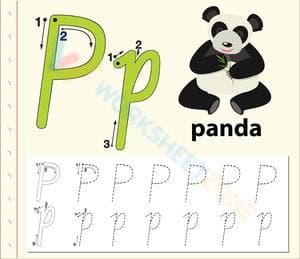
This handwriting worksheet helps early learners master the uppercase and lowercase letter P through guided tracing. Students follow numbered stroke directions to build muscle memory and letter recognition. By connecting the letter shape to the panda illustration, children reinforce phonics foundations and print awareness skills necessary for early reading success.
At a Glance
- Grade: Kindergarten · Subject: ELA Phonics
- Standard:
CCSS.ELA-LITERACY.L.K.1.A— Print uppercase and lowercase letters accurately- Skill Focus: Letter P formation and stroke order
- Format: 1 page · 16 tasks · No answer key needed · PDF
- Best For: Morning work, fine motor centers, and independent handwriting practice
- Time: 10–15 minutes
The worksheet features a large visual model of both uppercase P and lowercase p, complete with numbered arrows indicating proper stroke sequence. A friendly panda graphic anchors the beginning sound. Below the visual models, two rows of tracing practice provide 14 dashed-line letters (7 uppercase and 7 lowercase) for students to trace independently, ensuring structured repetition.
Zero-Prep Workflow
This resource requires minimal teacher preparation and fits into any daily routine. Follow these three steps to implement it:
- Print (1 minute): Print the single-page PDF document for your entire class or select students. No laminating or cutting is required.
- Distribute (1 minute): Hand out the sheets along with pencils or crayons. The visual stroke guides allow students to begin working immediately without complex instructions.
- Review (1 minute): Walk around the room to check grip and stroke direction. Since the worksheet is self-explanatory, it serves as an excellent emergency sub plan.
Total teacher preparation time is under 2 minutes, making this an efficient tool for busy classrooms.
Standards Alignment
This activity aligns directly with the Common Core State Standard `CCSS.ELA-LITERACY.L.K.1.A`, which requires students to print many uppercase and lowercase letters. Additionally, it supports `CCSS.ELA-LITERACY.RF.K.1.D` by helping students recognize and distinguish alphabetical orthography. Both standard codes can be copied directly into lesson plans, IEP goals, or district curriculum mapping tools.
How to Use It
Use this worksheet during direct instruction as a guided practice activity. Introduce the letter P, demonstrate the stroke order on the board, and have students trace the large letters with their fingers before using pencils. Alternatively, assign it as a quiet independent activity during literacy centers. For formative assessment, observe whether students follow the numbered arrows or draw the letters from the bottom up. The worksheet takes approximately 10 to 15 minutes to complete.
Who It's For
This resource is designed for kindergarteners and preschool students developing fine motor control and letter-sound correspondence. It also supports first-grade students who need remedial handwriting intervention. Pair this worksheet with a read-aloud book about pandas or an anchor chart displaying words that start with the letter P to reinforce phonemic awareness.
This letter tracing worksheet targets the foundational literacy skill of letter formation, aligned with standard CCSS.ELA-LITERACY.L.K.1.A. According to research by Fisher & Frey (2014) on the gradual release of responsibility, structured visual scaffolds—such as the numbered stroke guides and dashed lines featured here—are critical for helping early learners transition from guided practice to independent writing mastery. By combining visual cues with repetitive motor actions, the worksheet reinforces orthographic mapping, which is the cognitive process readers use to store written words for immediate retrieval. Practicing the letter P in conjunction with the "panda" keyword helps students solidify the connection between graphemes and phonemes. This resource provides the precise, low-stakes repetition necessary to build muscle memory and confidence in early writers, making it a highly valuable and practical addition to any kindergarten phonics curriculum.


