


























Views
Downloads

Printable Letter O Tracing Worksheet | Pre-K & K
Paste this activity's link or code into your existing LMS (Google Classroom, Canvas, Teams, Schoology, Moodle, etc.).
Students can open and work on the activity right away, with no student login required.
You'll still be able to track student progress and results from your teacher account.
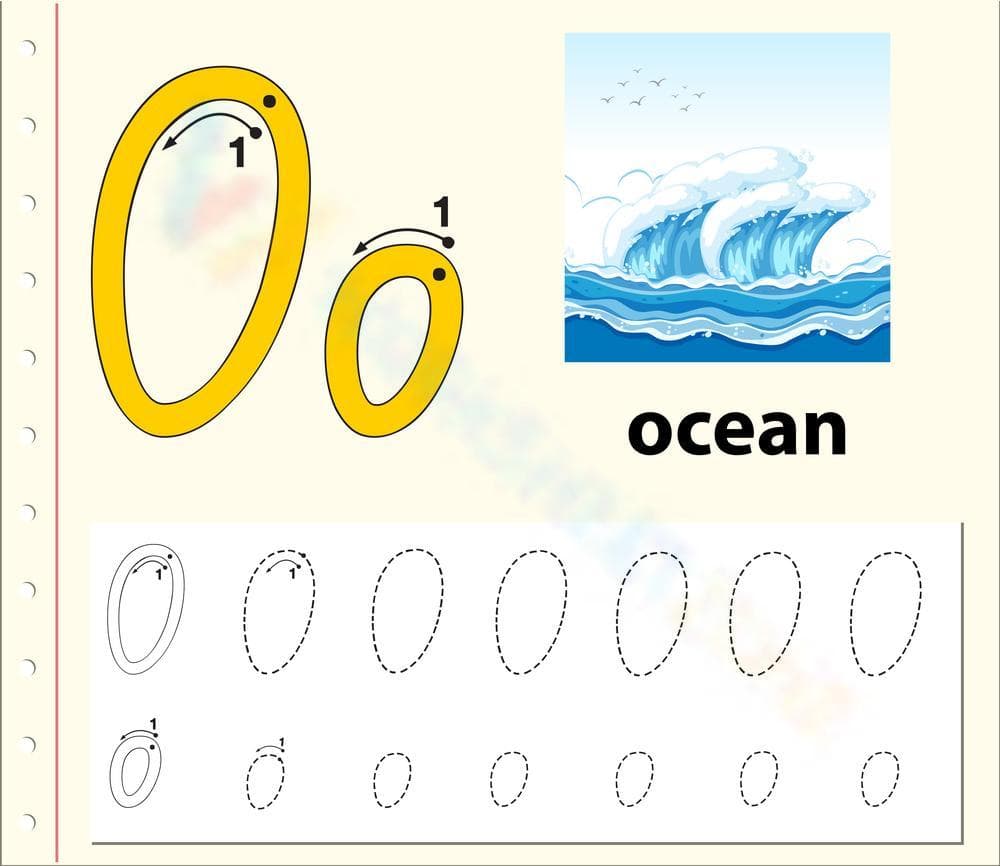
This printable Letter O tracing worksheet provides early learners with focused handwriting practice to develop fine motor control. By tracing uppercase and lowercase forms alongside an ocean theme, students build the foundational muscle memory required for fluent writing in preschool and kindergarten.
At a Glance
- Grade: Pre-K & Kindergarten · Subject: Handwriting
- Standard:
CCSS.ELA-LITERACY.L.K.1.A— Print many upper- and lowercase letters- Skill Focus: Letter O Tracing
- Format: 1 page · 14 problems · No answer key needed · PDF
- Best For: Morning work or literacy centers
- Time: 10–15 minutes
This single-page resource offers a clear layout for early writers. It features large, guided examples of uppercase and lowercase 'O' with directional arrows for proper stroke order. Students then complete 14 dashed-line tracing tasks. A vibrant ocean illustration and the vocabulary word "ocean" provide visual context, connecting the abstract letter shape to a concrete concept.
Zero-Prep Workflow
- Print (1 minute): Simply download the PDF and print the required number of copies. The high-contrast dashed lines ensure clean, readable prints even in black and white.
- Distribute (1 minute): Hand out the worksheets along with pencils or thick crayons for younger learners who need a wider grip.
- Review (1 minute): Briefly model the correct stroke order on the board using the numbered arrows provided at the top of the page.
With under three minutes of prep, this resource is perfect for sub plans or independent stations.
Standards Alignment
This handwriting activity is directly aligned to CCSS.ELA-LITERACY.L.K.1.A, which requires students to print many upper- and lowercase letters. By providing guided stroke paths and repetitive tracing opportunities, the worksheet ensures students meet the mechanical requirements of early literacy. Both standard codes can be copied directly into lesson plans, IEP goals, or district curriculum mapping tools.
How to Use It
This worksheet serves as excellent independent practice during morning arrival. Place it on student desks to establish a quiet routine while taking attendance. It also works well in small-group literacy centers. As a formative assessment tip, observe students to ensure they start at the top of the letter and follow the directional arrows, rather than drawing from the bottom up. Expected completion time is 10 to 15 minutes.
Who It's For
Designed for preschool and kindergarten students beginning to form letters, this resource also helps first-grade students requiring targeted intervention for fine motor delays. For differentiation, provide textured surfaces underneath the paper for tactile feedback. Pair this worksheet with an ocean read-aloud or a classroom alphabet anchor chart to reinforce the letter-sound connection.
Developing automaticity in letter formation through targeted practice is a critical component of early literacy instruction. This worksheet addresses CCSS.ELA-LITERACY.L.K.1.A by requiring students to print many upper- and lowercase letters accurately. According to Fisher & Frey (2014), providing students with clear visual models and structured, repetitive practice opportunities significantly improves their ability to transfer isolated mechanical skills into independent writing tasks. The inclusion of numbered directional arrows ensures that early learners internalize the correct motor patterns from the very beginning, preventing the development of inefficient handwriting habits that can severely impede writing fluency in later grades. By combining explicit stroke guidance with engaging thematic vocabulary, this resource supports both mechanical execution and conceptual understanding, making it an essential, evidence-based tool for early childhood educators focused on building strong foundational literacy skills.


