


























Views
Downloads
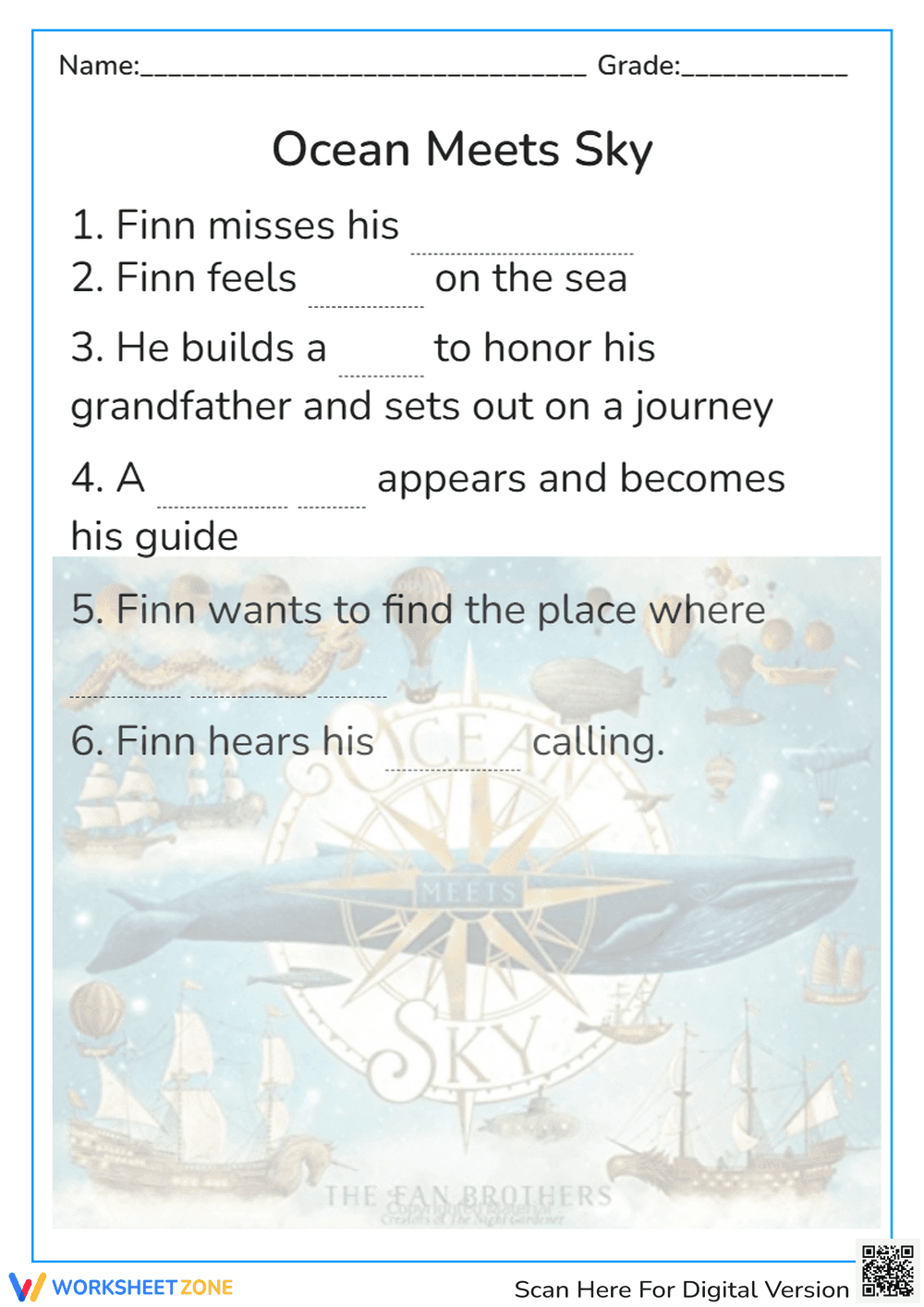

Ocean Meets Sky Printable Worksheet | Grade 2 ELA
Paste this activity's link or code into your existing LMS (Google Classroom, Canvas, Teams, Schoology, Moodle, etc.).
Students can open and work on the activity right away, with no student login required.
You'll still be able to track student progress and results from your teacher account.
This Grade 2 reading comprehension worksheet helps students demonstrate their understanding of the picture book "Ocean Meets Sky." By completing six targeted fill-in-the-blank sentences, learners practice identifying key plot points and character motivations. It is an effective tool for assessing literal comprehension and ensuring students grasp the foundational narrative arc of Finn’s journey.
At a Glance
- Grade: 2 · Subject: ELA
- Standard:
CCSS.ELA-LITERACY.RL.2.1— Answer who, what, where, when, why, and how questions about key details- Skill Focus: Story recall and narrative sequence
- Format: 1 page · 6 problems · Answer key included · PDF
- Best For: Post-reading comprehension check or quick assessment
- Time: 10–15 minutes
What's Inside
This single-page PDF features six cloze-style sentences that track the major events of the story. The worksheet includes a clear title and space for student identification. The tasks require students to recall specific nouns and verbs from the text, such as Finn's grandfather, the boat he builds, and his guide. A full answer key is provided for rapid grading.
Zero-Prep Workflow
- Print: Select the single-page PDF and print enough copies for your class (30 seconds).
- Distribute: Hand out the sheets to students following a read-aloud of the book (1 minute).
- Review: Check the answers as a whole group or collect them for a quick formative assessment (5 minutes).
Total teacher preparation time is under two minutes, making it an ideal sub plan addition.
Standards Alignment
The primary focus is `CCSS.ELA-LITERACY.RL.2.1`, which requires students to answer questions to demonstrate understanding of key details in a text. By filling in the blanks, students provide evidence of their reading. This also supports RL.2.3 by identifying how characters respond to major events. Both standard codes can be copied directly into lesson plans, IEP goals, or district curriculum mapping tools.
How to Use It
Use this worksheet immediately after a shared reading of "Ocean Meets Sky" to gauge initial comprehension. It works well as an independent "exit ticket" to see which students can recall the sequence of Finn's adventure. Alternatively, use it during small-group instruction to support English Language Learners who benefit from the sentence-frame structure provided by the fill-in-the-blank format.
Who It's For
This resource is tailored for second-grade students but can be used for first-grade enrichment or third-grade intervention. It is particularly helpful for students who struggle with open-ended writing but can identify key facts when prompted. Pair this with a visual anchor chart of the story's setting and characters for maximum student success.
This Grade 2 ELA resource is built to satisfy the requirements of CCSS.ELA-LITERACY.RL.2.1, focusing on the plain-English skill of recalling key details from a literary text. Research from Fisher & Frey (2014) emphasizes that scaffolded tasks, such as fill-in-the-blank sentences, serve as essential "checks for understanding" that bridge the gap between initial exposure and independent mastery. By providing 6 specific narrative prompts, this worksheet ensures students focus on the most significant elements of the story's plot and character development. According to the RAND AIRS 2024 report, high-quality supplemental materials that align closely with specific standards significantly improve student outcomes in early literacy. This worksheet provides a structured, low-stakes environment for students to practice evidence-based recall, which is a critical precursor to higher-order analysis and thematic interpretation in later elementary grades. It offers a reliable method for teachers to gather data on student comprehension.


