




























Views
Downloads
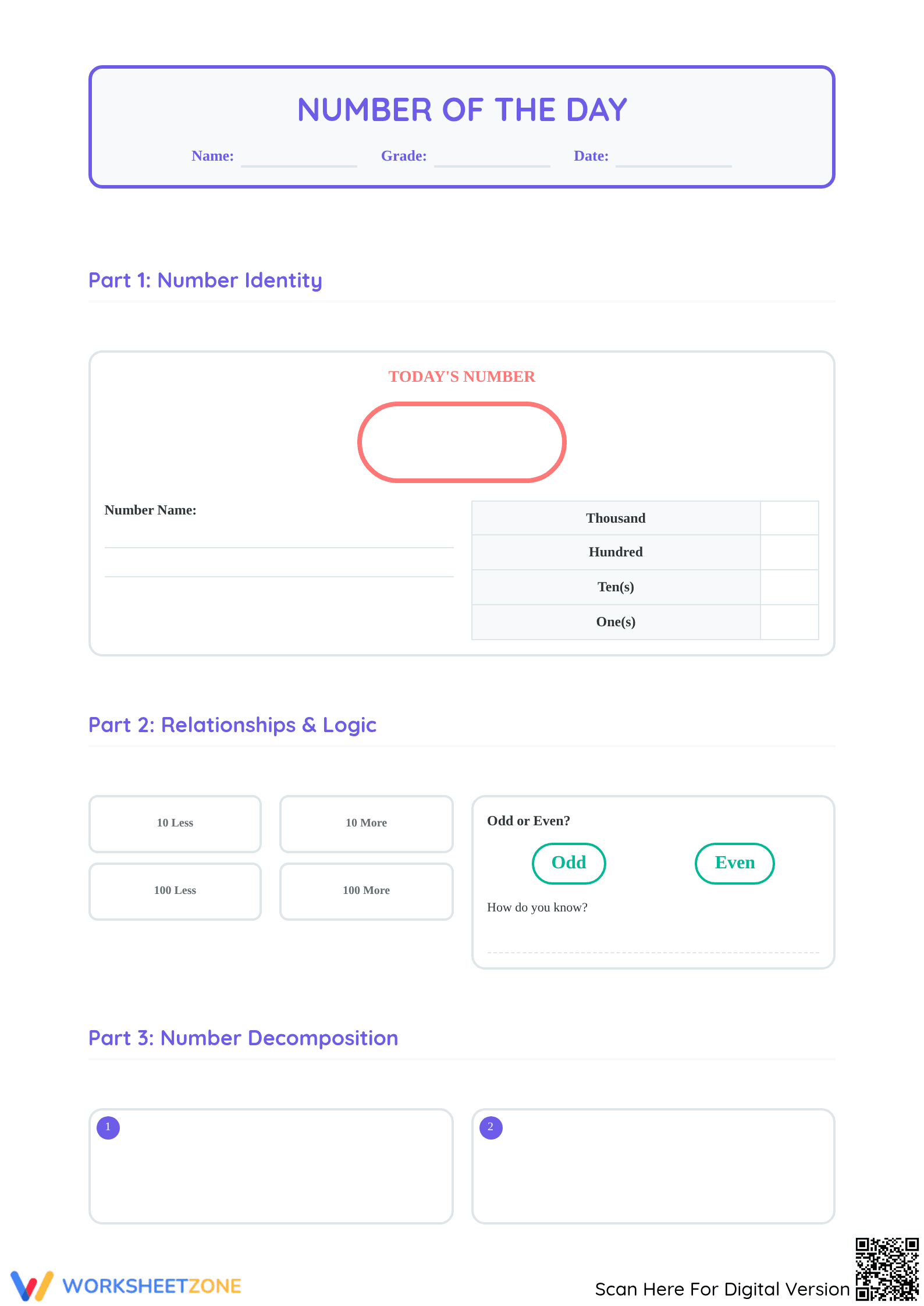


Printable Number of the Day Worksheet | Grade 2-3

Paste this activity's link or code into your existing LMS (Google Classroom, Canvas, Teams, Schoology, Moodle, etc.).
Students can open and work on the activity right away, with no student login required.
You'll still be able to track student progress and results from your teacher account.
Master number sense daily with this comprehensive Number of the Day routine. This worksheet transforms abstract mathematical concepts into a tangible daily practice, helping students internalize place value, properties of numbers, and mental math relationships. By engaging with a single number through multiple lenses, learners build the fluency required for advanced arithmetic in later elementary grades.
At a Glance
- Grade: 2-3 · Subject: Math
- Standard:
CCSS.MATH.CONTENT.2.NBT.A.3— Read and write numbers to 1000 using base-ten numerals and names- Skill Focus: Number Sense & Place Value
- Format: 2 pages · 12 tasks · Answer key included · PDF
- Best For: Daily morning work and warm-ups
- Time: 10–15 minutes
This two-page PDF includes four distinct sections designed for holistic number analysis. Students identify the number name and record place value digits from ones up to thousands in a structured table. The second part challenges them with mental math involving 10 or 100 more and less, alongside parity logic. Page two introduces financial literacy with a cent-value conversion and a rounding challenge to the nearest ten and hundred.
Zero-Prep Workflow
Implementing this routine takes less than two minutes of teacher time. Simply print the double-sided sheet and distribute it as students enter the classroom. Because the layout is consistent and intuitive, students can work independently after a single guided session. Reviewing the answers as a whole group takes approximately five minutes, making it an ideal bell-ringer activity that requires zero active preparation once the copies are made.
Standards Alignment
The primary focus of this resource is CCSS.MATH.CONTENT.2.NBT.A.3, which requires students to read and write numbers using multiple representations. It also supports CCSS.MATH.CONTENT.3.NBT.A.1 through its rounding tasks and CCSS.MATH.CONTENT.2.OA.C.3 with odd and even identification. Both standard codes can be copied directly into lesson plans, IEP goals, or district curriculum mapping tools for easy documentation.
How to Use It
Use this as a daily formative assessment tool during the first ten minutes of your math block. Observe which students struggle with the 100 less box or the rounding challenge to identify those needing targeted small-group intervention. It also serves as an excellent independent center activity or a reliable sub-plan resource, as the structured prompts guide students through the tasks without constant teacher intervention.
Who It's For
This resource is tailored for second and third-grade students developing number sense fluency. It provides necessary scaffolding for English Language Learners through the Number Name lines and clear place value labels. You can naturally pair this worksheet with physical base-ten blocks or a hundreds chart for students who require concrete manipulatives to visualize the decomposition tasks on the first page.
Research by Fisher & Frey (2014) emphasizes that Number of the Day routines are foundational to the gradual release of responsibility model, providing the consistent, distributed practice necessary for long-term retention of place value concepts. This Grade 2-3 worksheet directly supports CCSS.MATH.CONTENT.2.NBT.A.3 by requiring students to translate between numerals and number names while analyzing place value hierarchies up to the thousands. By integrating rounding and parity logic, the resource facilitates a multi-dimensional understanding of number properties. Data from NAEP suggests that students who engage in daily mental math exercises, such as finding 10 or 100 more than a given value, demonstrate significantly higher computational fluency in upper elementary grades. This printable tool provides a structured environment for that growth, ensuring students master the essential building blocks of the base-ten system through a predictable and effective instructional routine.


