


























Views
Plays
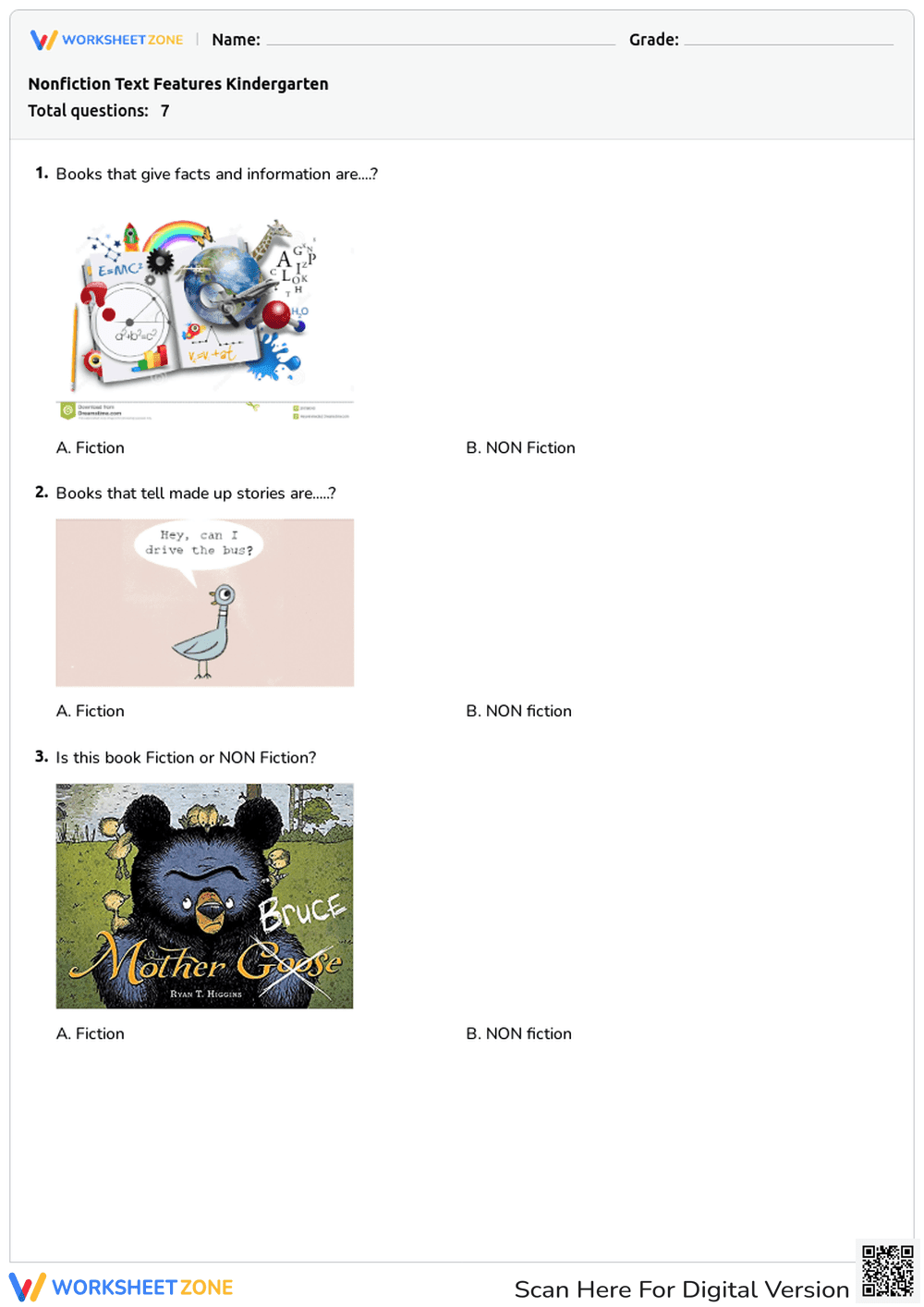


Fiction vs Nonfiction Worksheet | Grade 1 ELA Printable
Paste this activity's link or code into your existing LMS (Google Classroom, Canvas, Teams, Schoology, Moodle, etc.).
Students can open and work on the activity right away, with no student login required.
You'll still be able to track student progress and results from your teacher account.
This foundational reading worksheet helps early learners distinguish between fiction and nonfiction texts while identifying essential text features. By evaluating book covers and sample pages, students will practice recognizing titles, headings, and photographs, building the critical evaluation skills needed for independent reading comprehension and informational text navigation.
At a Glance
- Grade: 1 · Subject: ELA
- Standard:
CCSS.ELA-LITERACY.RI.1.5— Know and use various text features to locate facts.- Skill Focus: Fiction vs. Nonfiction and Text Features
- Format: 3 pages · 7 problems · PDF
- Best For: Formative assessment or independent practice
- Time: 10–15 minutes
Inside this resource, educators will find a three-page multiple-choice assessment featuring seven visual questions. The first section challenges students to categorize books as fiction or nonfiction based on cover art. Subsequent questions require learners to identify specific text features, such as headings and photographs, using clear examples from real texts. The visual nature provides strong scaffolding for early readers.
- Guided practice: The first 3 problems introduce the core concept of separating made-up stories from factual information using highly recognizable book covers.
- Supported practice: Problems 4 and 5 transition into identifying specific text features like headings, using arrows and clear visual cues to guide student attention.
- Independent practice: The final 2 problems ask students to independently identify titles and photographs without additional directional support.
This gradual-release approach follows the I Do, We Do, You Do model, ensuring students build confidence as they progress.
This resource is aligned to CCSS.ELA-LITERACY.RI.1.5: Know and use various text features to locate key facts or information in a text. It also supports foundational comprehension by asking students to distinguish between storybooks and informational texts. Both standard codes can be copied directly into lesson plans, IEP goals, or district curriculum mapping tools.
This worksheet is highly versatile and can be deployed during literacy centers or as a quick formative assessment after direct instruction on text features. For a collaborative activity, project the PDF on a smartboard and have students use whiteboards to vote on whether a book is fiction or nonfiction before completing the rest of the worksheet independently. Teachers should observe whether students rely on illustrations versus text cues to make their determinations. Expected completion time is 10 to 15 minutes.
This activity is designed for first-grade students, though it serves as an excellent review for second graders or a challenge for advanced kindergarteners. The heavy reliance on visual cues makes it particularly accessible for English Language Learners (ELLs) and visual learners who benefit from seeing real-world examples of book covers. It pairs perfectly with a classroom library sort or an anchor chart detailing the differences between storybooks and informational texts.
Mastering the distinction between narrative and informational texts is a critical milestone in early literacy development. According to Fisher & Frey (2014), explicit instruction in text features significantly improves a student's ability to navigate complex informational texts in later grades. This worksheet directly supports CCSS.ELA-LITERACY.RI.1.5 by requiring students to know and use various text features to locate facts. By practicing these foundational skills early, young learners develop a robust mental schema for how different types of texts are organized, which ultimately reduces cognitive load during independent reading tasks. Recognizing structural elements like headings, titles, and photographs allows early readers to preview texts effectively and set a clear purpose for reading. Integrating this targeted practice ensures students are well-prepared for the rigorous comprehension demands they will face in upper elementary classrooms.


