


























Views
Downloads
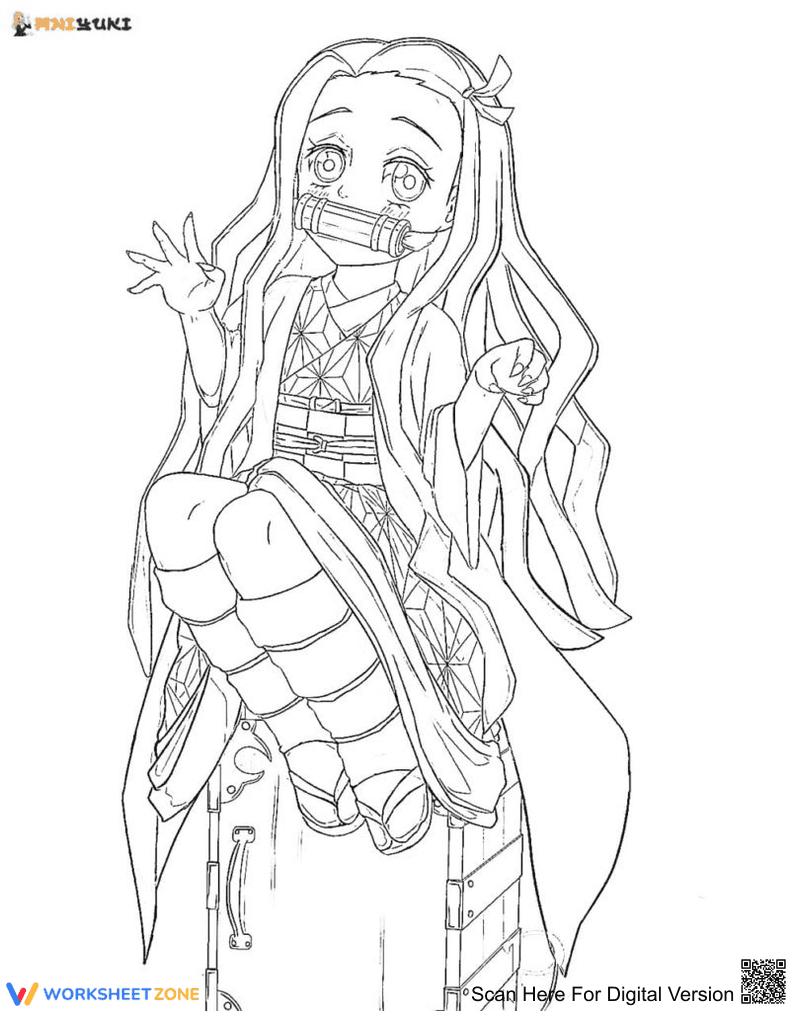

Nezuko Coloring Page | Essential Grade K-5 Printable
Paste this activity's link or code into your existing LMS (Google Classroom, Canvas, Teams, Schoology, Moodle, etc.).
Students can open and work on the activity right away, with no student login required.
You'll still be able to track student progress and results from your teacher account.
This Nezuko coloring page provides a high-interest creative outlet for students in Preschool through Grade 5. By focusing on the popular character Nezuko Kamado sitting on her iconic box, students engage in purposeful fine motor practice that strengthens the small muscle groups required for handwriting and precision tasks. It offers a calm, focused activity for various classroom settings.
At a Glance
- Grade: K-5 · Subject: Arts & Crafts
- Standard:
CCSS.ELA-LITERACY.SL.K.5— Add drawings or visual displays to descriptions to provide additional detail.- Skill Focus: Fine motor development and color theory
- Format: 1 page · 1 task · No answer key needed · PDF
- Best For: Indoor recess or early finisher activity
- Time: 15–30 minutes
The worksheet features a single, high-resolution line art illustration of Nezuko Kamado. The composition includes intricate details such as the pattern on her kimono and the texture of the wooden box, providing varying levels of difficulty for different age groups. This 1-page PDF is designed for immediate use with standard crayons, colored pencils, or markers.
The zero-prep workflow for this resource is designed for maximum efficiency. First, print the required number of copies (30 seconds). Second, distribute the pages along with coloring supplies to students (1 minute). Third, review the completed work by displaying it on a classroom wall to build community (30 seconds). Total teacher preparation time is under two minutes, making it an ideal emergency sub plan component.
This activity aligns with CCSS.ELA-LITERACY.SL.K.5, which encourages students to use visual displays to enhance their descriptions and ideas. While primarily an artistic endeavor, it supports the development of visual literacy and spatial awareness. This standard code can be copied directly into lesson plans, IEP goals, or district curriculum mapping tools to justify the inclusion of creative arts in the daily schedule.
Use this worksheet as a transition tool during high-energy periods or as a reward for completing core academic tasks. It serves as an excellent formative assessment for observing pencil grip and pressure control in younger learners. Expected completion time ranges from 15 minutes for a quick sketch to 30 minutes for detailed shading and color blending.
This resource is perfect for elementary students who are fans of anime and manga, providing a culturally relevant connection to their interests. It is particularly effective for students requiring sensory breaks or those working on occupational therapy goals. Pair this with a character description writing prompt or a lesson on Japanese culture for a more comprehensive instructional unit.
According to research by Fisher & Frey (2014), integrating visual arts into the classroom environment supports cognitive development and emotional regulation. Coloring activities, specifically those featuring familiar characters, reduce student anxiety and increase engagement with the learning environment. The use of CCSS.ELA-LITERACY.SL.K.5 ensures that even creative tasks remain grounded in developmental milestones. Studies from the RAND AIRS 2024 report suggest that fine motor precision in early childhood is a significant predictor of later academic success in both reading and mathematics. By providing structured opportunities for hand-eye coordination through high-interest media, educators can support these foundational skills without increasing teacher burnout. This worksheet serves as a practical application of these findings, offering a low-stakes yet high-reward method for maintaining student focus during non-instructional blocks or as part of a broader arts-integrated curriculum.


