


























Views
Downloads

Newton's First Law Worksheet | Grade 8 Essential
Paste this activity's link or code into your existing LMS (Google Classroom, Canvas, Teams, Schoology, Moodle, etc.).
Students can open and work on the activity right away, with no student login required.
You'll still be able to track student progress and results from your teacher account.
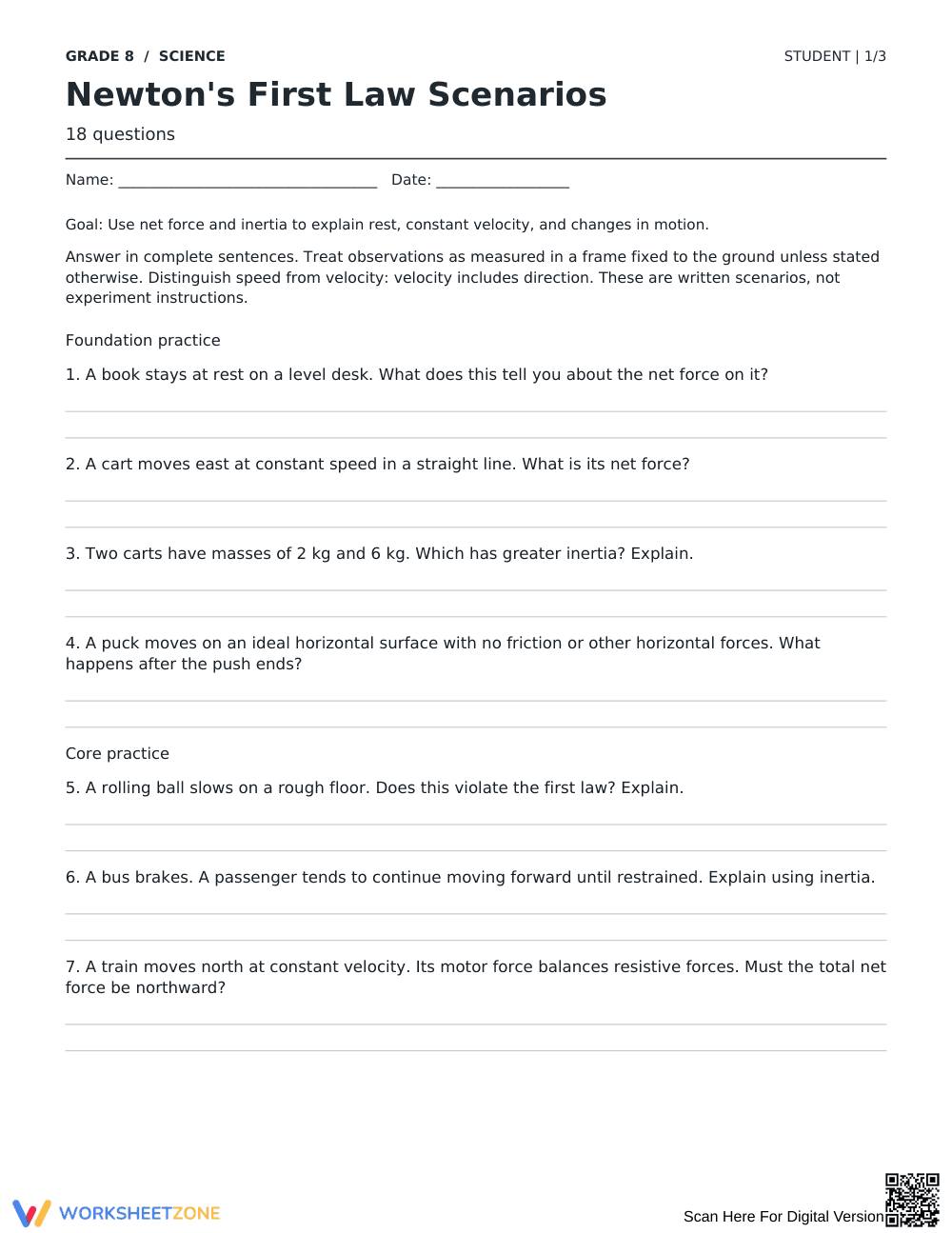
This physical science worksheet equips Grade 8 students to analyze balanced forces, unbalanced forces, and inertia across realistic mechanical contexts. Through written scenarios, learners evaluate rest, constant velocity, and changes in motion. Students develop conceptual precision by explaining phenomena in complete sentences without relying on simple rote recall or formula calculations.
At a Glance
- Grade: 8 · Subject: Science
- Standard:
MS-PS2-2— Plan an investigation or provide evidence that motion changes depend on net force- Skill Focus: Newton's first law of motion and inertia
- Format: 3 pages · 18 problems · Answer key included · PDF
- Best For: Mid-unit conceptual review and force analysis
- Time: 30–45 minutes
What's Inside
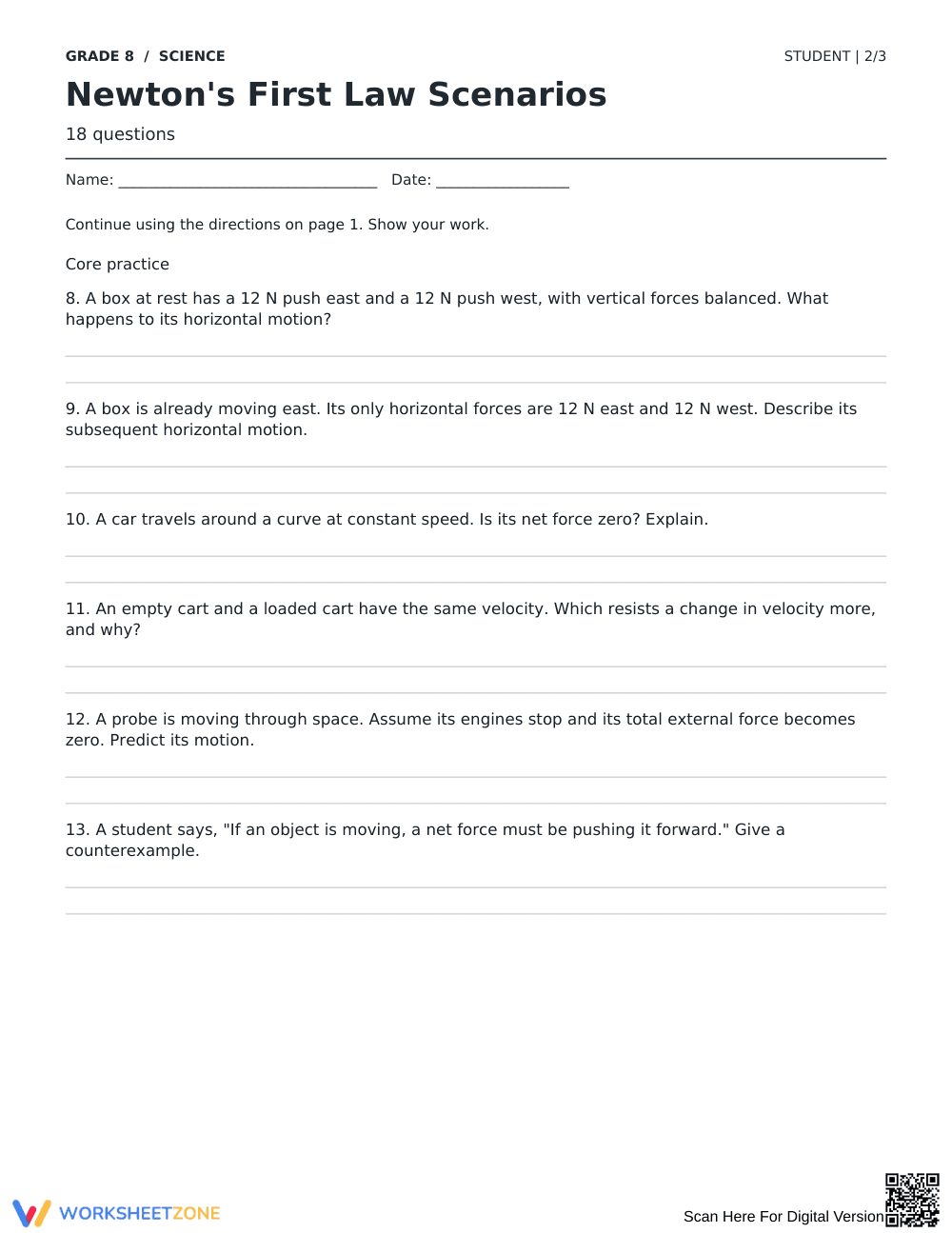
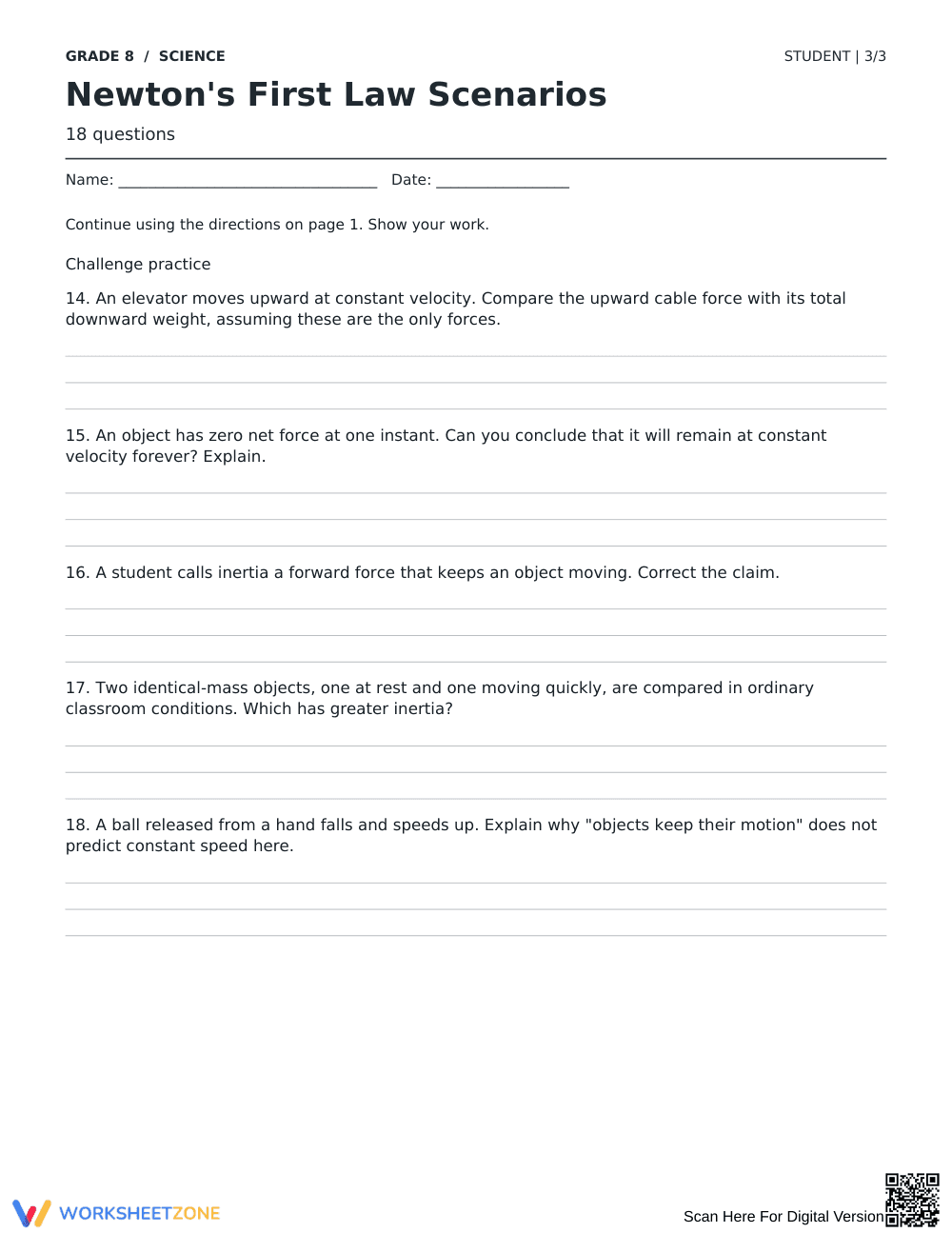
This 3-page student printable contains 18 structured, open-response prompts divided into three targeted sections. Tasks require students to determine horizontal and vertical net forces, evaluate moving objects, and critique common misconceptions regarding inertia. A complete 2-page teacher answer key provides explicit reasoning criteria, acceptable alternative explanations, and a clear 54-point scoring guideline.
Skill Progression
- Guided practice (Foundation practice, items 1–4): Scaffolds core concepts including stationary objects, constant velocity in a straight line, and mass-dependent inertia.
- Supported practice (Core practice, items 5–13): Expands problem complexity to real-world friction, sudden braking in vehicles, balanced opposing forces, and counterexamples to common student misbeliefs.
- Independent practice (Challenge practice, items 14–18): Demands rigorous conceptual evaluation of vertical cable tension, instantaneous zero net force, accelerating free-fall, and scientific definitions of inertia.
This sequence mirrors the gradual-release model, establishing baseline physical laws before challenging students to resolve tricky physics misconceptions independently.
Standards Alignment
This resource aligns directly to `MS-PS2-2`: Plan an investigation to provide evidence that the change in an object's motion depends on the sum of the forces on the object and the mass of the object. It also supports foundational concepts under physical science disciplinary core idea PS2.A regarding forces and motion. Both standard codes can be copied directly into lesson plans, IEP goals, or district curriculum mapping tools.
How to Use It
Deploy this worksheet after direct instruction on balanced forces or as a mid-unit checkpoint before moving to Newton's second law calculations. During independent work time, circulate to verify whether students conflate velocity with force; specifically check item 7 to confirm that students recognize that forward motion does not require a net forward force. Expect the full 18-question set to take 30 to 45 minutes of focused class time.
Who It's For
Designed for Grade 8 physical science classes, this resource serves general education students, honors cohorts, and introductory high school physics courses. For struggling learners, supply an anchor chart contrasting balanced versus unbalanced force diagrams prior to assigning the core practice questions.
According to EdReports 2024 evaluations of middle school science curricula, student mastery of physical science standards requires consistent practice in qualitative explanation alongside quantitative analysis. Aligning instruction to standard MS-PS2-2 demands that learners evaluate forces critically rather than assuming motion always implies an active push. This 18-item scenario pack provides targeted opportunities to confront intuitive misconceptions about inertia, velocity, and zero net force. By requiring written scientific justifications, the worksheet solidifies student conceptual frameworks, ensuring that eighth graders build the robust foundational knowledge necessary for subsequent work in classical mechanics and engineering design tasks.


