


























Views
Downloads


Printable Lunar New Year Story Worksheet | Grade 7-9
Paste this activity's link or code into your existing LMS (Google Classroom, Canvas, Teams, Schoology, Moodle, etc.).
Students can open and work on the activity right away, with no student login required.
You'll still be able to track student progress and results from your teacher account.
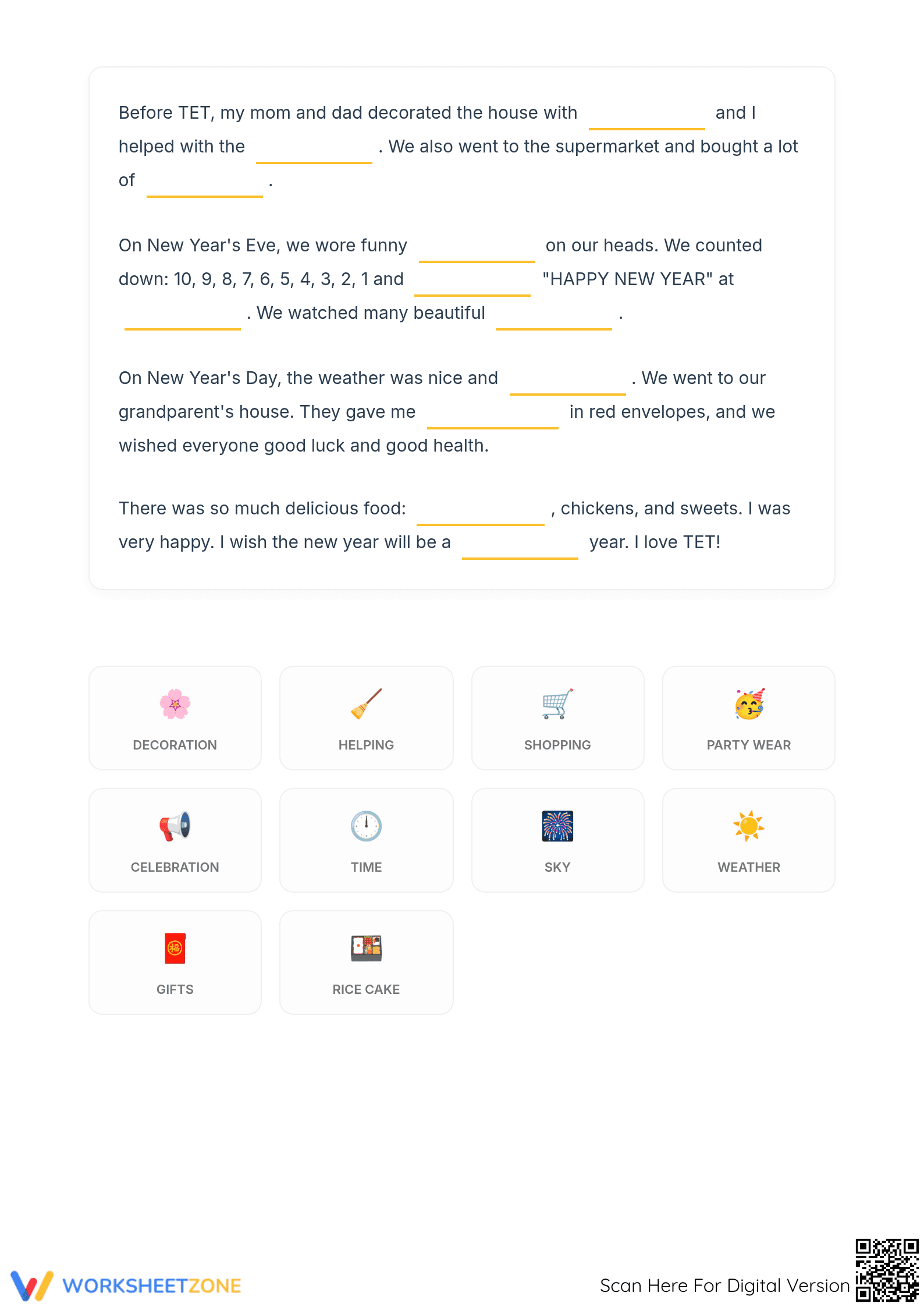
This Grade 7-9 Lunar New Year worksheet guides students through an immersive reading experience centered on the cultural traditions of TET in Vietnam. By combining narrative completion with visual clues, students strengthen their inferential reasoning and vocabulary before moving into deep comprehension checks. The final reflection ensures a personal connection to the global celebration theme.
At a Glance
- Grade: 7, 8, 9 · Subject: English Language Arts
- Standard:
CCSS.ELA-LITERACY.RI.7.1— Cite textual evidence to support analysis of explicit and implicit meanings- Skill Focus: Context Clues, Reading Comprehension, and Narrative Writing
- Format: 3 pages · 14 problems · Answer key included · PDF
- Best For: Holiday-themed secondary ELA cultural enrichment
- Time: 30–45 minutes
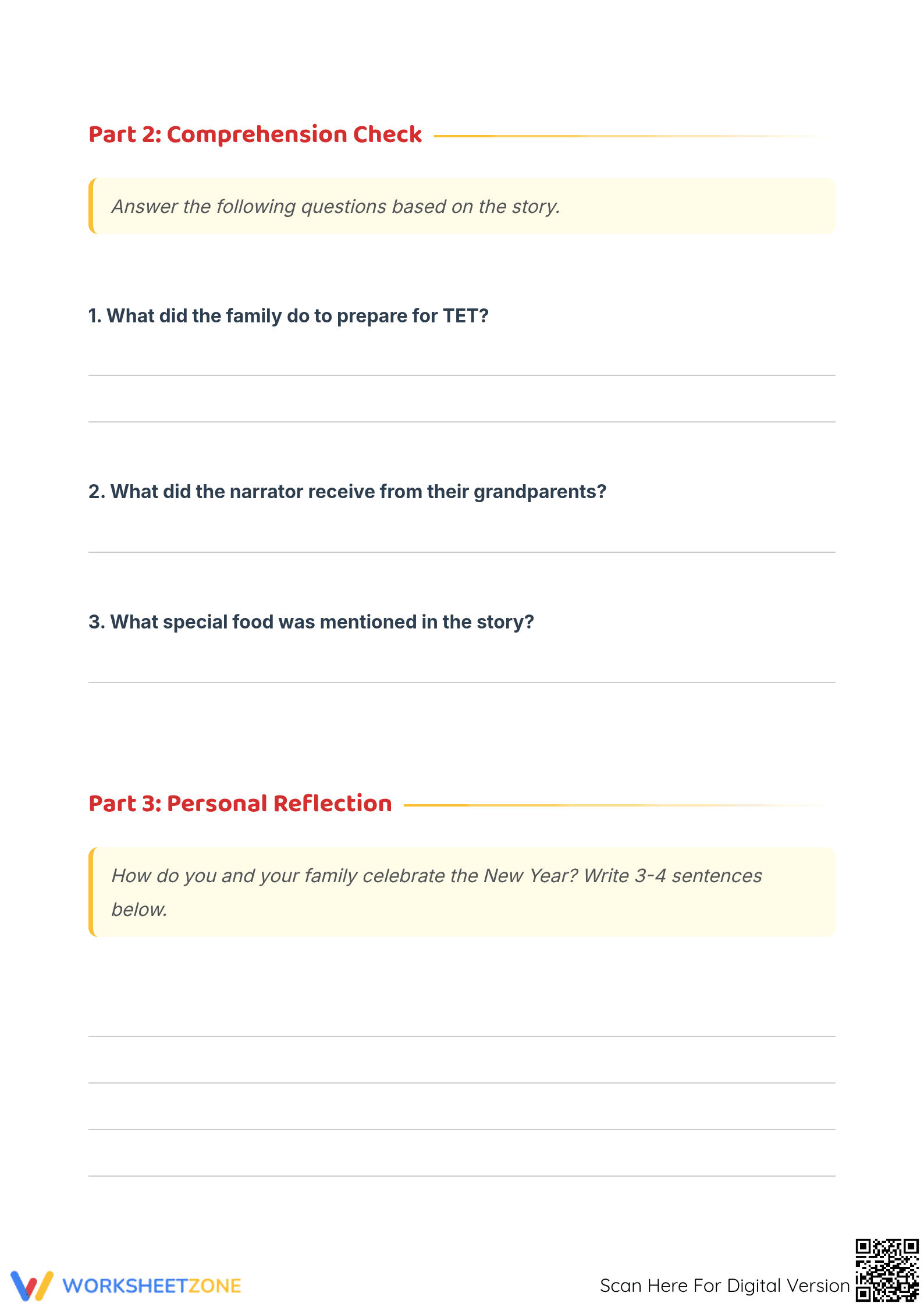
Inside this three-page resource, students will find a "Spirit of TET" narrative containing ten strategic blanks. A curated word bank of ten visual icons with labels helps students identify the correct terms based on context. Following the story, a comprehension section features three text-dependent questions, and the activity concludes with a structured personal reflection prompt for extended writing practice.
Zero-Prep Workflow
This resource is designed for immediate classroom implementation with minimal teacher intervention. First, print the document in under sixty seconds; the clean layout ensures high-quality reproduction even on standard school printers. Next, distribute the packet to students for independent or small-group work, as the visual clues make the task self-explanatory. Finally, use the provided answer key for a five-minute whole-class review or quick grading session.
Standards Alignment
The primary focus of this worksheet is `CCSS.ELA-LITERACY.RI.7.1`, which requires students to quote accurately from a text when explaining what the text says explicitly and when drawing inferences. Additionally, it supports `CCSS.ELA-LITERACY.L.7.4` by challenging students to determine the meaning of unknown words and phrases through context. Both standard codes can be copied directly into lesson plans, IEP goals, or district curriculum mapping tools.
How to Use It
Use this worksheet as a standalone cultural unit or a supplemental activity during the Spring festival season. It functions effectively as a formative assessment after a direct instruction lesson on Vietnamese traditions or as a zero-prep sub plan for middle school English classes. To maximize engagement, observe how students match the visual icons to the story blanks to gauge their mastery of semantic context clues.
Who It's For
This activity is tailored for students in Grade 7, Grade 8, and Grade 9 who are developing their reading fluency and descriptive writing skills. It is particularly beneficial for English Language Learners (ELL) who require multi-modal support, such as the included visual aids, to access complex informational texts. It pairs naturally with a short video or passage about Lunar New Year celebrations to provide a holistic learning experience.
According to the NAEP 2024 framework, integrating cultural context into reading comprehension tasks significantly increases student engagement and retention. This worksheet leverages the Spirit of TET to address CCSS.ELA-LITERACY.RI.7.1, requiring students to cite specific textual evidence and visual clues to complete a narrative. By transitioning from a scaffolded cloze activity to open-ended reflection, the resource supports cognitive development in adolescent learners. Research from ScienceDirect TpT Analysis indicates that multi-modal supports—such as the visual icons provided in this Lunar New Year story—are essential for ELL students in grades 7-9 to bridge vocabulary gaps without cognitive overload. This structure ensures that students can demonstrate mastery of informational text analysis while exploring global cultural traditions. The inclusion of a personal reflection section further aligns with the pedagogical shift toward social-emotional learning and cross-cultural competence in modern secondary English classrooms, providing a comprehensive assessment of both literal and inferential comprehension skills.


