


























Views
Downloads

Printable V Adjectives Worksheet | Grade 4 Vocabulary
Paste this activity's link or code into your existing LMS (Google Classroom, Canvas, Teams, Schoology, Moodle, etc.).
Students can open and work on the activity right away, with no student login required.
You'll still be able to track student progress and results from your teacher account.
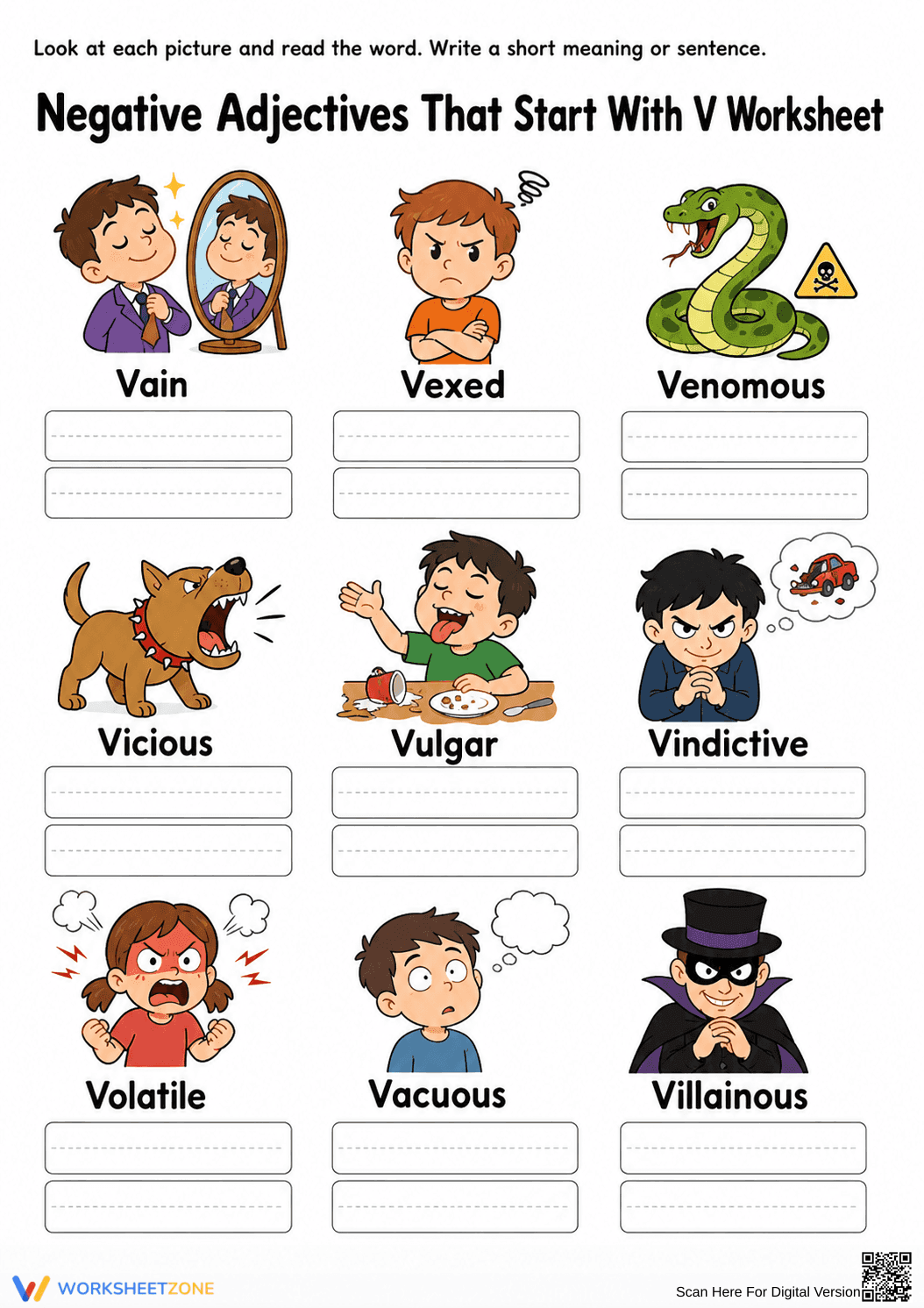
This Grade 4 vocabulary worksheet helps students acquire and use new descriptive words by focusing on negative adjectives starting with the letter V. Students examine nine distinct character illustrations to deduce the meaning of advanced vocabulary terms, then write their own definitions or contextual sentences to demonstrate comprehension.
At a Glance
- Grade: 4 · Subject: ELA
- Standard:
CCSS.ELA-LITERACY.L.4.6— Acquire and use grade-appropriate vocabulary accurately- Skill Focus: Vocabulary Acquisition
- Format: 1 page · 9 problems · Answer key included · PDF
- Best For: Independent practice or morning work
- Time: 15–20 minutes
Inside this single-page resource, educators will find nine structured vocabulary tasks featuring expressive, full-color illustrations. Each visual cue corresponds to a specific negative adjective, such as "vindictive," "vacuous," or "volatile." Below each image and word pair, students are provided with primary writing lines to draft a short definition or construct a complete sentence. A sample answer key is included to help teachers quickly evaluate sentence structure and contextual accuracy.
Designed for a zero-prep workflow:
- Print (1 minute): The single-page layout makes batch copying fast.
- Distribute (1 minute): Hand out the assignment for immediate engagement. The visual tasks are self-explanatory.
- Review (3 minutes): Use the provided sample responses to quickly check student sentences for correct context and grammatical mechanics.
With less than two minutes of total teacher preparation required, this activity serves as an excellent emergency sub plan or a quick transition task between major literacy blocks.
This activity is directly aligned with CCSS.ELA-LITERACY.L.4.6: "Acquire and use accurately grade-appropriate general academic and domain-specific words and phrases, including those that signal precise actions, emotions, or states of being." By matching complex emotional states to visual representations, students build a more robust descriptive lexicon. Both standard codes can be copied directly into lesson plans, IEP goals, or district curriculum mapping tools.
Deploy this worksheet during independent practice or as morning work to settle the class while building vocabulary. Alternatively, use it as a collaborative center activity where pairs of students discuss the illustrations before writing their sentences. As a formative assessment tip, observe whether students rely solely on the visual cues or if they attempt to use context from prior reading to define words like "vain" or "vulgar." Expect students to complete the nine tasks within 15 to 20 minutes.
Designed for fourth-grade students expanding their academic vocabulary, it also serves as review for fifth graders. The strong visual scaffolds make it particularly effective for English Language Learners (ELLs) who benefit from pictorial context clues when learning nuanced emotional adjectives. Pair this worksheet with a character analysis lesson or a creative writing prompt to encourage students to apply these new negative traits to fictional antagonists.
Effective vocabulary instruction requires multiple exposures to new words in meaningful contexts. According to Fisher & Frey (2014), integrating visual scaffolds with targeted vocabulary practice significantly improves retention and comprehension for elementary learners. This worksheet supports that pedagogical framework by pairing complex terms with expressive illustrations, prompting students to actively process the vocabulary. By aligning with CCSS.ELA-LITERACY.L.4.6 to acquire and use grade-appropriate vocabulary accurately, the activity ensures students move beyond rote memorization into practical application. Generating original sentences forces learners to grapple with the nuances of each adjective, solidifying their understanding. This evidence-based approach builds the descriptive language skills necessary for advanced reading comprehension and sophisticated narrative writing.


