


























Views
Downloads



Negative Adjectives Worksheet | Grade 4 ELA Printable
Paste this activity's link or code into your existing LMS (Google Classroom, Canvas, Teams, Schoology, Moodle, etc.).
Students can open and work on the activity right away, with no student login required.
You'll still be able to track student progress and results from your teacher account.
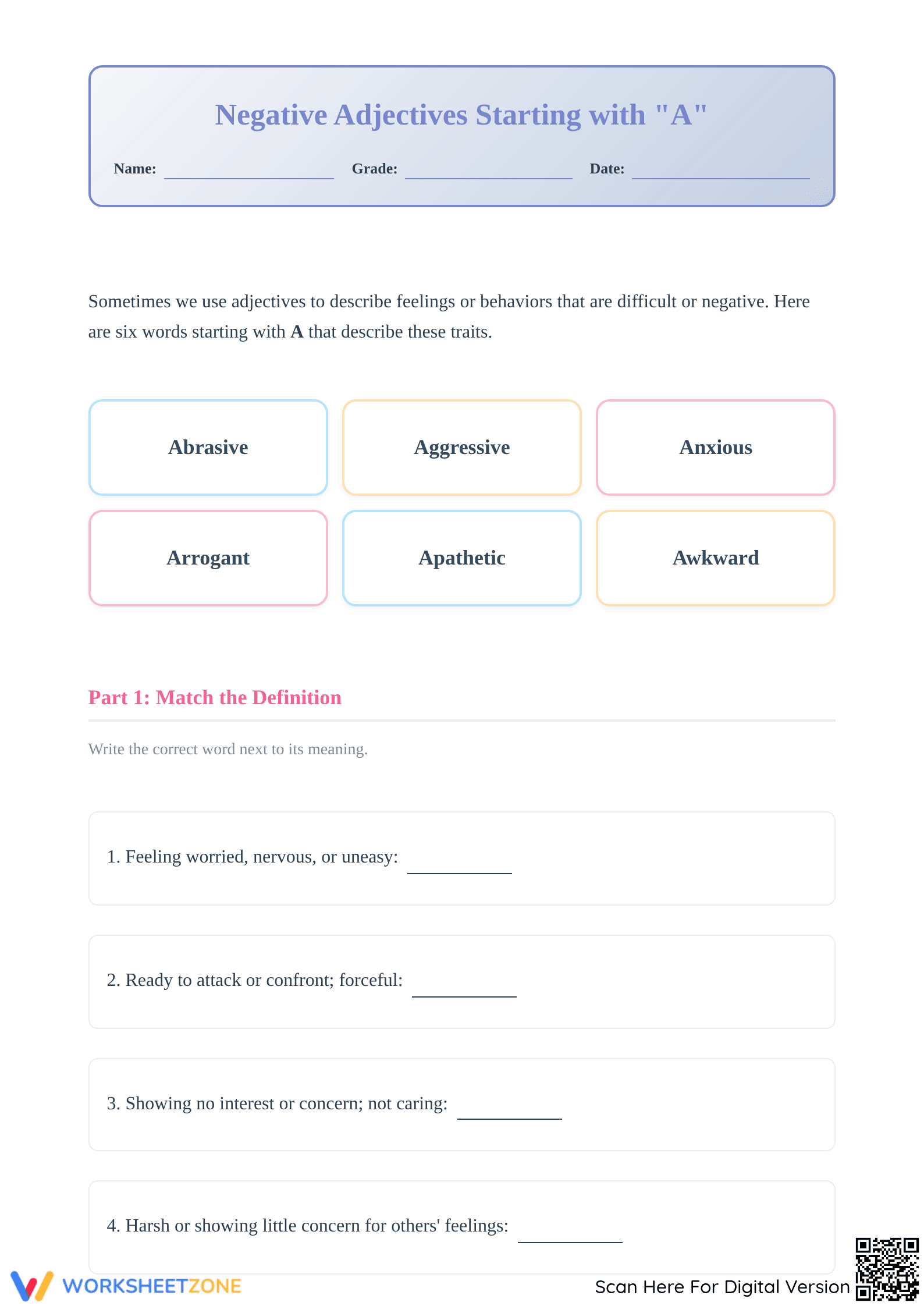
This vocabulary worksheet helps students master negative adjectives starting with the letter A, such as "anxious" and "arrogant." By connecting these descriptive words to real-life scenarios and definitions, learners expand their emotional vocabulary and improve their ability to write precise, expressive sentences.
At a Glance
- Grade: 4 · Subject: ELA
- Standard:
CCSS.ELA-LITERACY.L.4.6— Acquire and use grade-appropriate vocabulary- Skill Focus: Negative Adjectives
- Format: 3 pages · 11 problems · Answer key included · PDF
- Best For: Independent practice and vocabulary building
- Time: 15–20 minutes
This resource features a clear word bank containing six targeted adjectives: abrasive, aggressive, anxious, arrogant, apathetic, and awkward. The three-page layout includes a definition matching section, a real-life scenario application activity, and a creative writing prompt. A complete answer key is provided to ensure quick and accurate grading for educators.
- Guided practice: Students begin by matching the six target vocabulary words to their exact definitions, establishing a foundational understanding of each term.
- Supported practice: Next, learners read four brief real-life scenarios and determine which adjective best describes the person's behavior in context.
- Independent practice: Finally, students select one word from the list to write their own original sentence, demonstrating full comprehension.
This gradual-release approach ensures students confidently move from basic recognition to active application in their own writing.
This activity is aligned to CCSS.ELA-LITERACY.L.4.6: Acquire and use accurately grade-appropriate general academic and domain-specific words and phrases. It also supports reading comprehension by helping students identify real-life connections between words and their use. Both standard codes can be copied directly into lesson plans, IEP goals, or district curriculum mapping tools.
Teachers can use this worksheet as a morning work activity to introduce new vocabulary or as an independent center assignment during language arts blocks. When reviewing the real-life scenarios, use it as a formative assessment to observe whether students can accurately infer emotional states from contextual clues. Most students will complete the full three-page sequence in 15 to 20 minutes.
This resource is designed for third and fourth-grade students developing their descriptive writing skills. It provides excellent scaffolding for English Language Learners who benefit from explicit vocabulary instruction and clear contextual examples. Pair this worksheet with a character analysis lesson to help students apply these new adjectives to characters in their current reading books.
Explicit vocabulary instruction is a critical component of reading comprehension and expressive writing development in elementary classrooms. According to Fisher & Frey (2014), providing students with multiple exposures to new words in varied, meaningful contexts significantly increases their ability to retain and utilize that vocabulary independently. This worksheet directly supports that research by requiring students to acquire and use grade-appropriate vocabulary (CCSS.ELA-LITERACY.L.4.6) through a strategic sequence of definition matching, contextual analysis, and original sentence generation. By focusing specifically on negative adjectives starting with the letter A, educators can help students articulate complex emotions and character traits more effectively. Structured practice with targeted word lists ensures that learners move beyond basic memorization and begin integrating sophisticated language into their daily communication, reading comprehension responses, and academic writing tasks.


