


























Views
Downloads
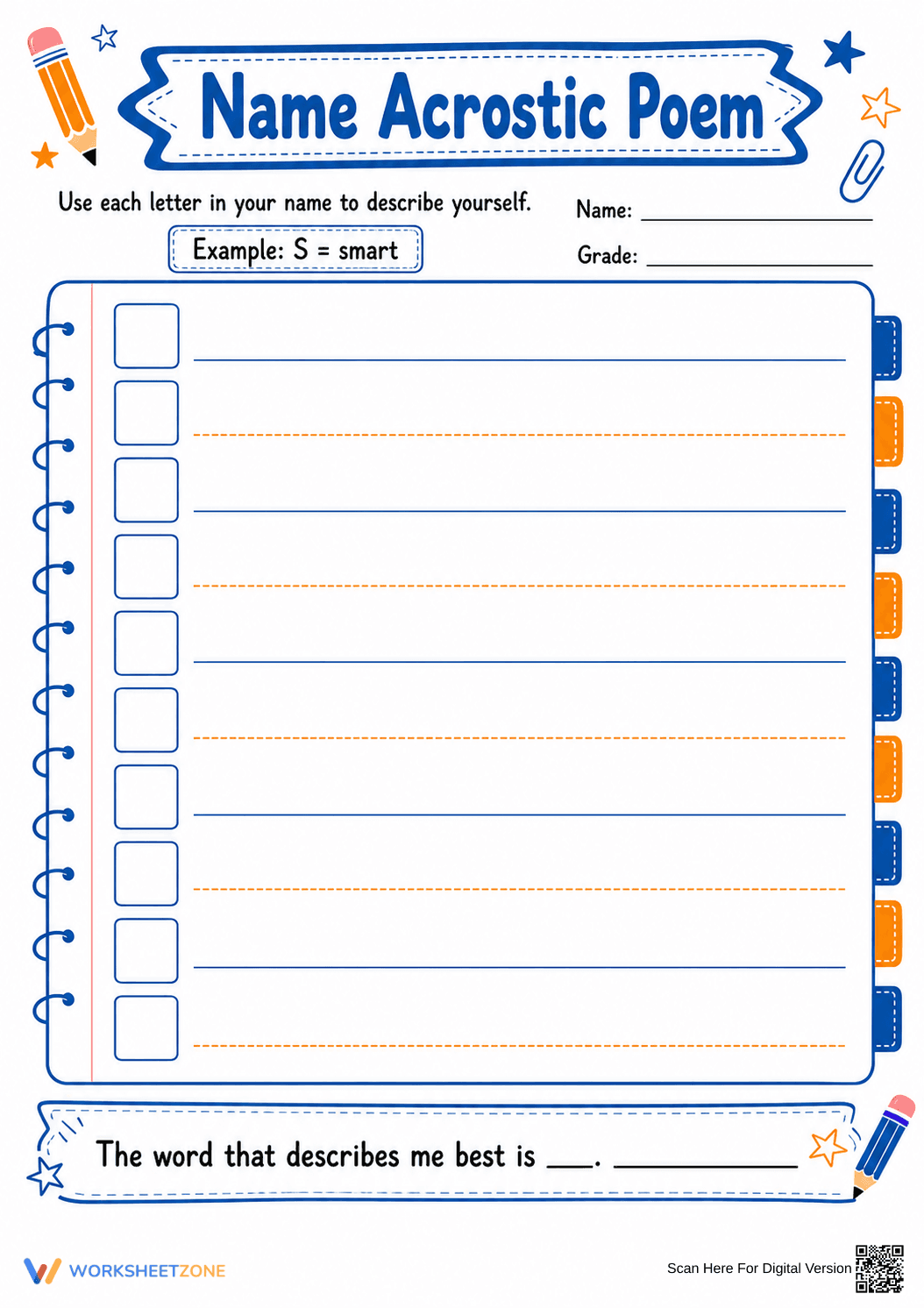

Name Acrostic Poem Worksheet | Grade 3 Essential
Paste this activity's link or code into your existing LMS (Google Classroom, Canvas, Teams, Schoology, Moodle, etc.).
Students can open and work on the activity right away, with no student login required.
You'll still be able to track student progress and results from your teacher account.
This Name Acrostic Poem worksheet provides a creative framework for Grade 3 students to explore self-identity and descriptive vocabulary. By using the letters of their own names to generate adjectives and phrases, learners engage in a meaningful writing exercise that builds confidence and word-choice skills. It is an ideal icebreaker or creative writing warm-up.
At a Glance
- Grade: 3 · Subject: ELA
- Standard:
CCSS.ELA-LITERACY.W.3.10— Write routinely over shorter time frames for a range of tasks and purposes- Skill Focus: Descriptive Vocabulary & Poetry
- Format: 1 page · 11 tasks · Answer key not applicable · PDF
- Best For: Back-to-school icebreakers or creative writing warm-ups
- Time: 15–20 minutes
This single-page PDF features a clean, notebook-style layout with 10 vertical letter boxes and corresponding ruled lines. It includes a playful header, a clear instructional prompt, and a helpful "S = smart" example to guide student thinking. The bottom of the page contains a dedicated reflection strip where students identify their strongest personal trait, ensuring a focused conclusion to the activity.
The zero-prep design allows for immediate classroom implementation. First, print the required number of copies (30 seconds). Second, distribute the sheets and explain the acrostic format using the provided example (1 minute). Third, review the completed poems or have students share their favorite descriptive word during a closing circle (5 minutes). Total teacher preparation time is under two minutes, making it a perfect sub plan addition.
This resource aligns with `CCSS.ELA-LITERACY.W.3.10`, which requires students to write routinely over shorter time frames for specific tasks, purposes, and audiences. It also supports vocabulary acquisition by encouraging the use of precise adjectives. Both standard codes can be copied directly into lesson plans, IEP goals, or district curriculum mapping tools.
Use this worksheet during the first week of school as a low-stakes formative assessment of student handwriting and vocabulary range. It also serves as an excellent "early finisher" task or a calm-down activity after recess. Observe how students select words—look for those who struggle to find adjectives for specific letters, as this indicates a need for a classroom word wall or targeted vocabulary support.
This activity is designed for general education Grade 3 students but is easily adaptable for English Language Learners (ELLs) who may need a bilingual dictionary. It pairs naturally with a classroom anchor chart of positive character traits or a read-aloud about identity and self-esteem. The visual layout is uncluttered to support students with executive functioning challenges.
According to Fisher & Frey (2014), routine writing tasks that connect to a student's personal identity significantly increase engagement and help solidify the instructional cycle. This Name Acrostic Poem worksheet utilizes the `CCSS.ELA-LITERACY.W.3.10` standard to provide a structured yet flexible environment for short-form creative expression. Research from the RAND AIRS 2024 report suggests that integrating social-emotional components, such as self-description and reflection, into ELA curriculum improves student retention of descriptive vocabulary. By focusing on the plain-English skill of using letters to generate related descriptors, this resource bridges the gap between basic phonics and complex character analysis. It provides a measurable data point for teachers to assess a student's ability to categorize information and apply adjectives accurately within a constrained poetic format, making it a versatile tool for diverse elementary classrooms.


