


























Views
Downloads
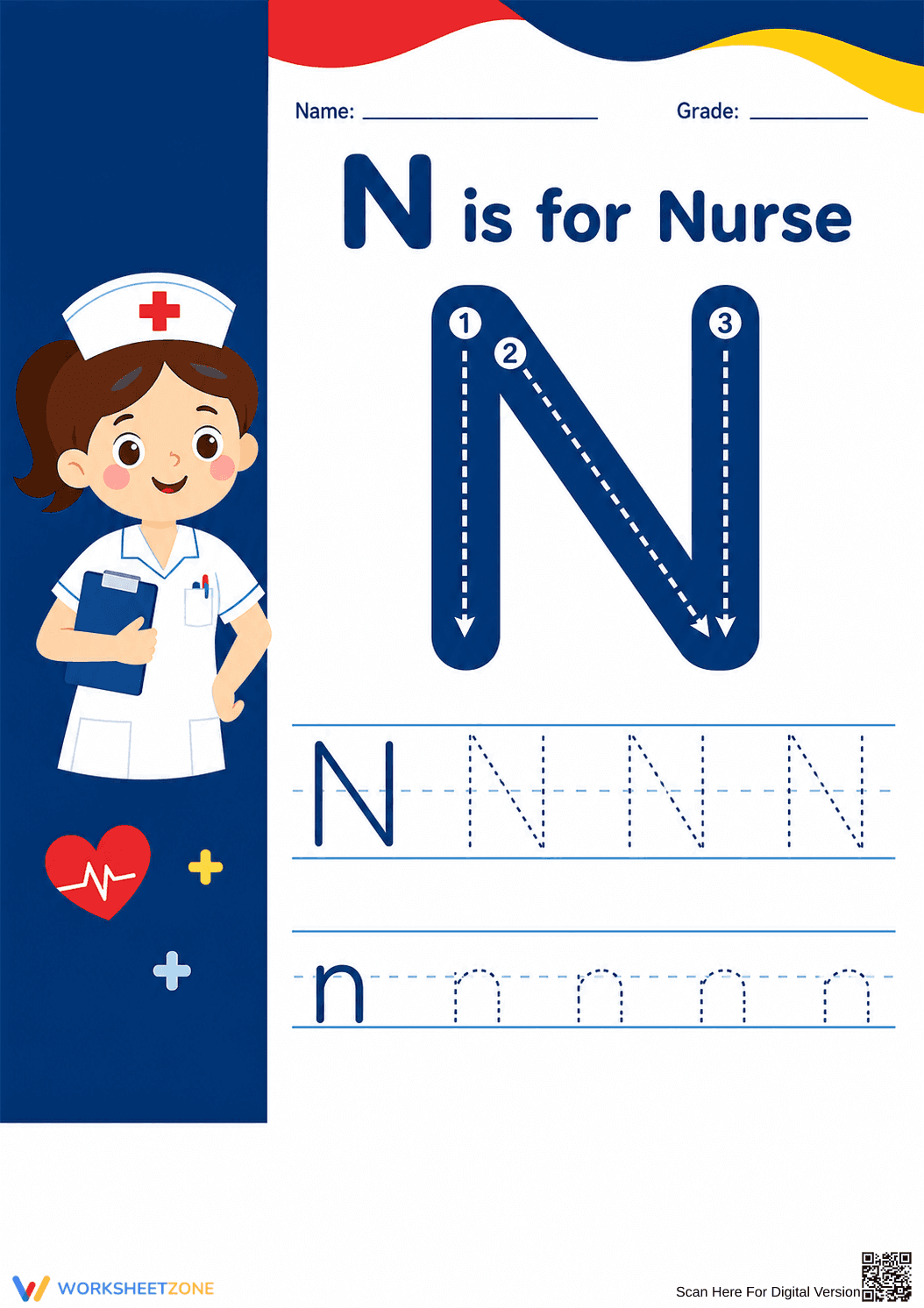

Letter N Tracing Worksheet | Grade K Printable
Paste this activity's link or code into your existing LMS (Google Classroom, Canvas, Teams, Schoology, Moodle, etc.).
Students can open and work on the activity right away, with no student login required.
You'll still be able to track student progress and results from your teacher account.
This foundational handwriting worksheet helps early learners master the formation of the uppercase and lowercase letter N. By tracing guided strokes and practicing independently, students develop essential fine motor control and reinforce beginning sound recognition with a helpful nurse illustration.
At a Glance
- Grade: K · Subject: ELA
- Standard:
CCSS.ELA-LITERACY.L.K.1.A— Print upper- and lowercase letters- Skill Focus: Letter N Formation
- Format: 1 page · 9 tracing tasks · No answer key · PDF
- Best For: Morning work or centers
- Time: 5–10 minutes
This single-page resource features a large, numbered guide for tracing the uppercase letter N, complete with directional arrows to ensure proper stroke order. Below the main guide, students will find two dedicated practice rows containing dashed letters for both uppercase and lowercase N. A vibrant illustration of a nurse provides a visual anchor for the "N is for Nurse" beginning sound connection, making the activity engaging for young learners.
This resource is designed for immediate classroom implementation with a simple three-step workflow:
- Print (1 minute): Generate copies directly from the PDF file. The high-contrast design ensures clear dashed lines even in black and white.
- Distribute (1 minute): Hand out to students along with pencils or crayons. The visual cues make the task immediately obvious.
- Review (1 minute): Quickly check student work for correct stroke direction and line adherence.
Total teacher preparation time is under two minutes, making this ideal for sub plans or literacy centers.
This worksheet aligns directly with CCSS.ELA-LITERACY.L.K.1.A, requiring students to print many upper- and lowercase letters. It also supports foundational phonics skills by linking the letter N to a familiar word and image. Both standard codes can be copied directly into lesson plans, IEP goals, or district curriculum mapping tools.
Use this worksheet during morning arrival to settle students into the daily routine. It also functions perfectly as an independent station during literacy centers while the teacher conducts small group reading instruction. As a formative assessment tip, observe students while they trace the large guided letter at the top; watch to ensure they are starting at the top line and following the numbered arrows rather than drawing from the bottom up. Expected completion time is between five and ten minutes.
This resource is primarily designed for kindergarten students who are developing their handwriting and letter recognition skills. It also serves as an intervention tool for first-grade students needing stroke correction. For differentiation, teachers can provide textured surfaces underneath the paper or have students trace the letters with multiple colored crayons for rainbow writing. Pair this worksheet with a read-aloud book featuring community helpers or a classroom anchor chart focusing on the letter N.
Effective handwriting instruction requires explicit modeling and guided practice with clear directional cues. According to Fisher & Frey (2014), providing structured scaffolds during the initial stages of skill acquisition significantly improves long-term retention and automaticity in early learners. This worksheet directly addresses CCSS.ELA-LITERACY.L.K.1.A by requiring students to print upper- and lowercase letters accurately. The inclusion of numbered arrows ensures that students internalize the correct motor pathways rather than simply copying shapes without understanding the mechanics. By combining fine motor practice with beginning sound recognition, educators can create a more cohesive and engaging literacy experience. Consistent, brief practice sessions with targeted feedback help young learners transition from conscious letter formation to fluent writing, ultimately reducing cognitive load during more complex composition tasks later in their academic journey and supporting overall reading development.


