


























Views
Downloads

My Reading Goal Worksheet | Grade 3 Printable
Paste this activity's link or code into your existing LMS (Google Classroom, Canvas, Teams, Schoology, Moodle, etc.).
Students can open and work on the activity right away, with no student login required.
You'll still be able to track student progress and results from your teacher account.
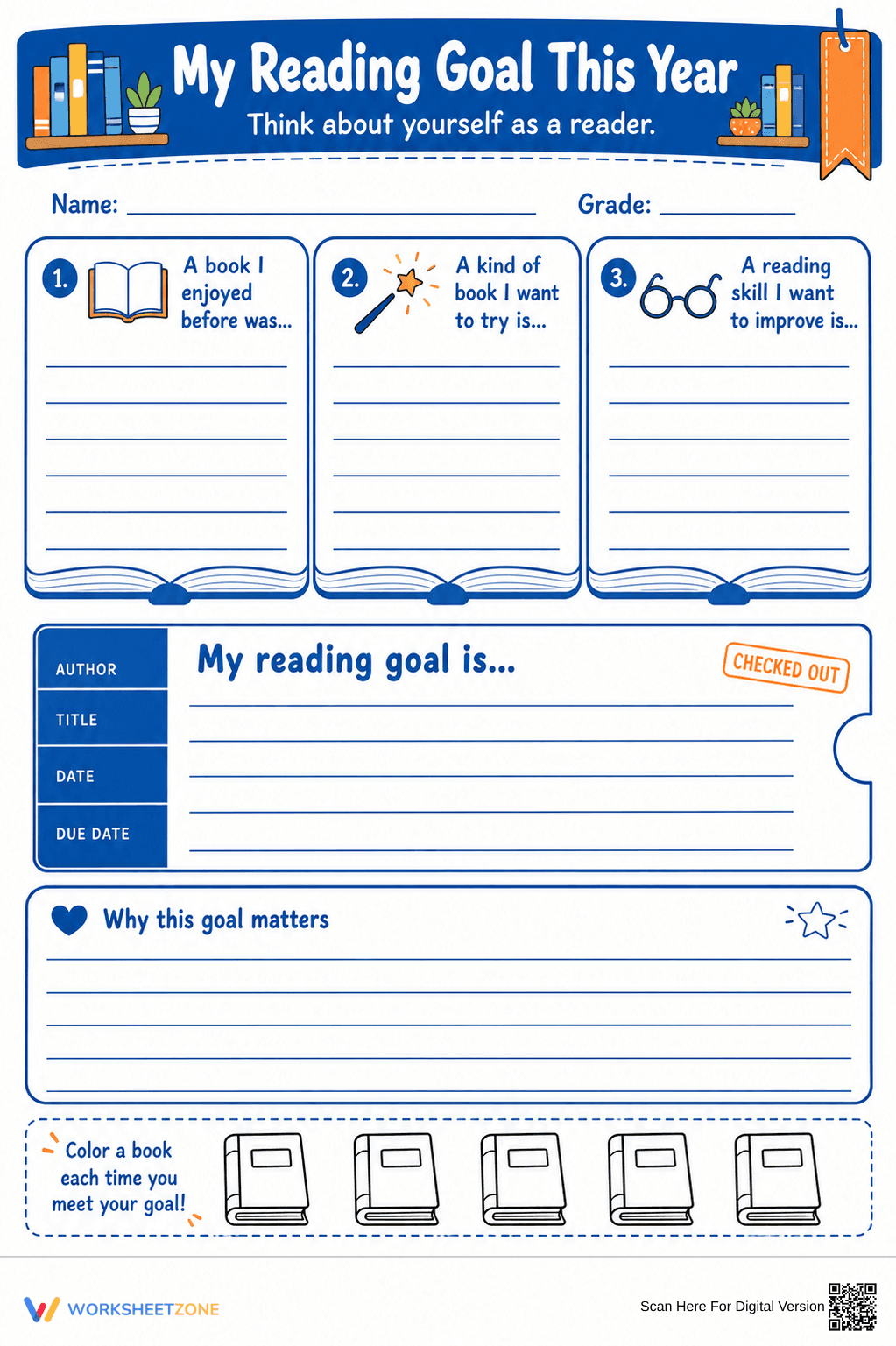
This Grade 3 reading goal worksheet empowers students to take ownership of their literacy journey through structured reflection and intentional goal setting. By identifying past successes and future targets, learners develop the metacognitive skills necessary for independent reading growth. This resource provides a clear framework for students to articulate their reading identity and commit to specific, measurable improvements.
At a Glance
- Grade: 3 · Subject: ELA
- Standard:
CCSS.ELA-LITERACY.W.3.10— Write routinely for a range of discipline-specific tasks, purposes, and audiences- Skill Focus: Literacy reflection and goal setting
- Format: 1 page · 5 tasks · No answer key · PDF
- Best For: Back-to-school or new semester goal setting
- Time: 15–20 minutes
The worksheet features a clean, journal-style layout with five distinct sections. It includes three rounded reflection cards for identifying past favorites, new genres, and specific skill targets. A central library-card-themed box provides space for the primary reading goal, while a dedicated section encourages students to explain why their goal matters. Finally, a five-book tracker at the bottom allows for immediate visual progress monitoring.
Zero-Prep Workflow
- Print: Select the single-page PDF and print enough copies for your class (30 seconds).
- Distribute: Hand out the worksheets during a morning meeting or ELA block (1 minute).
- Review: Briefly explain the library card and tracker sections to ensure students understand the visual cues (2 minutes).
Total teacher prep time is under 4 minutes, making this an ideal resource for busy mornings or sub plans.
This resource aligns with `CCSS.ELA-LITERACY.W.3.10`, which requires students to write routinely over extended time frames for a range of discipline-specific tasks, purposes, and audiences. It also supports speaking and listening standards by providing a foundation for collaborative discussions about reading habits. Both standard codes can be copied directly into lesson plans, IEP goals, or district curriculum mapping tools.
Assign this worksheet during the first week of a new semester to establish a culture of literacy. Use the completed forms as a formative assessment tool; by reviewing the skill improvement section, you can identify common needs for future mini-lessons. Students should spend approximately 15 to 20 minutes completing the reflection and goal-setting portions to ensure thoughtful responses.
This resource is designed for students in Grades 2 through 5, with scaffolding suitable for developing writers. It is particularly effective for students who benefit from visual organizers and clear section boundaries. Pair this worksheet with a classroom reading log or a genre-focused anchor chart to provide students with a comprehensive literacy support system throughout the school year.
According to Fisher & Frey (2014), metacognitive goal-setting in literacy allows students to take ownership of their learning. This worksheet facilitates that process by requiring students to identify specific skills and articulate their rationale. By aligning with CCSS.ELA-LITERACY.W.3.10, the resource supports routine writing for specific purposes. Research from the NAEP suggests that students who reflect on reading habits demonstrate higher engagement with complex texts. This printable tool provides a structured framework for Grade 3 students to transition into active, goal-oriented learners. The inclusion of a visual tracker reinforces positive reinforcement cycles, critical for developing reading stamina. Educators can use this data to tailor small-group instruction based on self-identified needs, ensuring that literacy interventions are relevant and student-centered.


