


























Views
Downloads
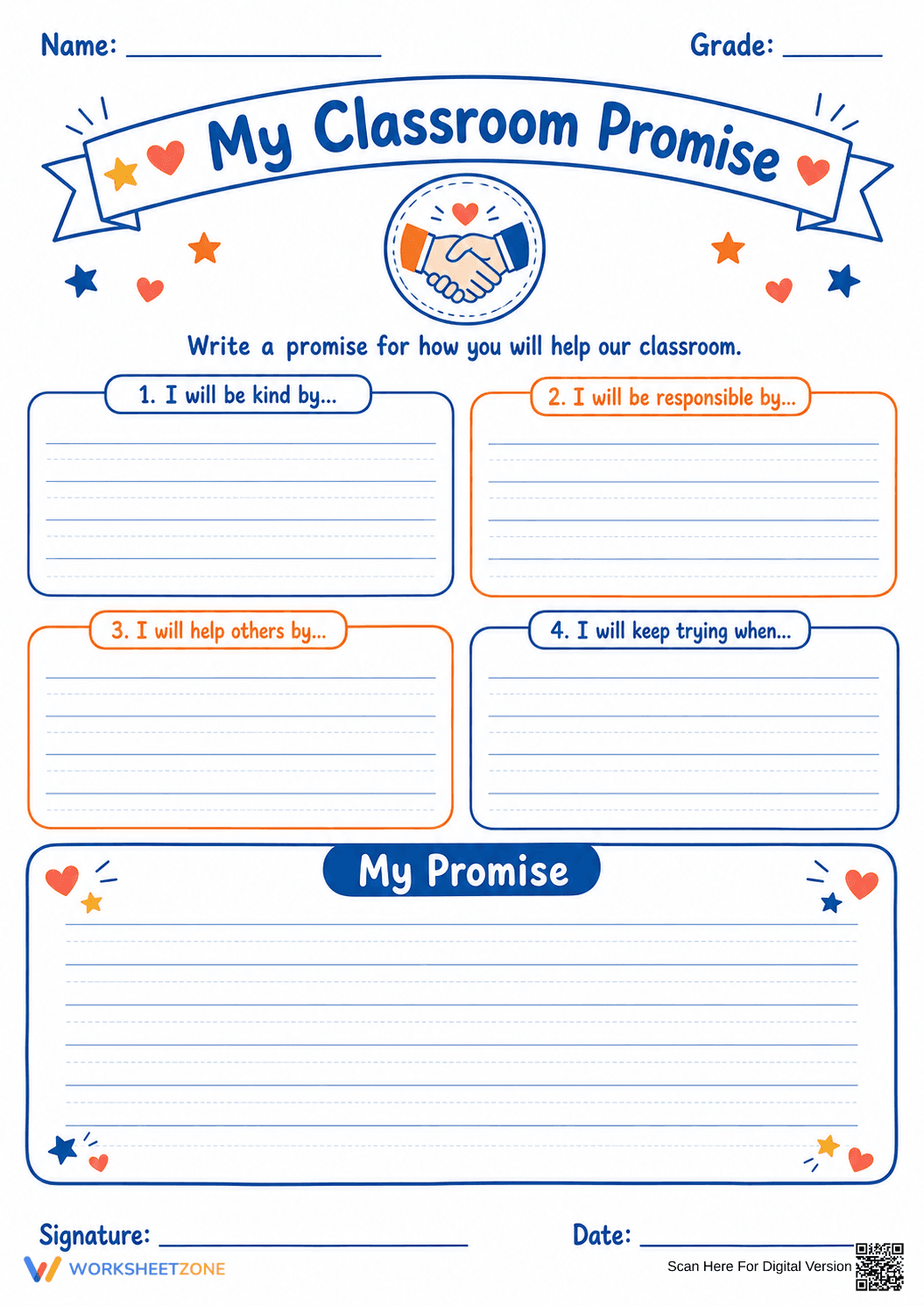

My Classroom Promise Worksheet | Essential Grade 3 Writing
Paste this activity's link or code into your existing LMS (Google Classroom, Canvas, Teams, Schoology, Moodle, etc.).
Students can open and work on the activity right away, with no student login required.
You'll still be able to track student progress and results from your teacher account.
This Grade 3 reflective writing worksheet helps students establish personal accountability and community goals. By brainstorming specific actions for kindness and responsibility, learners create a formal commitment to their classroom environment. It provides a structured framework for students to articulate their role in a positive learning culture before drafting a final promise.
At a Glance
- Grade: 3 · Subject: Writing
- Standard:
CCSS.ELA-LITERACY.W.3.4— Produce writing where the development and organization are appropriate to the task- Skill Focus: Reflective Writing & Goal Setting
- Format: 1 page · 5 tasks · No answer key needed · PDF
- Best For: Back-to-school community building and SEL
- Time: 20–30 minutes
This single-page PDF features four guided planning boxes with sentence starters to scaffold student thinking. It includes a large, primary-ruled writing area for a final synthesis of their ideas. The design uses clear, child-friendly fonts and a handshake icon to emphasize the promise theme, complete with signature and date lines for formal student buy-in.
Zero-Prep Workflow
This resource is designed for immediate classroom implementation. First, print the single-page PDF for your entire class (1 minute). Next, distribute the sheets and discuss the meaning of a promise in a community context (5 minutes). Finally, students complete the four planning prompts and their final draft independently, allowing you to circulate and provide feedback (20 minutes). It is an ideal sub-plan or first-week activity.
Standards Alignment
This worksheet aligns with `CCSS.ELA-LITERACY.W.3.4`, which requires students to produce writing where the development and organization are appropriate to the task and purpose. By using the four planning boxes to organize thoughts before the final My Promise section, students practice logical progression. This standard code can be copied directly into lesson plans, IEP goals, or district curriculum mapping tools.
How to Use It
Use this during the first week of school to establish behavioral expectations through a student-centered lens. It serves as a formative assessment to gauge handwriting skills and sentence structure early in the year. Expect students to spend 25 minutes total; the planning boxes prevent writer's block by breaking the task into manageable segments.
Who It's For
This is designed for general education students in Grades 2–5, with scaffolds that support English Language Learners and students with IEPs. It pairs naturally with a classroom read-aloud about community or a direct instruction lesson on social-emotional learning and goal setting.
According to Fisher & Frey (2014), providing students with structured scaffolds like sentence frames and planning organizers is critical for developing writing stamina and clarity. This My Classroom Promise worksheet utilizes these evidence-based strategies to help Grade 3 students meet the demands of CCSS.ELA-LITERACY.W.3.4. By breaking the reflective writing process into four distinct prompts—kindness, responsibility, helping others, and perseverance—the resource ensures that students produce organized, task-appropriate content. Research from the NAEP indicates that students who engage in regular reflective writing tasks demonstrate higher levels of engagement and better mastery of expressive language. This worksheet provides a concrete artifact for student portfolios, allowing educators to track growth in both social-emotional awareness and writing proficiency throughout the academic year. It is a practical tool for fostering a positive classroom culture while meeting rigorous literacy standards.


