


























Views
Downloads

Essential Metaphors Worksheet | Grade 4 ELA Practice
Paste this activity's link or code into your existing LMS (Google Classroom, Canvas, Teams, Schoology, Moodle, etc.).
Students can open and work on the activity right away, with no student login required.
You'll still be able to track student progress and results from your teacher account.
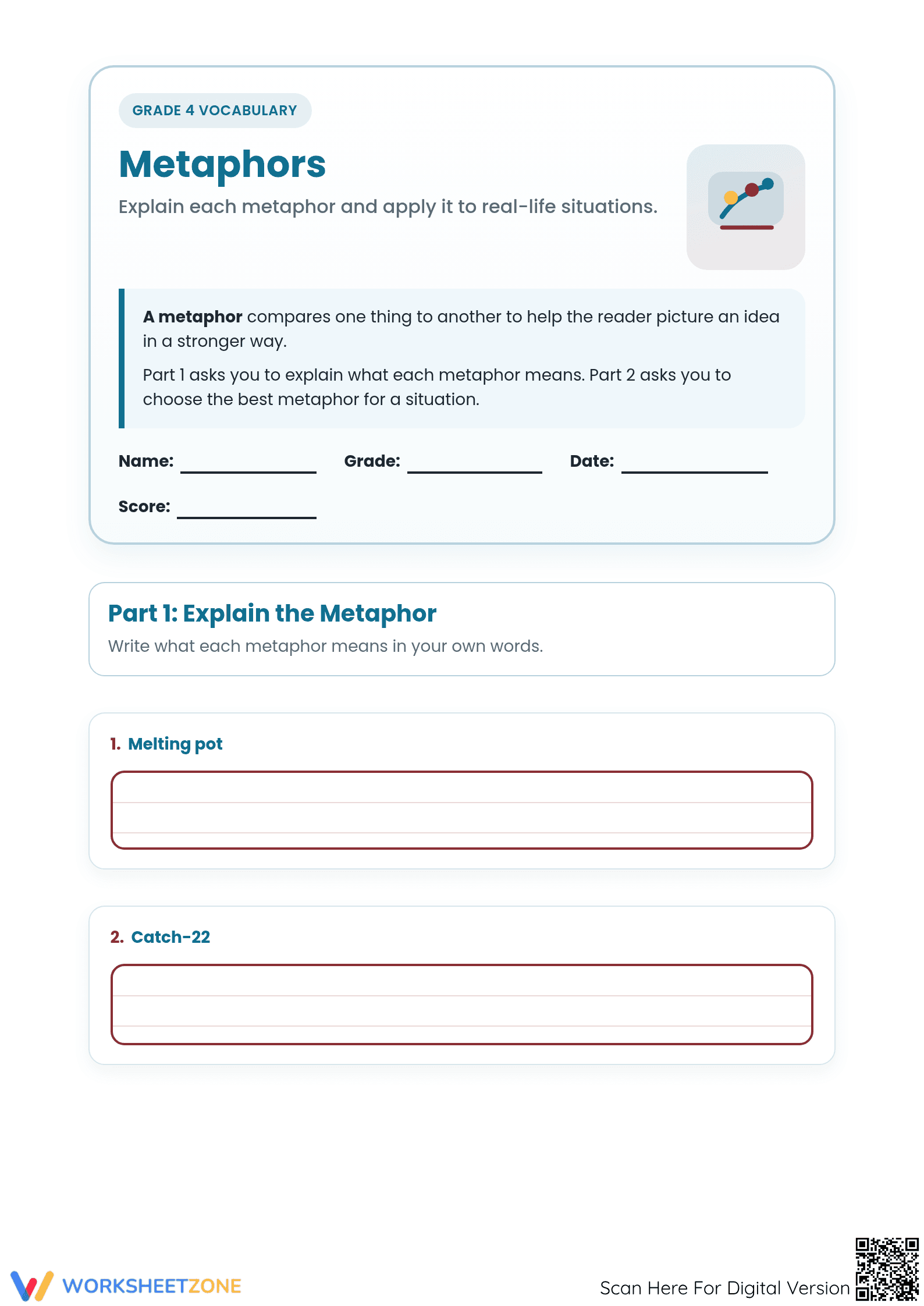
This Grade 4 worksheet focuses on the critical ELA skill of identifying and explaining metaphors. Students will move beyond literal meanings to understand how figurative language creates vivid imagery. By explaining common metaphors and applying them to specific scenarios, learners develop the deep linguistic comprehension required for advanced reading and writing mastery in upper elementary grades.
At a Glance
- Grade: 4 · Subject: ELA
- Standard:
CCSS.ELA-LITERACY.L.4.5.A— Explain the meaning of simple similes and metaphors in context- Skill Focus: Figurative Language: Metaphors
- Format: 3 pages · 10 problems · Answer key included · PDF
- Best For: Vocabulary building and reading comprehension practice
- Time: 20–30 minutes
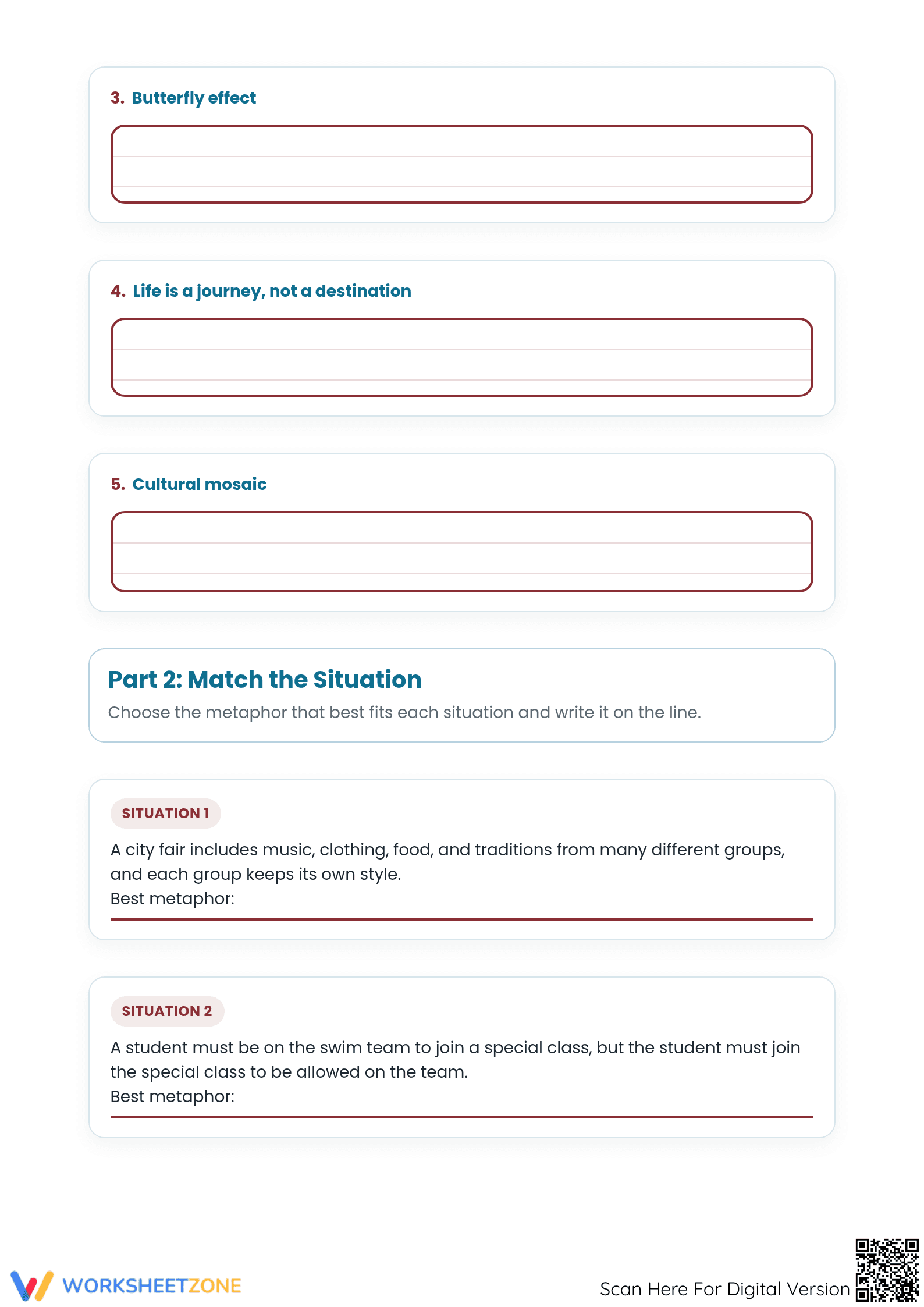
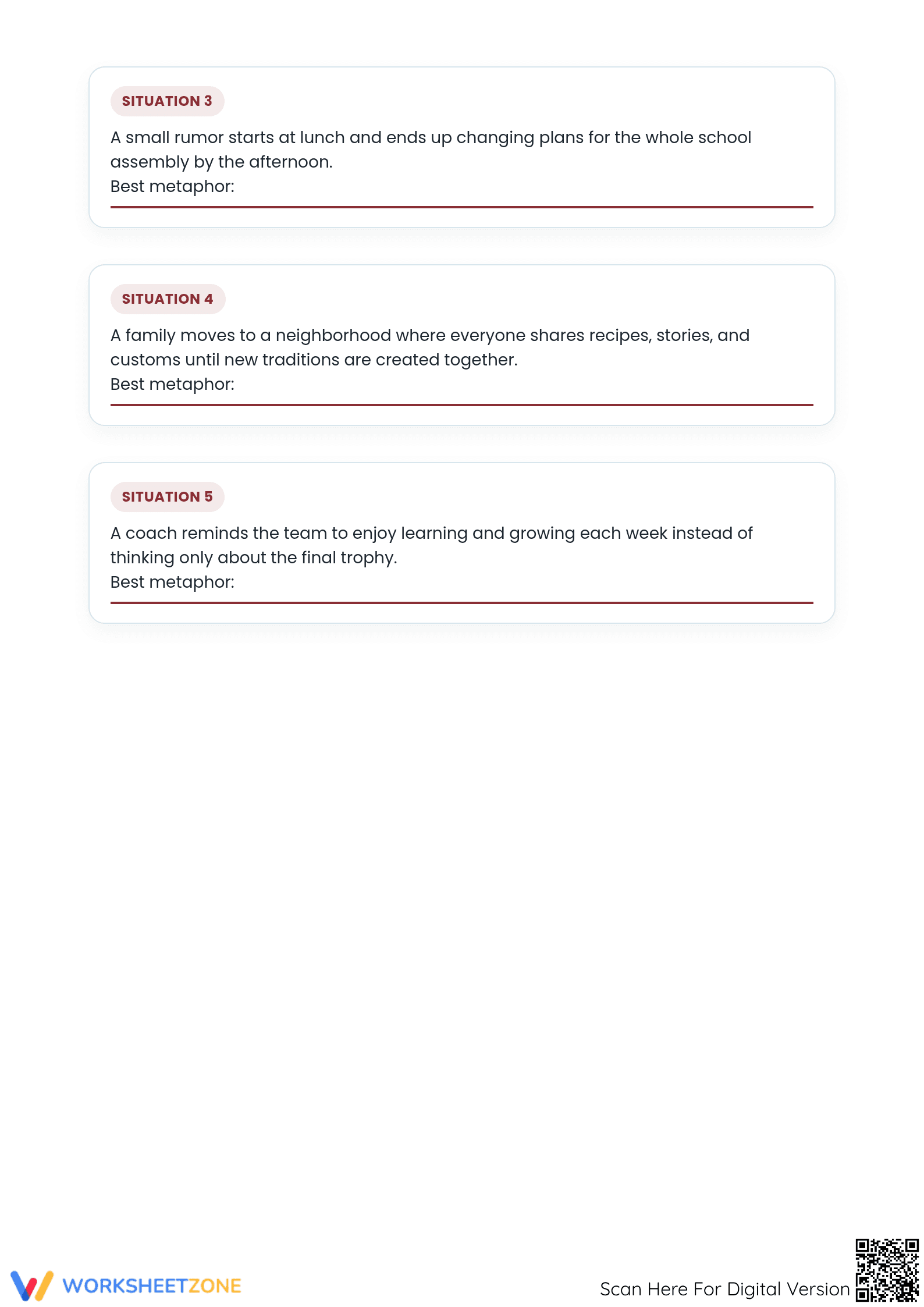
The package contains three high-quality PDF pages designed for clarity and student engagement. Part 1 features five high-frequency metaphors, including "Melting pot" and "Catch-22," with dedicated writing space for personal definitions. Part 2 presents five narrative situations where students must select the most appropriate metaphor to describe the scenario. A full answer key is provided for efficient grading and immediate student feedback.
Skill Progression
- Guided practice: The introductory section defines metaphors as comparative tools, providing a mental framework before students begin the five generative tasks in Part 1.
- Supported practice: The transition to Part 2 provides contextualized situations that scaffold the application of the metaphors studied in the first section.
- Independent practice: Five final matching tasks require students to synthesize their understanding by identifying the abstract concept within a concrete story.
This sequence ensures students move from recognition to application using a standard instructional release model.
Standards Alignment
The primary focus is CCSS.ELA-LITERACY.L.4.5.A, which requires students to "Explain the meaning of simple similes and metaphors in context." By requiring both written explanations and situational application, this resource ensures students meet the standard's rigorous demand for linguistic comprehension. Both standard codes can be copied directly into lesson plans, IEP goals, or district curriculum mapping tools.
How to Use It
Use this resource as a mid-lesson check for understanding during a unit on figurative language. It serves as an excellent formative assessment tool; teachers should observe if students can articulate the hidden comparison in the matching section. Expect completion within 25 minutes, making it ideal for independent desk work or a literacy center rotation following direct instruction on idioms and metaphors.
Who It's For
This resource is tailored for fourth-grade students but provides valuable review for fifth graders or enrichment for advanced third graders. It is particularly effective for English Language Learners (ELL) who need structured practice with non-literal English. Pair this worksheet with a literary passage or a figurative language anchor chart to provide students with a visual reference during the writing tasks.
Effective instruction in figurative language, such as metaphors, is essential for transitioning students from literal to inferential reading. According to the RAND AIRS 2024 report, students who receive explicit practice with word relationships and nuances demonstrate significantly higher scores on standardized reading assessments. This worksheet aligns with the CCSS.ELA-LITERACY.L.4.5.A standard, focusing on the plain-English skill of explaining how one thing is described by comparing it to another. By engaging in both generative writing (Part 1) and evaluative matching (Part 2), students build the schema necessary to decode complex texts. Research from Fisher & Frey (2014) emphasizes that contextualized word study is more effective than rote memorization. This three-page resource provides exactly that, offering ten distinct opportunities for students to master metaphors in a structured, classroom-ready format. It is a vital addition to any Grade 4 ELA curriculum focused on literacy excellence and vocabulary depth.


