


























Views
Downloads

Printable Rhyming Words Worksheet | Kindergarten ELA
Paste this activity's link or code into your existing LMS (Google Classroom, Canvas, Teams, Schoology, Moodle, etc.).
Students can open and work on the activity right away, with no student login required.
You'll still be able to track student progress and results from your teacher account.
This foundational phonics worksheet helps early readers recognize and match rhyming words, a critical step in developing strong phonological awareness. By identifying words with matching ending sounds across multiple activities, students build the auditory discrimination skills necessary for future reading fluency and spelling success.
At a Glance
- Grade: Kindergarten · Subject: ELA
- Standard:
CCSS.ELA-LITERACY.RF.K.2.A— Recognize and produce rhyming words- Skill Focus: Rhyming and Phonological Awareness
- Format: 3 pages · 15 problems · Answer key included · PDF
- Best For: Independent practice and literacy centers
- Time: 15–20 minutes
This comprehensive resource includes three distinct pages of rhyming practice, totaling 15 interactive problems. Students will complete two word-matching activities where they draw lines to connect rhyming pairs, followed by a multiple-choice rhyme challenge. The clean, distraction-free layout features clear, decodable text, making it accessible for early readers. A complete answer key is provided for quick grading or self-checking.
The activities follow a clear gradual-release progression to build student confidence:
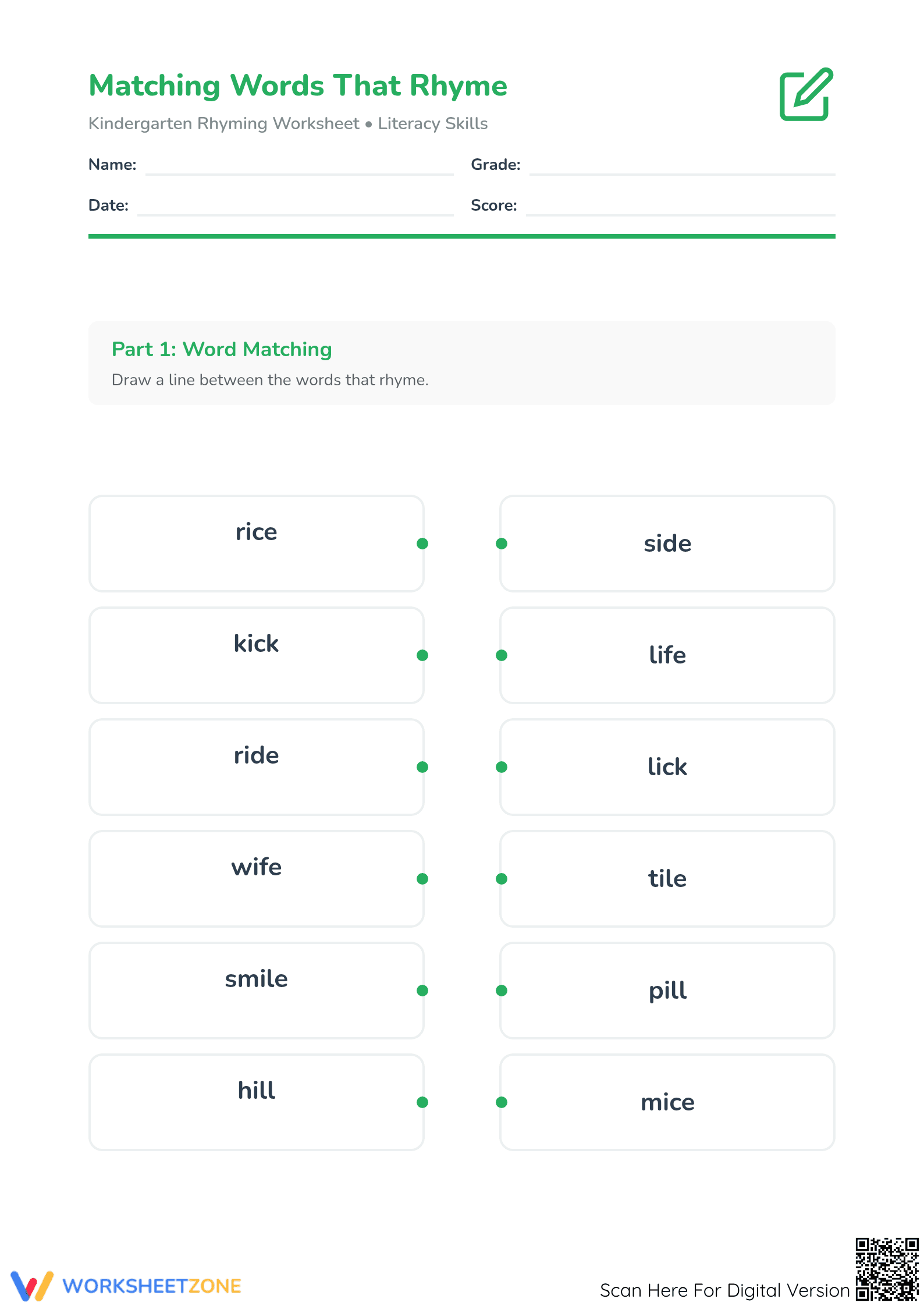
- Guided practice: Part 1 introduces word matching with six pairs of simple, familiar words (e.g., rice/mice, kick/lick), allowing students to visually and auditorily connect ending sounds.
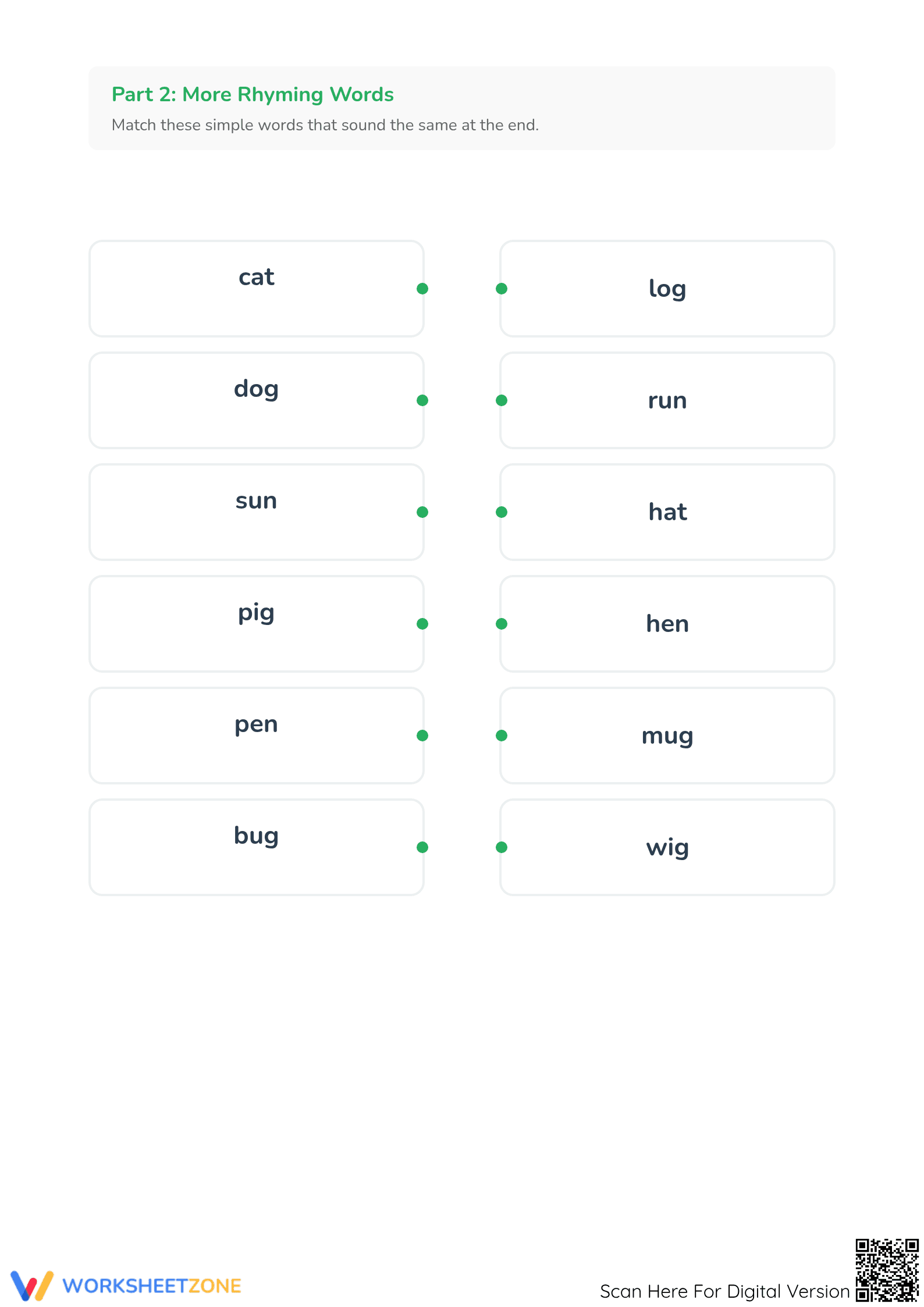
- Supported practice: Part 2 reinforces the skill with six additional CVC (consonant-vowel-consonant) word pairs like cat/hat and bug/mug, solidifying their understanding of rhyme families.
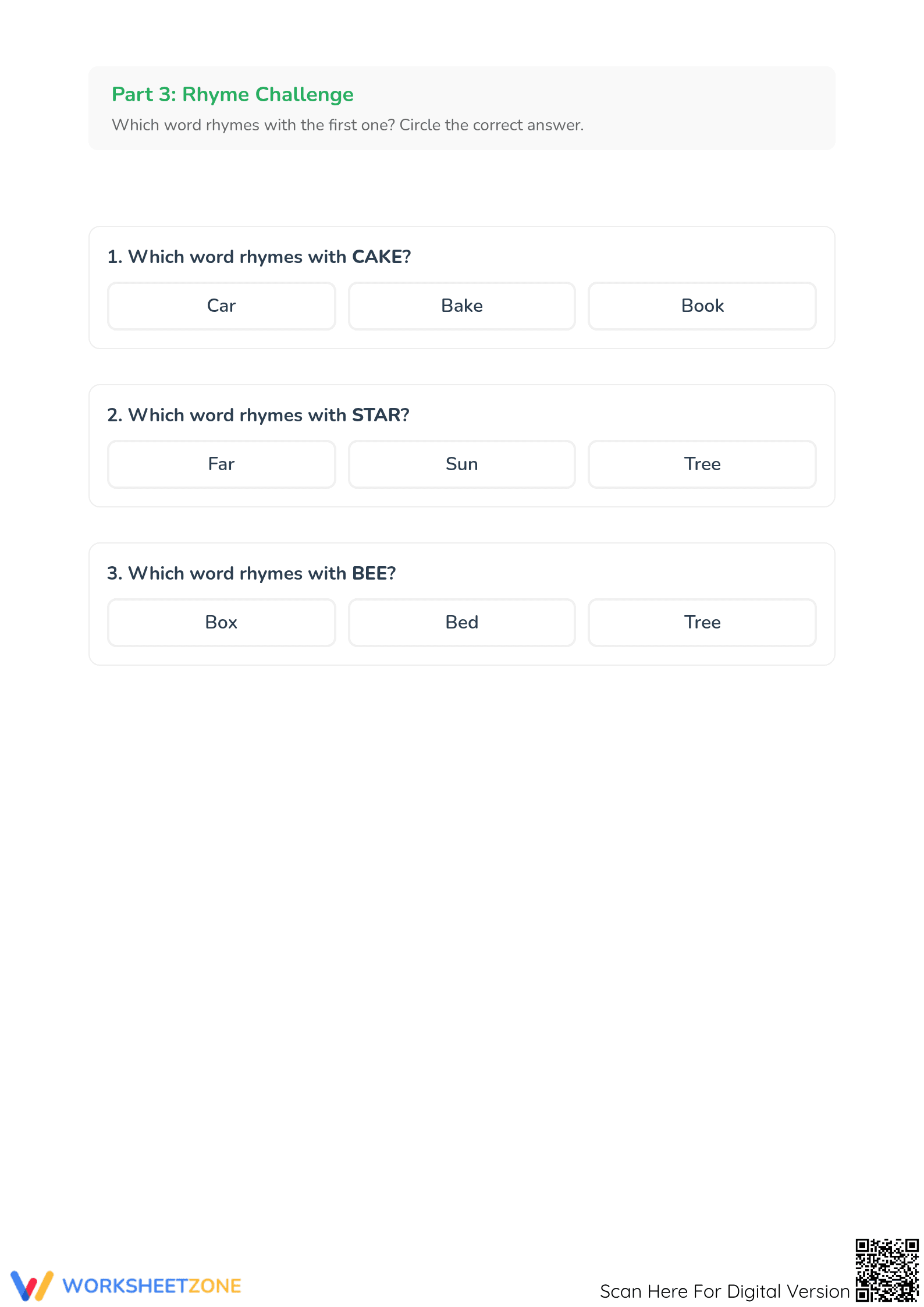
- Independent practice: Part 3 presents a "Rhyme Challenge" where students must independently evaluate three options and circle the correct rhyming match for a target word.
This structured I Do, We Do, You Do approach ensures mastery of basic phonemic patterns.
This worksheet is directly aligned to primary standard CCSS.ELA-LITERACY.RF.K.2.A: Recognize and produce rhyming words. It also supports early decoding skills by exposing students to common word families and spelling patterns. Both standard codes can be copied directly into lesson plans, IEP goals, or district curriculum mapping tools.
Teachers can utilize this worksheet during morning work or as a focused literacy center activity after direct instruction on rhyming. For a formative assessment observation tip, listen to students as they complete the matching sections; encourage them to read the words aloud to ensure they are hearing the rhymes rather than just guessing. The entire three-page packet typically takes 15 to 20 minutes to complete.
This resource is designed for Kindergarten and early first-grade students developing their phonological awareness. It serves as an excellent intervention tool for older students who need foundational phonics reinforcement. For optimal results, pair this worksheet with a read-aloud of a rhyming picture book or a classroom anchor chart displaying common word families.
Mastering phonological awareness is a critical predictor of later reading achievement. Standard CCSS.ELA-LITERACY.RF.K.2.A requires students to recognize and produce rhyming words, a skill that trains the brain to categorize sounds and identify phonetic patterns. According to a comprehensive EdReports 2024 analysis of early literacy curricula, explicit and systematic practice with rhyming and phonemic manipulation significantly improves decoding fluency in early elementary students. When children actively engage in matching rhyming pairs, they strengthen their auditory processing capabilities, which directly translates to more accurate spelling and reading comprehension. This targeted practice ensures that young learners build the essential cognitive pathways required to transition from emergent to fluent readers, establishing a robust foundation for all future literacy development and academic success across subjects.


