


























Views
Plays



Magnets Work Comprehension | Essential Grade 3 Science
Paste this activity's link or code into your existing LMS (Google Classroom, Canvas, Teams, Schoology, Moodle, etc.).
Students can open and work on the activity right away, with no student login required.
You'll still be able to track student progress and results from your teacher account.
This Grade 3 science and reading worksheet helps students master informational text comprehension through the study of magnetism. By engaging with the "Magnets Work" expository text, learners identify key details, define domain-specific vocabulary like "repel," and determine the author's purpose. It provides a clear path for students to demonstrate their understanding of physical science concepts.
At a Glance
- Grade: 3 · Subject: Science & ELA
- Standard:
CCSS.ELA-LITERACY.RI.3.1— Ask and answer questions to demonstrate understanding of a text- Skill Focus: Expository text comprehension
- Format: 4 pages · 10 problems · Answer key included · PDF
- Best For: Quick formative assessment or sub plans
- Time: 15–20 minutes
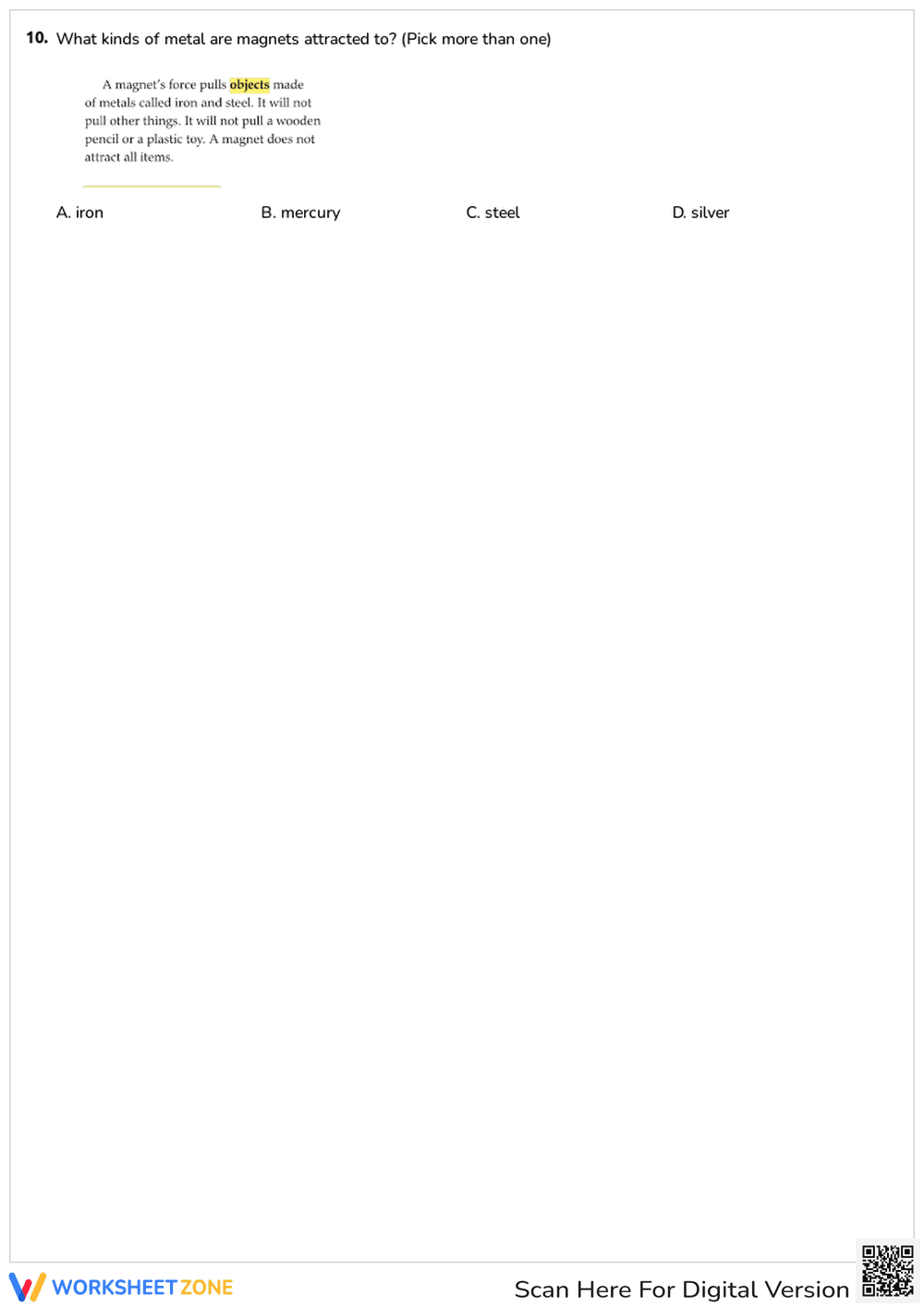
The resource contains a 4-page structured quiz featuring 10 multiple-choice and true/false questions. Each question is paired with a specific excerpt or visual aid from the "Magnets Work" text, including diagrams of magnetic poles and train technology. The layout includes clear headings, highlighted vocabulary terms, and a full answer key for rapid grading.
Teachers can implement this resource in under 2 minutes. First, print the 4-page PDF for each student. Second, distribute the sheets as a silent reading activity or a guided "Shared Read" assessment. Finally, use the included answer key to review student responses immediately. This streamlined workflow makes it an ideal choice for emergency sub plans or end-of-unit science checks.
This worksheet is primarily aligned with CCSS.ELA-LITERACY.RI.3.1, which requires students to ask and answer questions to demonstrate understanding of a text, referring explicitly to the text as the basis for the answers. It also supports NGSS 3-PS2-3 by exploring the nature of magnetic interactions. Both standard codes can be copied directly into lesson plans, IEP goals, or district curriculum mapping tools.
Assign this worksheet during the "independent practice" phase of a literacy block after a whole-class reading of an informational text. It also serves as an effective formative assessment tool to gauge student grasp of magnetic forces before moving into hands-on lab experiments. Expect students to complete the 10-question set within 15 to 20 minutes.
This resource is designed for Grade 3 students but is highly appropriate for Grade 2 enrichment or Grade 4 review. It supports English Language Learners through the use of visual diagrams and highlighted text evidence. Pair this worksheet with a physical magnet exploration station or an anchor chart detailing the properties of North and South poles.
Research from Fisher & Frey (2014) emphasizes that close reading of complex informational texts is essential for developing disciplinary literacy in science. This worksheet facilitates that process by requiring students to return to the text to verify facts about magnetic force and material attraction. By aligning with CCSS.ELA-LITERACY.RI.3.1, the 10-task assessment ensures students move beyond surface-level reading to achieve deep comprehension of expository structures. The inclusion of visual evidence, such as the magnetic pole diagrams, mirrors the multi-modal learning strategies recommended by the NAEP for improving science literacy scores. Educators can utilize this data-driven approach to identify specific gaps in student understanding of physical science concepts while simultaneously reinforcing critical reading skills necessary for academic success across the curriculum.


