


























Views
Downloads
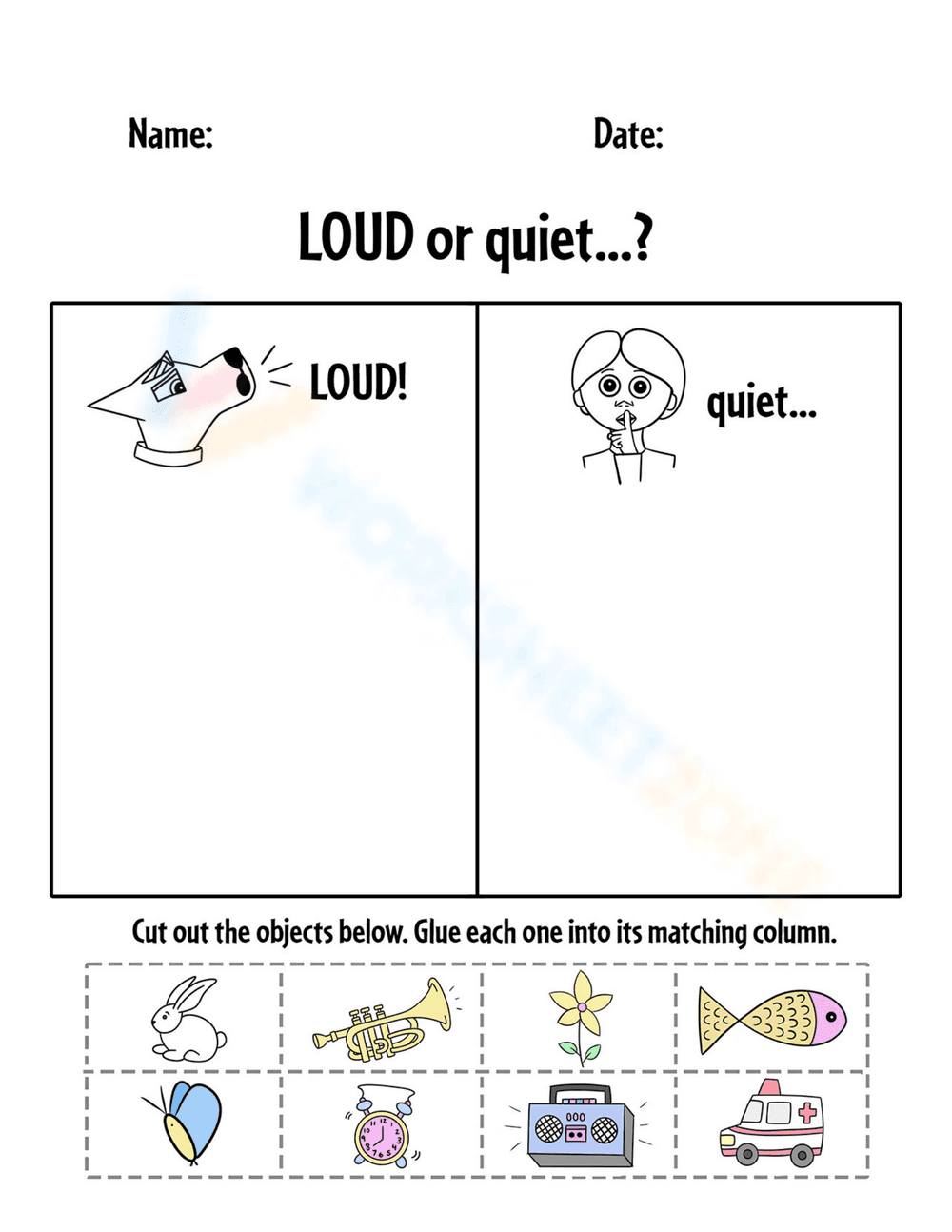

Loud or Quiet Sorting Worksheet | Grade 1 Printable
Paste this activity's link or code into your existing LMS (Google Classroom, Canvas, Teams, Schoology, Moodle, etc.).
Students can open and work on the activity right away, with no student login required.
You'll still be able to track student progress and results from your teacher account.
This Grade 1 science worksheet helps students identify and classify loud and quiet sounds through a hands-on sorting activity. By evaluating everyday objects and the noises they produce, young learners build foundational physical science skills. The cut-and-paste format keeps students engaged while reinforcing their understanding of sound properties.
At a Glance
- Grade: 1 · Subject: Science
- Standard:
1-PS4-1— Identify and categorize sounds based on volume- Skill Focus: Sound Classification
- Format: 1 page · 8 problems · Answer key included · PDF
- Best For: Independent practice or centers
- Time: 10–15 minutes
This single-page resource features a two-column sorting chart labeled for loud and quiet sounds. At the bottom, students find eight picture cards representing objects and animals like a trumpet, butterfly, ambulance, and flower. Students cut out these eight images and glue them into the correct column based on their typical volume. An answer key is provided for quick grading.
Zero-Prep Workflow
- Print (1 minute): Print the single-page PDF. No special materials are required beyond scissors and glue.
- Distribute (1 minute): Hand out the worksheets to students during your science block or place them in a designated science center.
- Review (3 minutes): Use the provided answer key to quickly check student work or project it on the board for a whole-class self-check.
With a total teacher prep time of under two minutes, this activity is highly suitable for emergency sub plans or last-minute schedule changes.
Standards Alignment
This activity aligns with 1-PS4-1, asking students to provide evidence that vibrating materials make sound. Categorizing sounds as loud or quiet is the first step in analyzing sound properties. Both standard codes can be copied directly into lesson plans, IEP goals, or district curriculum mapping tools.
How to Use It
Use this worksheet during independent practice in a science unit on sound. It works exceptionally well after a direct instruction lesson where the teacher demonstrates loud and soft sounds using classroom instruments. As a formative assessment observation tip, watch how students categorize the rabbit or fish; this provides an opportunity to discuss how some things make very little sound rather than no sound at all. Expected completion time ranges from 10 to 15 minutes, depending on the student's cutting and pasting speed.
Who It's For
Designed for first-grade students, this resource also serves as an excellent review for second graders. The visual cues make it accessible for English Language Learners and students needing modified assignments. Pair this sorting activity with a read-aloud book about the five senses or an anchor chart detailing energy types.
Understanding basic physical science concepts, such as sound volume, requires active cognitive engagement and categorization skills. According to a recent ScienceDirect TpT Analysis, early elementary students demonstrate higher retention of abstract concepts like energy and sound when they participate in tactile, visually supported sorting tasks. This worksheet directly supports 1-PS4-1 by having students identify and categorize sounds based on volume. When young learners physically manipulate picture cards—moving a trumpet to the loud column and a flower to the quiet column—they bridge the gap between theoretical science concepts and real-world application. This hands-on approach reduces cognitive load while reinforcing critical thinking. By integrating motor skills with scientific classification, educators can foster a deeper, more intuitive grasp of foundational physics principles that will support students throughout their academic careers.


