


























Views
Downloads
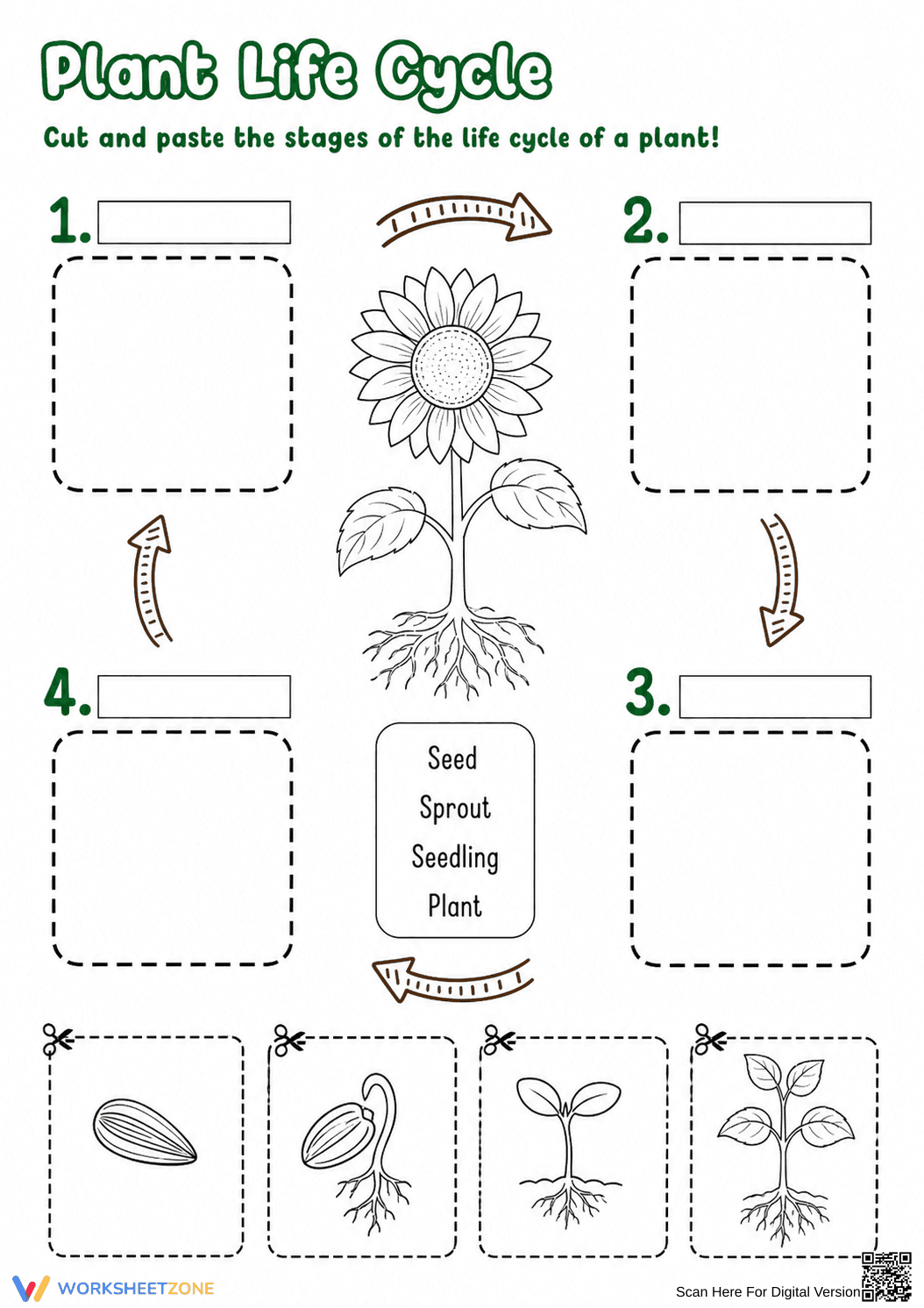

Grade 1 Plant Life Cycle — Printable No-Prep Worksheet
Paste this activity's link or code into your existing LMS (Google Classroom, Canvas, Teams, Schoology, Moodle, etc.).
Students can open and work on the activity right away, with no student login required.
You'll still be able to track student progress and results from your teacher account.
This hands-on science worksheet helps young learners master the plant life cycle by actively sequencing the stages of growth. Students will cut, paste, and label four distinct phases—from a simple seed to a fully mature plant—building both foundational biology knowledge and essential fine motor skills in one engaging activity.
At a Glance
- Grade: 1 · Subject: Science
- Standard:
K-LS1-1— Describe patterns of plant growth and survival- Skill Focus: Sequencing the plant life cycle
- Format: 1 page · 4 problems · Answer key included · PDF
- Best For: Independent practice and science centers
- Time: 15–20 minutes
This single-page resource features a clear layout designed for early elementary students. It includes a central illustration of a sunflower, four numbered sequencing boxes with directional arrows, and a helpful word bank. At the bottom, students will find four dashed cut-out boxes containing illustrations of each developmental stage, ready to be sorted into chronological order.
Zero-Prep Workflow
This resource minimizes teacher preparation. Follow these three steps:
- Print (1 minute): Print the single-page PDF. No special materials needed beyond scissors and glue.
- Distribute (1 minute): Hand out the worksheets. Visual instructions make the task immediately clear.
- Review (3 minutes): Use the included answer key to verify sequences or project it for self-correction.
With under two minutes of prep time, this activity is an excellent, stress-free option for busy afternoons or substitute plans.
Standards Alignment
This activity aligns with the Next Generation Science Standards, specifically focusing on K-LS1-1: Use observations to describe patterns of what plants and animals (including humans) need to survive. By sequencing the growth stages, students observe the pattern of development inherent in all living things. It also supports early sequencing and chronological thinking skills. Both standard codes can be copied directly into lesson plans, IEP goals, or district curriculum mapping tools.
How to Use It
Use this worksheet directly after a whole-class read-aloud about seeds, or place it in an independent science center. As a formative assessment tip, observe students while they sort the images before gluing; this allows you to quickly check for understanding and correct misconceptions about the sprout and seedling stages. Expected completion time is 15 to 20 minutes.
Who It's For
Designed for Kindergarten and first-grade students learning basic biological concepts. The visual cues and hands-on manipulation provide built-in differentiation supporting visual and kinesthetic learners. It pairs wonderfully with a classroom seed-planting activity or an anchor chart detailing plant parts.
Integrating hands-on manipulation with core science concepts significantly enhances early childhood learning outcomes. This worksheet targets the foundational skills outlined in K-LS1-1, requiring students to describe patterns of plant growth and survival through active sequencing. According to a comprehensive ScienceDirect TpT Analysis, instructional materials that combine physical tasks—such as cutting and pasting—with cognitive sorting exercises lead to higher retention rates of domain-specific vocabulary in early elementary cohorts. By physically moving the stages from seed to mature plant, young learners construct a more robust mental model of biological cycles than they would through passive observation alone. This multimodal approach ensures that abstract scientific patterns become concrete, observable facts, laying the groundwork for more advanced life science investigations in subsequent grade levels. Teachers can rely on this evidence-based format to deliver rigorous, developmentally appropriate science instruction.


