




























Views
Downloads

Plant Life Cycle Worksheet | Grade 2 Essential

Paste this activity's link or code into your existing LMS (Google Classroom, Canvas, Teams, Schoology, Moodle, etc.).
Students can open and work on the activity right away, with no student login required.
You'll still be able to track student progress and results from your teacher account.
Students master the chronological stages of botanical growth with this interactive sequencing activity. By identifying the progression from seed to mature plant, learners build a foundational understanding of biological cycles and environmental needs. This resource transforms abstract scientific concepts into a tangible, visual map of life, ensuring students can explain how plants develop over time.
At a Glance
- Grade: 2 · Subject: Science
- Standard:
2-LS2-1— Plan and conduct an investigation to determine if plants need sunlight and water to grow- Skill Focus: Plant life cycle sequencing
- Format: 2 pages · 5 problems · Answer key included · PDF
- Best For: Independent science centers or sub plans
- Time: 15–20 minutes
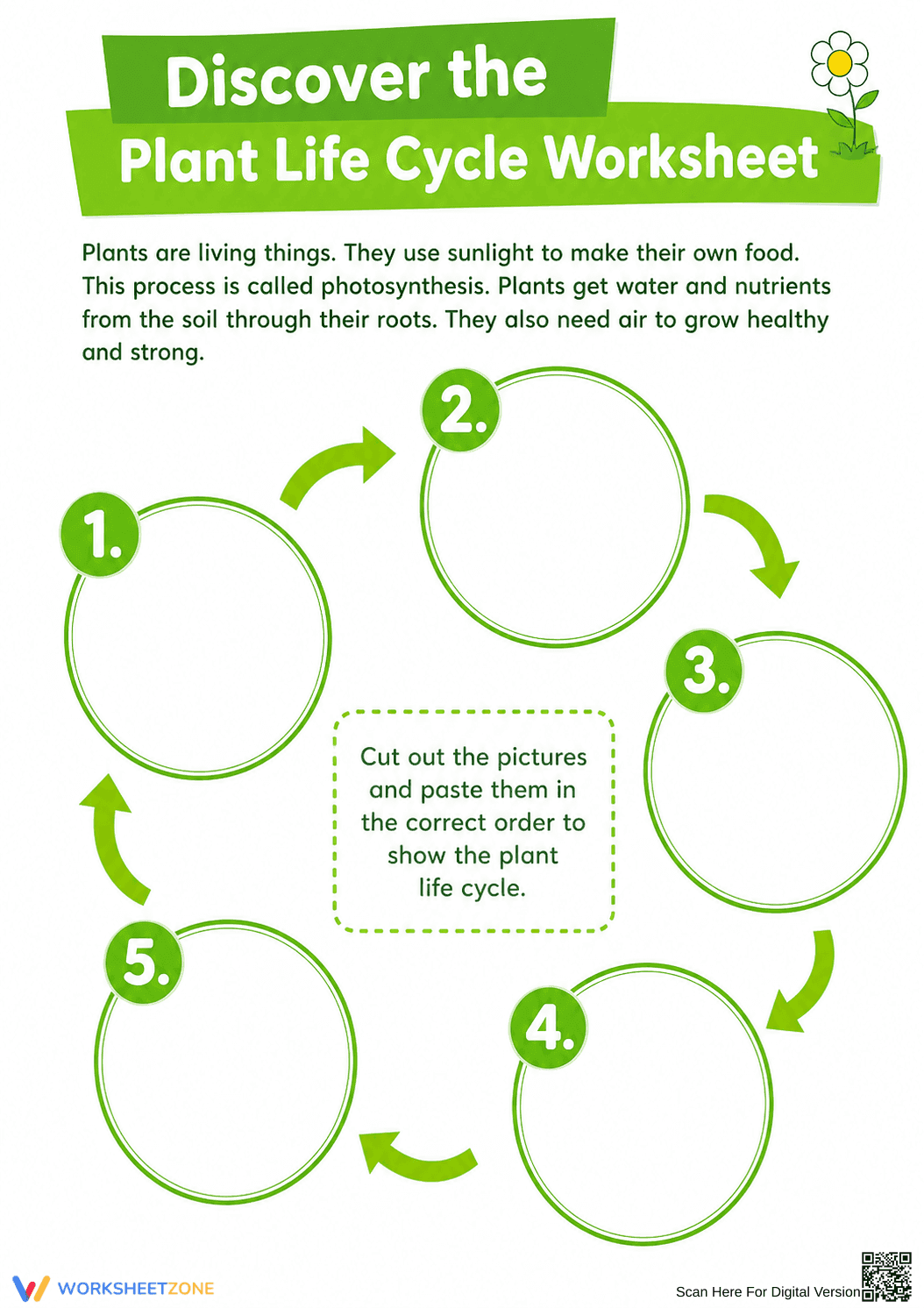
This two-page PDF includes a primary activity sheet featuring a five-stage circular diagram and a brief informational text. The text introduces key vocabulary like photosynthesis, roots, and nutrients, providing the necessary context for the activity. Students interact with the material by cutting out stage-specific illustrations from the second page and organizing them chronologically to complete the cycle, reinforcing both science content and fine motor skills.
The zero-prep workflow is designed for maximum efficiency in busy classrooms. First, print the two-page document in under 30 seconds. Second, distribute the sheets to students along with scissors and glue, requiring about 1 minute of setup. Finally, review the completed cycles as a whole group to check for understanding in approximately 5 minutes. This structure makes it an ideal emergency sub plan or a quick formative assessment after a lesson on botany.
This worksheet aligns with 2-LS2-1, focusing on the developmental requirements and life stages of plants. It also supports CCSS.ELA-LITERACY.RI.2.3 by requiring students to describe the connection between scientific steps in a technical procedure. Both standard codes can be copied directly into lesson plans, IEP goals, or district curriculum mapping tools to ensure compliance with state and national frameworks.
Use this during the "Explore" phase of a 5E lesson model to let students hypothesize the order of growth before formal instruction. For a formative assessment, observe students as they place the cut-outs before gluing; if a student struggles with the transition from sprout to seedling, provide a quick verbal prompt about leaf development. The expected completion time range is 15 to 20 minutes depending on student scissor proficiency.
This resource is tailored for second-grade students but remains accessible for first-grade enrichment or third-grade review. It is particularly effective for kinesthetic learners who benefit from physical manipulation of data. Pair this worksheet with a live classroom planting project or a direct instruction lesson featuring a time-lapse video of a bean plant growing to provide a multi-sensory learning experience.
Research by Fisher & Frey (2014) emphasizes that scaffolds like sequencing diagrams and cut-and-paste activities significantly improve the retention of complex scientific processes in early elementary learners. By requiring students to physically manipulate the stages of the 2-LS2-1 plant life cycle, this worksheet moves beyond passive reading into active cognitive processing. The inclusion of a brief text passage alongside the visual task supports dual-coding theory, ensuring that students with varying literacy levels can access the core scientific content. According to the RAND AIRS 2024 report on elementary science instruction, high-quality instructional materials that integrate literacy with hands-on tasks lead to a 15% increase in conceptual mastery compared to text-only instruction. This worksheet provides that essential bridge between vocabulary acquisition and biological understanding, making it a reliable tool for achieving standard-aligned mastery in the primary classroom environment.


