


























Views
Downloads
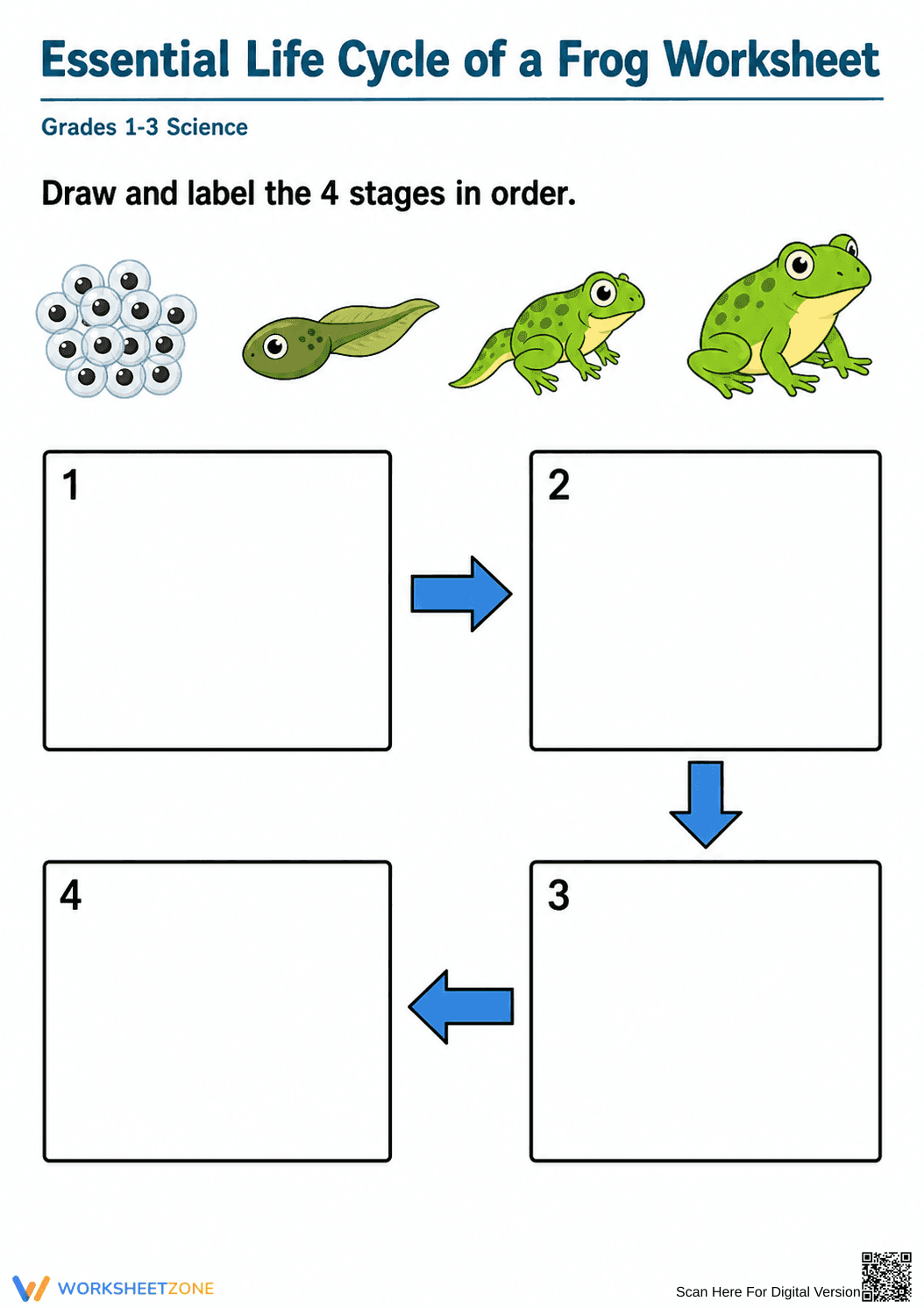

Grade 1-3 Frog Life Cycle — Printable No-Prep Worksheet
Paste this activity's link or code into your existing LMS (Google Classroom, Canvas, Teams, Schoology, Moodle, etc.).
Students can open and work on the activity right away, with no student login required.
You'll still be able to track student progress and results from your teacher account.
Students master the biological progression of amphibians with this focused frog life cycle worksheet. By sequencing the four distinct stages of development, learners demonstrate their understanding of growth and change in living organisms. This activity provides a structured framework for students to visualize and document metamorphosis in a clear, logical order.
At a Glance
- Grade: 1-3 · Subject: Science
- Standard:
3-LS1-1— Develop models to describe organism life cycles- Skill Focus: Sequencing metamorphosis stages
- Format: 1 page · 4 tasks · Answer key included · PDF
- Best For: Independent science center or quick assessment
- Time: 15–20 minutes
This comprehensive science resource features a single-page layout designed for immediate classroom use. The worksheet includes clear illustrations of the four frog life cycle stages—eggs, tadpole, froglet, and adult frog—along with four numbered sequencing boxes. Students are tasked with drawing and labeling each stage in the correct chronological order, supported by directional arrows that reinforce the cyclical nature of biological development. A full answer key is provided for efficient grading.
Zero-Prep Workflow
The zero-prep design allows teachers to implement this lesson in under two minutes. First, print the single-page PDF (30 seconds). Second, distribute the worksheets to students during your living things unit (30 seconds). Third, review the completed drawings and labels using the included key (1 minute). This streamlined workflow makes the resource an ideal solution for emergency sub plans or last-minute science enrichment.
Standards Alignment
This resource is primarily aligned to 3-LS1-1: Develop models to describe that organisms have unique and diverse life cycles but all have in common birth, growth, reproduction, and death. By creating a visual model of the frog's life cycle, students engage directly with the crosscutting concept of patterns and systems. Both standard codes can be copied directly into lesson plans, IEP goals, or district curriculum mapping tools.
How to Use It
Use this worksheet as a summative assessment after a lesson on amphibians or as a morning activity to activate prior knowledge before a laboratory observation of tadpoles. For a formative assessment tip, observe students as they label the froglet stage; this specific transition often reveals whether students understand the intermediate steps of metamorphosis. Expected completion time is 15 to 20 minutes depending on drawing detail.
Who It's For
This resource is tailored for elementary students in grades 1 through 3, with particular utility for visual learners and English Language Learners who benefit from the clear illustrations. It pairs naturally with a classroom anchor chart showing real-life photographs of pond habitats or a read-aloud session featuring books about pond life.
According to the RAND AIRS 2024 analysis of elementary science instruction, the use of visual modeling and sequencing tasks significantly improves long-term retention of biological concepts in early childhood education. This life cycle of a frog worksheet implements these findings by requiring students to synthesize their understanding of the 3-LS1-1 standard through both drawing and labeling. By focusing on the plain-English skill of sequencing metamorphosis stages, the activity bridges the gap between passive observation and active scientific modeling. Research indicates that when students physically construct a cycle—connecting birth, growth, and maturity—they are highly likely to accurately identify similar patterns in other species. This self-contained module provides the rigorous alignment and clear instructional scaffolding necessary for effective science literacy, serving as a reliable tool for both general education classrooms and specialized science labs across the United States.


