


























Views
Downloads
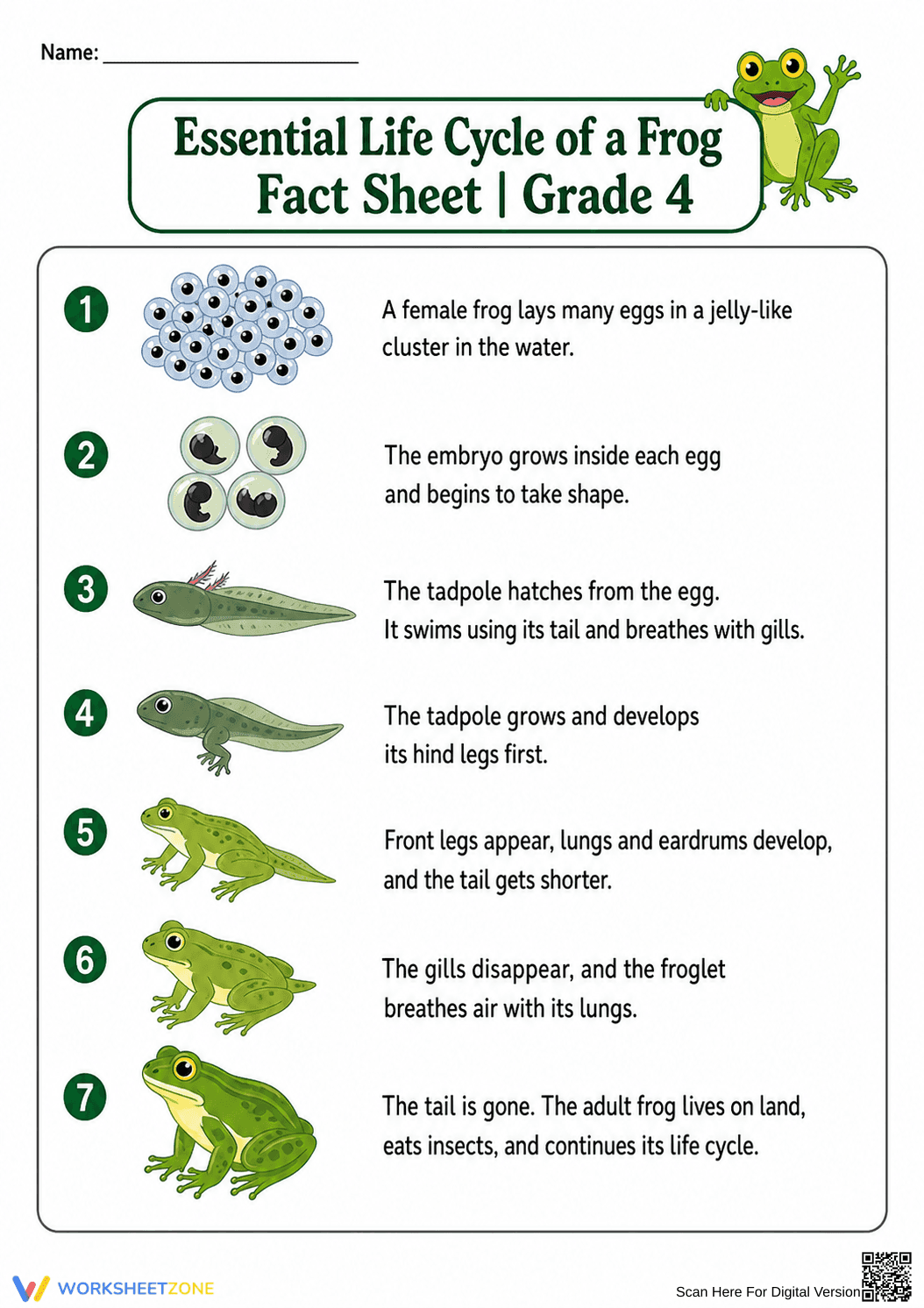

Essential Frog Life Cycle Fact Sheet | Grade 4 Ready
Paste this activity's link or code into your existing LMS (Google Classroom, Canvas, Teams, Schoology, Moodle, etc.).
Students can open and work on the activity right away, with no student login required.
You'll still be able to track student progress and results from your teacher account.
This Grade 4 science resource provides a clear look at the biological development of amphibians. By examining the life cycle of a frog, students visualize the transition from aquatic eggs to terrestrial adults. This sheet simplifies complex biological processes into seven distinct stages to ensure high student comprehension.
At a Glance
- Grade: 4 · Subject: Living Things
- Standard:
3-LS1-1— Develop models to describe that organisms have unique and diverse life cycles- Skill Focus: Amphibian biological development stages
- Format: 1 page · 7 descriptive stages · Reference sheet · PDF
- Best For: Science centers and independent reference material
- Time: 10–15 minutes
Inside this single-page reference guide, you will find high-quality illustrations paired with concise text descriptions for seven key developmental milestones. The sheet begins with egg clusters and comma-shaped embryos, moving through the tadpole and froglet stages, and concluding with the adult frog. Each section highlights specific anatomical changes such as gill disappearance and lung development.
Zero-Prep Workflow
The zero-prep design ensures you can integrate this resource into your lesson in seconds. First, print the single-page PDF (30 seconds). Second, distribute the sheet to students as a desk reference or anchor chart insert (1 minute). Third, have students review the stages independently or as a group to anchor their understanding of living things (5 minutes).
Standards Alignment
This resource is aligned to `3-LS1-1`, which requires students to develop models to describe that organisms have unique and diverse life cycles. While designated for Grade 4, it serves as a rigorous review of life science concepts and internal structures as outlined in `4-LS1-1`. Both standard codes can be copied directly into lesson plans, IEP goals, or district curriculum mapping tools.
How to Use It
Use this fact sheet as a "hook" during the introduction of a unit on living things to build background knowledge. Alternatively, provide it as a scaffold during an independent writing task where students must summarize the life cycle in their own words. For a quick formative check, observe if students can identify the transition from gills to lungs within 15 minutes of reading.
Who It's For
This fact sheet is ideal for fourth-grade students, including English Language Learners who benefit from the strong visual-text pairing. It provides a foundational scaffold for students who may struggle with dense textbook chapters. Pair this resource with a reading passage on pond ecosystems or a hands-on diagramming activity to maximize its instructional impact.
The `3-LS1-1` standard focuses on the student's ability to identify birth, growth, reproduction, and death as commonalities across diverse organisms. This fact sheet facilitates that mastery by providing a clear, sequential model of amphibian development. According to the `ScienceDirect TpT Analysis`, high-quality visual aids in science education significantly improve long-term retention of cyclical concepts by reducing cognitive load during initial exposure. By presenting anatomical changes—such as the shrinking tail and the development of front legs—as discrete, understandable events, teachers can help students bridge the gap between observation and abstract biological theory. This resource ensures that Grade 4 students meet the core requirements for understanding living things while providing a durable reference that can be used across multiple lessons or as a permanent addition to a student's science notebook for year-long review.


