




























Views
Downloads
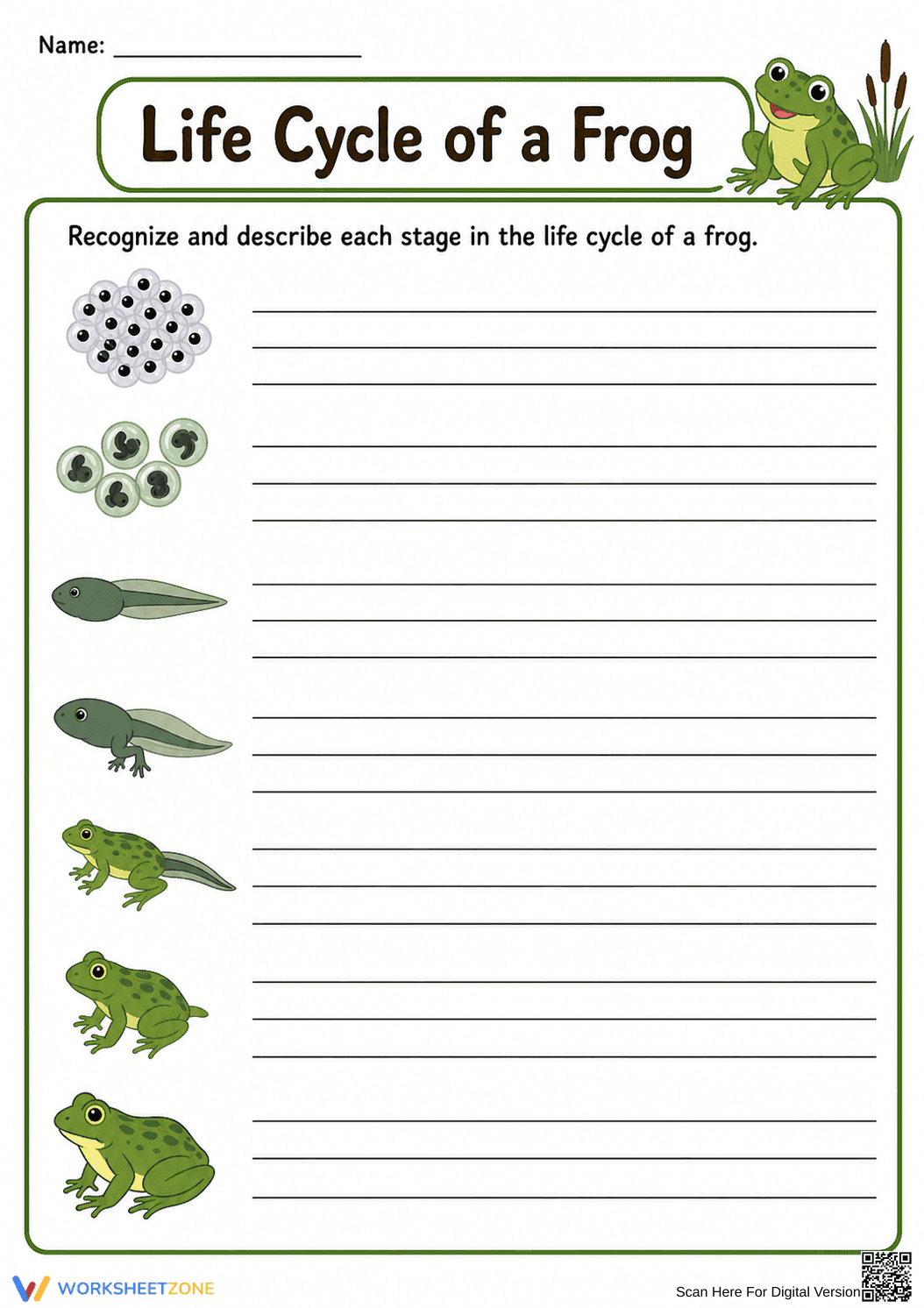

Printable Frog Life Cycle Worksheet | Grade 3

Paste this activity's link or code into your existing LMS (Google Classroom, Canvas, Teams, Schoology, Moodle, etc.).
Students can open and work on the activity right away, with no student login required.
You'll still be able to track student progress and results from your teacher account.
This Grade 3 science worksheet helps students master biological development by describing the seven stages of a frog's life cycle. Students observe detailed illustrations and write concrete descriptions for each developmental milestone, transforming abstract scientific concepts into clear written observations that reinforce their understanding of amphibian growth.
At a Glance
- Grade: 3 · Subject: Science
- Standard:
3-LS1-1— Describe developmental milestones in an organism's life cycle- Skill Focus: Describing amphibian life cycle stages
- Format: 1 page · 7 tasks · Answer key included · PDF
- Best For: Independent practice and science review
- Time: 15–20 minutes
This single-page resource features seven clear diagrams representing a frog's development, from eggs to adult. Beside each visual prompt, students use ample horizontal lines to draft scientific observations. The layout maximizes clarity, and an integrated answer key facilitates immediate feedback or efficient grading.
The zero-prep workflow is designed for busy educators. First, print the single-sheet PDF (30 seconds). Second, distribute to students for independent work (1 minute). Finally, review the descriptions using the provided answer key to identify misconceptions about amphibian metamorphosis (5 minutes). Total teacher preparation time remains under two minutes, making this ideal for substitute plans.
This resource aligns to the 3-LS1-1 Next Generation Science Standard, requiring students to develop models describing that organisms have diverse life cycles but share common birth, growth, reproduction, and death phases. Both standard codes can be copied directly into lesson plans, IEP goals, or district curriculum mapping tools.
Integrate this worksheet during the Explain or Evaluate phases of the 5E model. It serves as an excellent follow-up to a digital simulation of amphibian growth, requiring 15 to 20 minutes. For a formative assessment, observe whether students use specific scientific vocabulary like tadpole or metamorphosis in their descriptions.
Designed for Grade 3 and Grade 4 students, this activity builds descriptive writing skills within a scientific context. It provides natural differentiation for English Language Learners through clear image cues. Pair this worksheet with a classroom life-cycle anchor chart to provide additional scaffolding for struggling readers.
The efficacy of visual-to-text transcription in science education is well-documented in the RAND AIRS 2024 report on elementary STEM literacy. By requiring students to describe observable physical changes across seven developmental stages, this worksheet reinforces the cognitive connection between biological facts and linguistic expression. Research indicates that structured observation activities significantly improve retention of complex biological sequences compared to passive reading alone. Worksheets combining visual stimuli with open-ended description lines allow for a nuanced evaluation of student mastery. This resource provides the necessary structure for students to demonstrate their understanding of the 3-LS1-1 standard, specifically the ability to describe developmental milestones in an organism's life cycle, while building technical vocabulary. Educators can rely on this evidence-based design to support rigorous science instruction.


