




























Views
Downloads
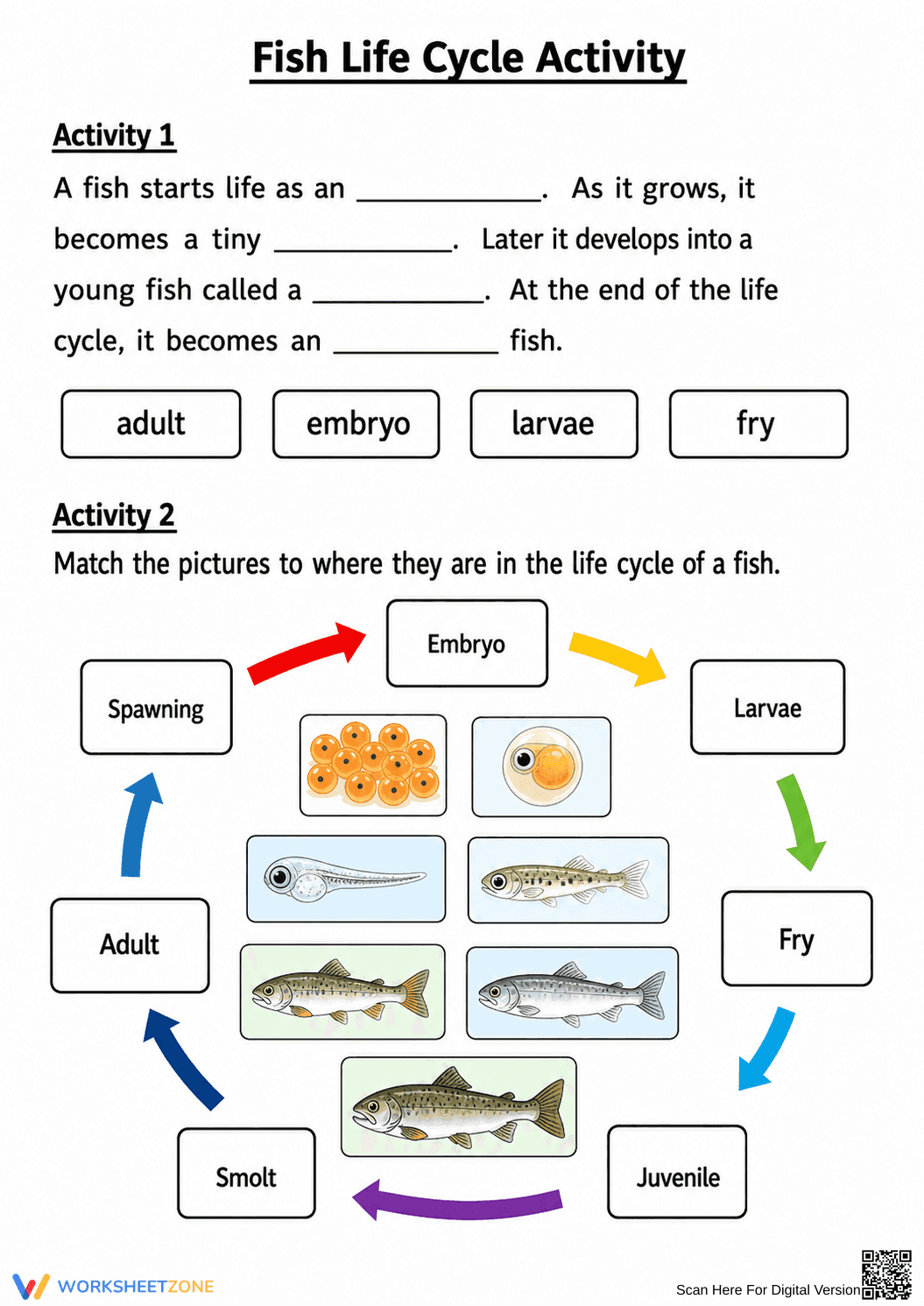

Fish Life Cycle Activity | Essential Grade 3 Science

Paste this activity's link or code into your existing LMS (Google Classroom, Canvas, Teams, Schoology, Moodle, etc.).
Students can open and work on the activity right away, with no student login required.
You'll still be able to track student progress and results from your teacher account.
This Grade 3 science worksheet provides a clear, structured approach for students to master the biological stages of aquatic life. By engaging with both linguistic and visual tasks, learners develop a concrete understanding of how organisms grow and change over time. Students will successfully identify key developmental milestones from spawning to adulthood.
At a Glance
- Grade: 3 · Subject: Science
- Standard:
3-LS1-1— Develop models to describe that organisms have unique and diverse life cycles- Skill Focus: Fish life cycle stages and vocabulary
- Format: 1 page · 11 problems · Answer key included · PDF
- Best For: Independent practice or quick formative assessment
- Time: 15–20 minutes
This single-page PDF contains two distinct activities designed to reinforce biological concepts. Activity 1 features a cloze-style paragraph with four blanks, supported by a clear word bank containing essential terms like embryo and larvae. Activity 2 provides a visual cycle diagram where students match seven detailed illustrations to their corresponding labels, including specific stages like smolt and juvenile.
This resource is designed for immediate classroom implementation with a total teacher preparation time of under two minutes. First, print the single-page PDF for your class (1 minute). Second, distribute the sheets as a transition activity or science center task (30 seconds). Finally, use the included answer key for a rapid whole-group review or individual grading (30 seconds). It serves as an ideal sub plan or bell-ringer activity.
The primary focus is 3-LS1-1: "Develop models to describe that organisms have unique and diverse life cycles but all have in common birth, growth, reproduction, and death." This worksheet specifically addresses the growth and unique life cycle components by detailing the specific metamorphosis of fish. Both standard codes can be copied directly into lesson plans, IEP goals, or district curriculum mapping tools.
Use this worksheet during the Explain or Elaborate phase of a 5E science lesson. It works effectively as a formative assessment after a direct instruction session on aquatic ecosystems. Teachers should observe if students can correctly sequence the smolt and juvenile stages, as these are often the most challenging. Completion typically ranges from 15 to 20 minutes depending on prior knowledge.
This activity is tailored for elementary students in grades 2 through 5, particularly those requiring visual scaffolds to grasp complex biological sequences. It is an excellent resource for English Language Learners (ELLs) due to the heavy reliance on pictorial cues and word banks. Pair this with a short non-fiction passage about salmon or trout for a comprehensive literacy-science integration.
The Fish Life Cycle Activity aligns with the pedagogical frameworks established by Fisher & Frey (2014) regarding the gradual release of responsibility. By providing a word bank for the initial cloze activity and visual anchors for the diagrammatic matching, the resource scaffolds the cognitive load required to internalize complex biological terminology. Research from the RAND AIRS 2024 report suggests that high-quality, standards-aligned supplemental materials like this one significantly improve student retention of domain-specific vocabulary in the life sciences. Specifically, the use of the 3-LS1-1 standard ensures that students are not just memorizing facts but are building a conceptual model of organism development. This worksheet facilitates the transition from basic identification to the higher-order thinking required to compare diverse life cycles across different species. It provides a reliable, evidence-based tool for educators seeking to meet NGSS requirements while maintaining high levels of student engagement through interactive, multi-modal tasks.


