


























Views
Downloads
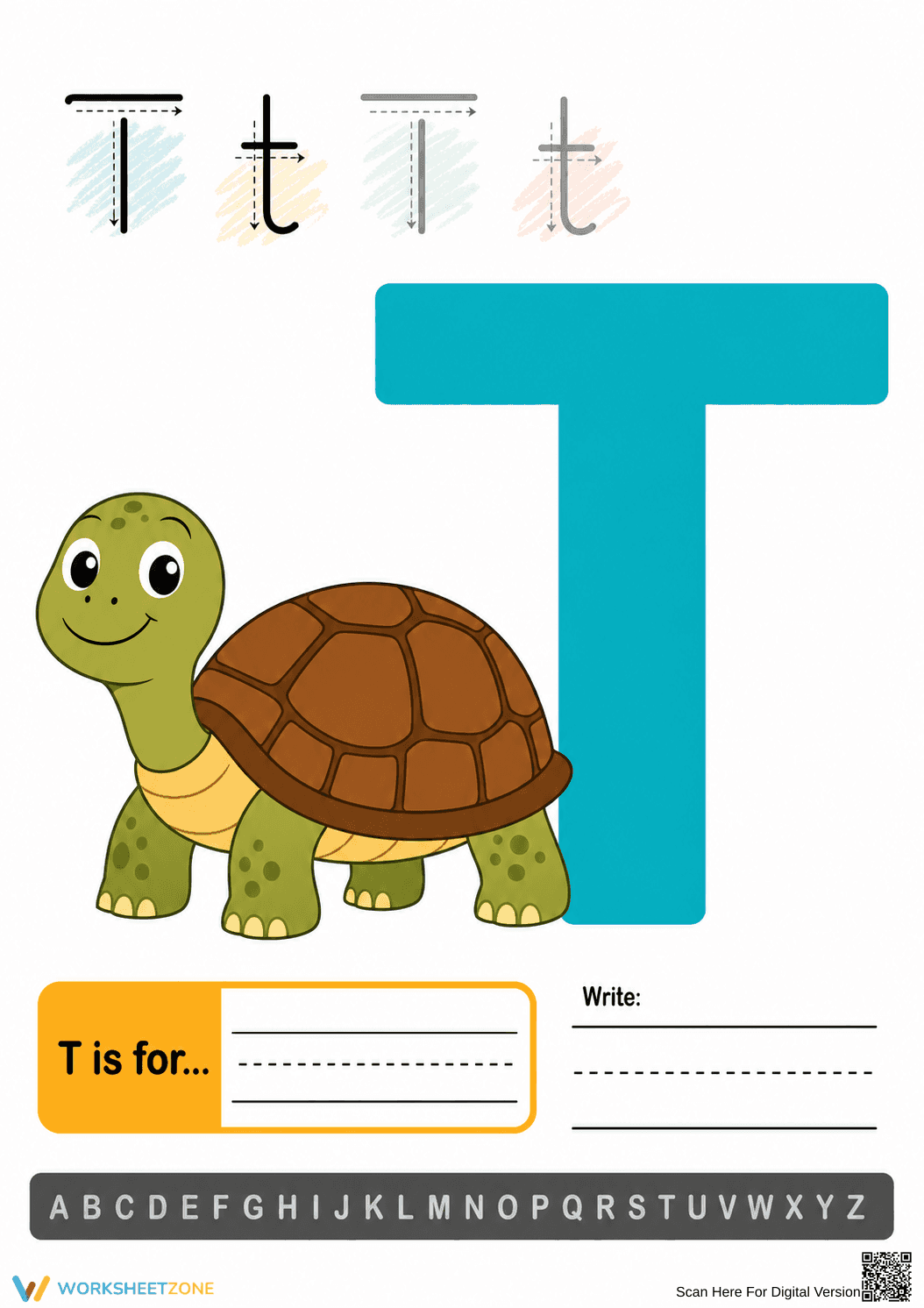

Printable Letter T Beginning Sound Worksheet | Grade K
Paste this activity's link or code into your existing LMS (Google Classroom, Canvas, Teams, Schoology, Moodle, etc.).
Students can open and work on the activity right away, with no student login required.
You'll still be able to track student progress and results from your teacher account.
This foundational phonics worksheet helps early learners master the beginning sound of the letter T. Students practice letter formation and sound recognition through guided tracing and writing activities. By connecting the visual letter to its phonetic sound using a familiar animal, children build essential early literacy skills.
At a Glance
- Grade: K · Subject: ELA
- Standard:
CCSS.ELA-LITERACY.RF.K.3.A— Produce the primary sound for each consonant- Skill Focus: Letter T Beginning Sound
- Format: 1 page · 3 problems · No answer key · PDF
- Best For: Independent practice
- Time: 10–15 minutes
This single-page resource features clear, directional arrows for tracing both uppercase and lowercase T. It includes a large, engaging illustration of a turtle to reinforce the beginning sound connection. The bottom section provides primary writing lines for students to practice writing the word "turtle" or other T-words independently. An alphabet strip at the footer helps students contextualize the letter's position within the alphabet.
This resource is designed for a zero-prep classroom workflow:
- Print: Generate class sets in under one minute. The black-and-white friendly design saves ink.
- Distribute: Hand out immediately during morning work or literacy centers. No cutting or laminating required.
- Review: Quickly assess student letter formation and sound comprehension in real-time as they work.
Total teacher preparation time is under two minutes, making this an excellent addition to emergency substitute plans or last-minute center rotations.
This activity is directly aligned to CCSS.ELA-LITERACY.RF.K.3.A: Demonstrate basic knowledge of one-to-one letter-sound correspondences by producing the primary sound or many of the most frequent sounds for each consonant. It also supports handwriting standards by requiring students to print upper- and lowercase letters. Both standard codes can be copied directly into lesson plans, IEP goals, or district curriculum mapping tools.
Teachers can utilize this worksheet during morning work to establish a calm, focused start to the day while reinforcing the letter of the week. Alternatively, it serves as an effective independent station during guided reading rotations. While students are working, observe their pencil grip and stroke direction during the tracing portion to provide immediate corrective feedback. Expected completion time ranges from 10 to 15 minutes depending on the student's fine motor proficiency.
This resource is primarily designed for Kindergarten students developing basic phonics and handwriting skills. It is also highly effective for pre-K students who are ready for formal letter instruction, or first graders needing targeted intervention on consonant sounds. Pair this worksheet with a read-aloud book featuring prominent T-words or a classroom anchor chart displaying various objects that start with the letter T.
Early mastery of letter-sound correspondence is a critical predictor of future reading success. According to Fisher & Frey (2014), explicit instruction in foundational skills, combined with immediate application through guided practice, significantly improves phonetic retention in early childhood settings. This worksheet targets CCSS.ELA-LITERACY.RF.K.3.A by requiring students to produce the primary sound for each consonant, specifically focusing on the letter T. By integrating visual cues, such as the turtle illustration, with kinesthetic tracing activities, the resource addresses multiple learning modalities simultaneously. This multimodal approach ensures that students not only recognize the letter visually but also connect it to its phonetic output and physical formation. Consistent practice with these targeted, single-skill activities builds the automaticity necessary for fluent decoding and encoding as students progress through primary grades.


