


























Views
Downloads

Printable Letter H Tracing Worksheet | Grade 1 Ready
Paste this activity's link or code into your existing LMS (Google Classroom, Canvas, Teams, Schoology, Moodle, etc.).
Students can open and work on the activity right away, with no student login required.
You'll still be able to track student progress and results from your teacher account.
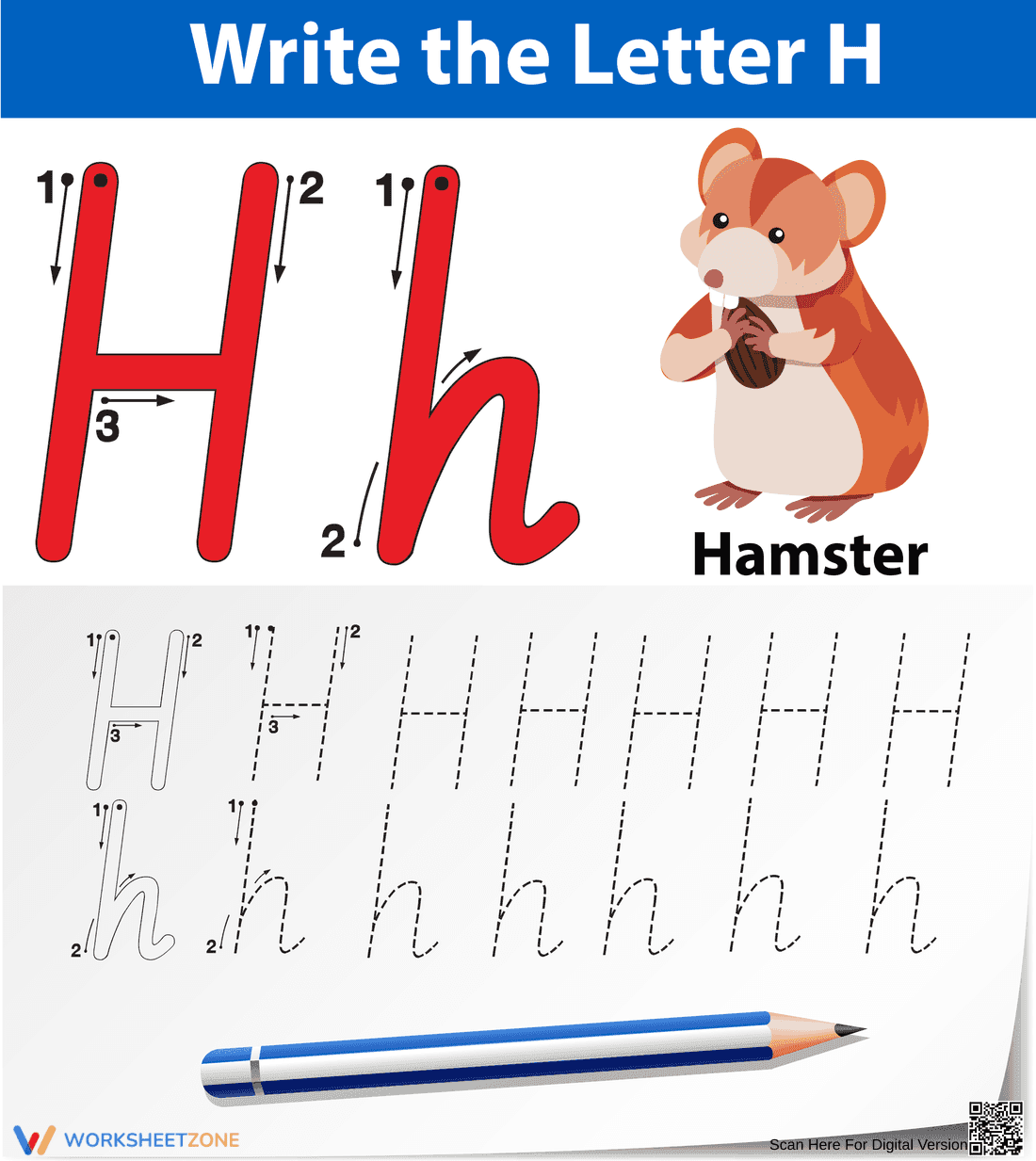
This Grade 1 handwriting worksheet provides focused practice for mastering the letter H. By utilizing numbered directional arrows, students learn the correct stroke order for both uppercase and lowercase forms. This foundational activity ensures students develop the muscle memory required for legible writing and consistent letter sizing in their daily literacy tasks.
At a Glance
At a Glance
- Grade: 1 · Subject: Handwriting
- Standard:
CCSS.ELA-LITERACY.L.1.1.A— Print all upper- and lowercase letters correctly and legibly- Skill Focus: Letter H formation
- Format: 1 page · 14 problems · Visual cues included · PDF
- Best For: Independent morning work or literacy centers
- Time: 5–10 minutes
This resource features a large-scale visual guide at the top, showing the three-stroke process for uppercase 'H' and the two-stroke process for lowercase 'h'. Below the guide, students find two rows of tracing practice. The first row contains 7 uppercase letters, while the second row provides 7 lowercase letters. A friendly hamster illustration provides a phonemic connection, reinforcing the /h/ sound alongside the physical writing task.
Zero-Prep Workflow
- Print: Generate the single-page PDF in less than 30 seconds.
- Distribute: Hand out sheets during transition periods or as students arrive for morning work.
- Review: Because the worksheet includes numbered stroke guides, students can work immediately without verbal instructions. Reviewing completed work takes under 1 minute per student.
Total teacher preparation time is targeted at under 2 minutes, making this an ideal solution for sub plans or unexpected schedule changes.
Standards Alignment
This resource is specifically designed to meet `CCSS.ELA-LITERACY.L.1.1.A`, which requires students to print all upper- and lowercase letters. By providing explicit tracing paths, the worksheet scaffolds the learning process from guided imitation to independent production. This standard code can be copied directly into lesson plans, IEP goals, or district curriculum mapping tools.
How to Use It
Use this worksheet during the independent practice phase of a handwriting lesson. After demonstrating the letter H on a whiteboard, assign this sheet to reinforce the lesson. It also serves as an excellent formative assessment tool; observe students as they work to ensure they follow the numbered arrows rather than drawing the letter from the bottom up. Completion typically takes 5 to 10 minutes depending on student fine motor development.
Who It's For
This practice page is ideal for first-grade students refining their handwriting. It is also highly effective for English Language Learners (ELLs) who are familiarizing themselves with the Roman alphabet. Pair this worksheet with a letter-sound anchor chart or a short reading passage featuring "H" words like "hamster," "hat," and "house" to reinforce the connection between graphemes and phonemes.
According to the RAND AIRS 2024 report on foundational literacy, explicit instruction in letter formation is a critical precursor to writing fluency and overall reading development. This worksheet addresses the CCSS.ELA-LITERACY.L.1.1.A standard by providing the structured repetition necessary for students to internalize the physical movements of writing. Research by Fisher & Frey (2014) emphasizes the importance of the gradual release of responsibility; the numbered stroke guides act as a temporary scaffold that allows students to practice the correct plain-English skill of printing letters legibly before moving to unlined paper. By integrating visual cues with motor practice, this resource supports the development of fine motor control and orthographic mapping. Consistent use of such targeted tracing activities has been shown to reduce cognitive load during later composition tasks, allowing students to focus on content rather than mechanics.


