


























Views
Downloads
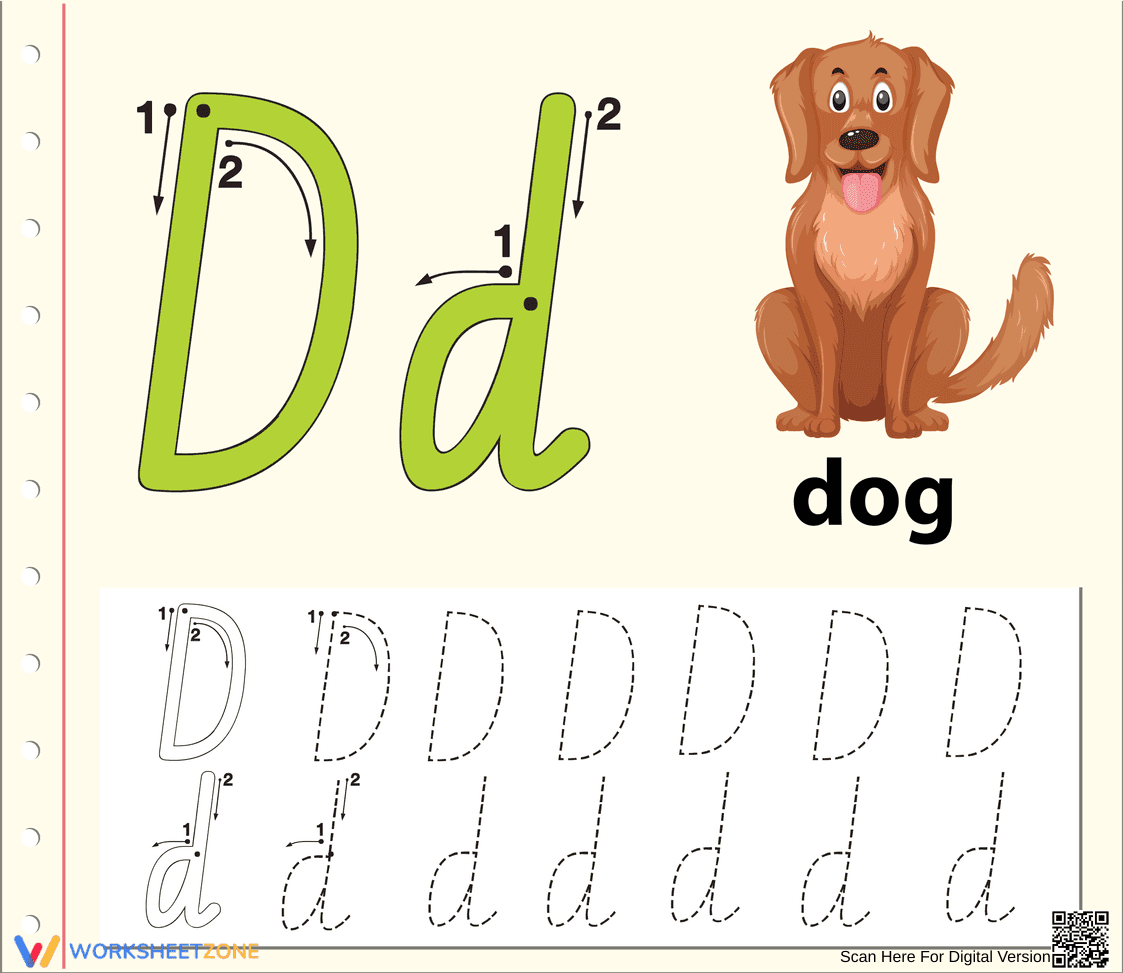

Letter D Tracing Worksheet | Kindergarten Printable
Paste this activity's link or code into your existing LMS (Google Classroom, Canvas, Teams, Schoology, Moodle, etc.).
Students can open and work on the activity right away, with no student login required.
You'll still be able to track student progress and results from your teacher account.
This foundational handwriting worksheet provides early learners with focused practice on forming the letter D. By tracing both uppercase and lowercase letters in a D'nealian style, students develop fine motor control and muscle memory essential for fluent writing. The engaging dog illustration helps anchor letter-sound correspondence.
At a Glance
- Grade: Kindergarten · Subject: ELA
- Standard:
CCSS.ELA-LITERACY.L.K.1.A— Print many upper- and lowercase letters- Skill Focus: Letter D Tracing
- Format: 1 page · 14 problems · No answer key needed · PDF
- Best For: Independent practice
- Time: 10–15 minutes
This single-page resource features a large, numbered directional guide for uppercase and lowercase letter D, demonstrating proper stroke order. Below the model, students find 14 dashed tracing tasks—seven uppercase and seven lowercase. The worksheet utilizes a D'nealian manuscript style, characterized by a slight slant that eases the transition to cursive. A cheerful dog illustration reinforces the phonetic connection.
This worksheet requires minimal teacher preparation:
- Print (1 minute): Generate the PDF and print a class set directly from your computer.
- Distribute (1 minute): Hand out the sheets along with pencils or crayons. The visual stroke guides make verbal instructions brief.
- Review (1 minute): Quickly scan student work to ensure they are following the directional arrows rather than drawing the letters backward.
With a total prep time of under two minutes, this resource is highly suitable for emergency sub plans, morning work, or literacy centers.
This activity aligns directly with CCSS.ELA-LITERACY.L.K.1.A, which requires students to print many upper- and lowercase letters. It also supports foundational phonics skills by pairing the target letter with a familiar vocabulary word (dog). Both standard codes can be copied directly into lesson plans, IEP goals, or district curriculum mapping tools.
Teachers can deploy this worksheet during morning arrival as a quiet, focused task that settles students into the daily routine. Alternatively, it serves as an excellent independent station during guided reading rotations. While students are tracing, teachers should observe their pencil grip and stroke direction, offering immediate corrective feedback if a child starts the letter from the bottom instead of the top. Expected completion time is 10 to 15 minutes.
This resource is primarily designed for Kindergarten and Preschool students mastering basic letter formation. It is also highly effective for first-grade students who need targeted intervention to correct poor handwriting habits or letter reversals. For a comprehensive lesson, pair this tracing sheet with a read-aloud book featuring a dog protagonist or a tactile activity like forming the letter D in a sand tray.
Developing automaticity in letter formation is a critical precursor to expressive writing and reading fluency in early childhood education. According to Fisher & Frey (2014), explicit instruction in handwriting, combined with structured guided practice, significantly reduces the cognitive load required for basic transcription. This reduction allows young writers to focus their mental energy on content generation and vocabulary selection. This worksheet directly supports that essential developmental milestone by targeting CCSS.ELA-LITERACY.L.K.1.A, ensuring students can accurately print many upper- and lowercase letters. By providing numbered directional arrows and dashed tracing models, the resource scaffolds the complex motor planning process required for early writers. Consistent practice with these specific stroke sequences builds the muscle memory necessary for legible and efficient handwriting. Early intervention in letter formation prevents the fossilization of incorrect habits, ultimately supporting broader literacy goals and reading comprehension across the primary grades.


