


























Views
Downloads

Essential Landforms Worksheet | Grades K-2 Printable
Paste this activity's link or code into your existing LMS (Google Classroom, Canvas, Teams, Schoology, Moodle, etc.).
Students can open and work on the activity right away, with no student login required.
You'll still be able to track student progress and results from your teacher account.
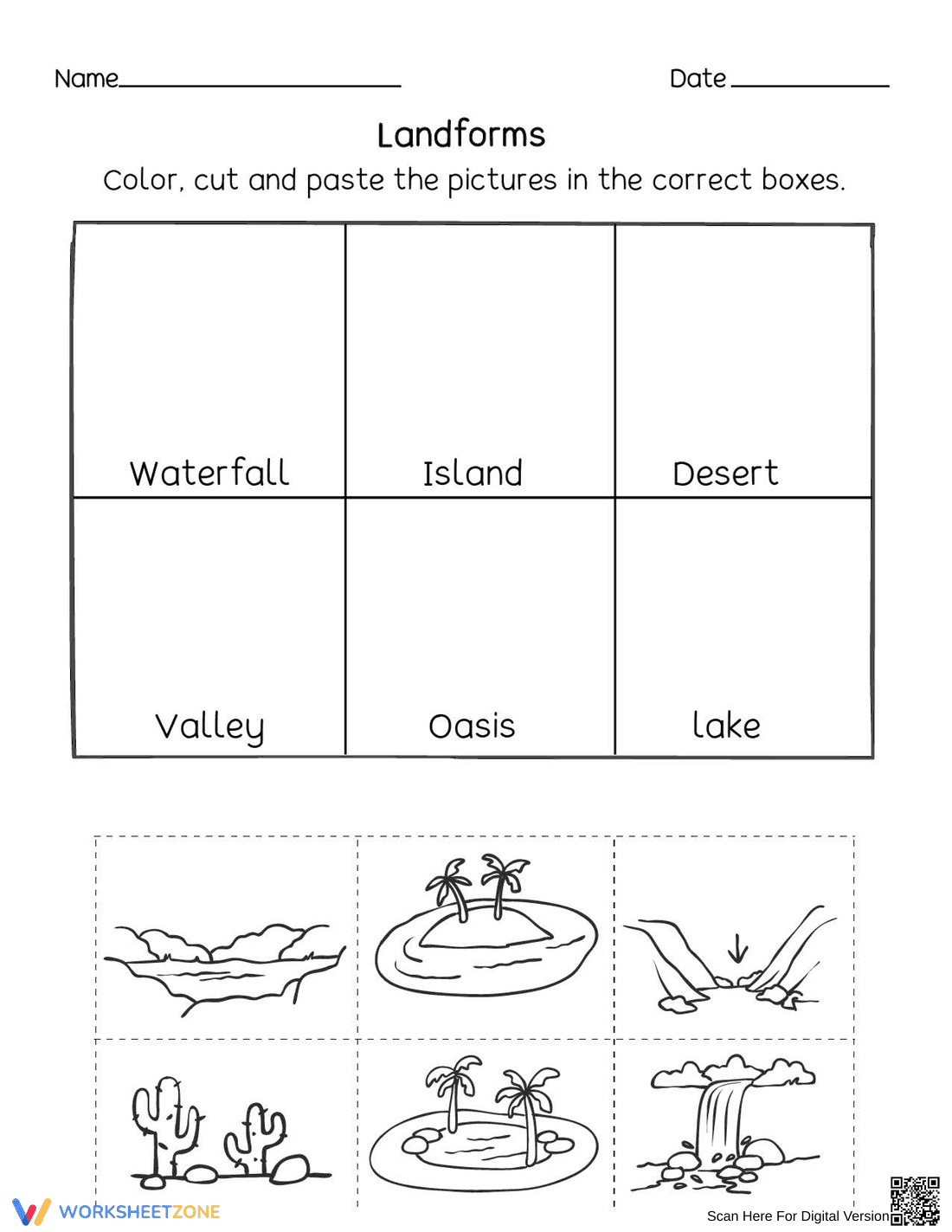
Students identify and categorize essential geographic features with this hands-on landforms worksheet. By matching visual representations to their correct terms, learners build foundational vocabulary and spatial awareness. This activity ensures children recognize the distinct characteristics of mountains, valleys, and bodies of water through active engagement and fine motor practice.
At a Glance
- Grade: K-2 · Subject: Science
- Standard:
2-ESS2-2— Develop a model to represent the shapes and kinds of land and water- Skill Focus: Landform Identification
- Format: 1 page · 6 problems · Answer key included · PDF
- Best For: Independent practice or center activity
- Time: 15–20 minutes
What's Inside
This single-page PDF includes six distinct landform illustrations and matching vocabulary labels. Students encounter specific geographic terms including Waterfall, Island, Desert, Valley, Oasis, and Lake. The layout provides large sorting boxes for younger learners and clear dotted lines to guide cutting, making it an accessible resource for developing fine motor skills alongside scientific content knowledge.
Zero-Prep Workflow
The zero-prep workflow for this resource is designed for maximum classroom efficiency. Teachers can print the required number of copies in under 30 seconds and distribute them immediately with no prior assembly. Students can complete the entire matching process in approximately 15 minutes, allowing for a quick 2-minute review period at the end of the lesson. It serves as an ideal sub plan or quiet-time activity.
Standards Alignment
This activity is aligned with 2-ESS2-2, requiring students to develop a model to represent the shapes and kinds of land and bodies of water in an area. By creating a physical match between the icon and the name, students build the mental models necessary for complex Earth science concepts. This standard code can be copied directly into lesson plans, IEP goals, or district curriculum mapping tools.
How to Use It
Use this worksheet as a summative check during a unit on Earth systems or as a formative assessment after introducing landform vocabulary. During instruction, observe how students distinguish between land-locked features like valleys and water-based features like islands. It is expected that most Grade 1 or 2 students will complete the task independently within 20 minutes of starting.
Who It's For
This resource is designed for Kindergarten through Grade 2 students who are building their scientific literacy. The visual nature of the task makes it particularly effective for English Language Learners and students requiring additional scaffolding. Pair this worksheet with a physical map or an anchor chart showing real-world photos of each landform to deepen the connection between illustrations and reality.
According to research from EdReports 2024, high-quality instructional materials that integrate hands-on tactile activities significantly improve retention of scientific vocabulary in early elementary learners. This worksheet addresses the 2-ESS2-2 standard by requiring students to identify land and water features through a modeling exercise. The process of coloring and pasting requires students to spend more time observing the specific visual details of each landform, which reinforces the cognitive link between the term and the geographic feature. Studies in ScienceDirect TpT Analysis suggest that "print-and-go" resources with clear visual cues reduce teacher cognitive load while maintaining high student engagement levels. By providing 6 targeted matching problems, the resource ensures students achieve a baseline mastery of primary landforms without overwhelming them with text-heavy instructions. This focused approach is essential for meeting the diverse needs of a K-2 classroom while adhering to rigorous state and national science frameworks.


