


























Views
Plays
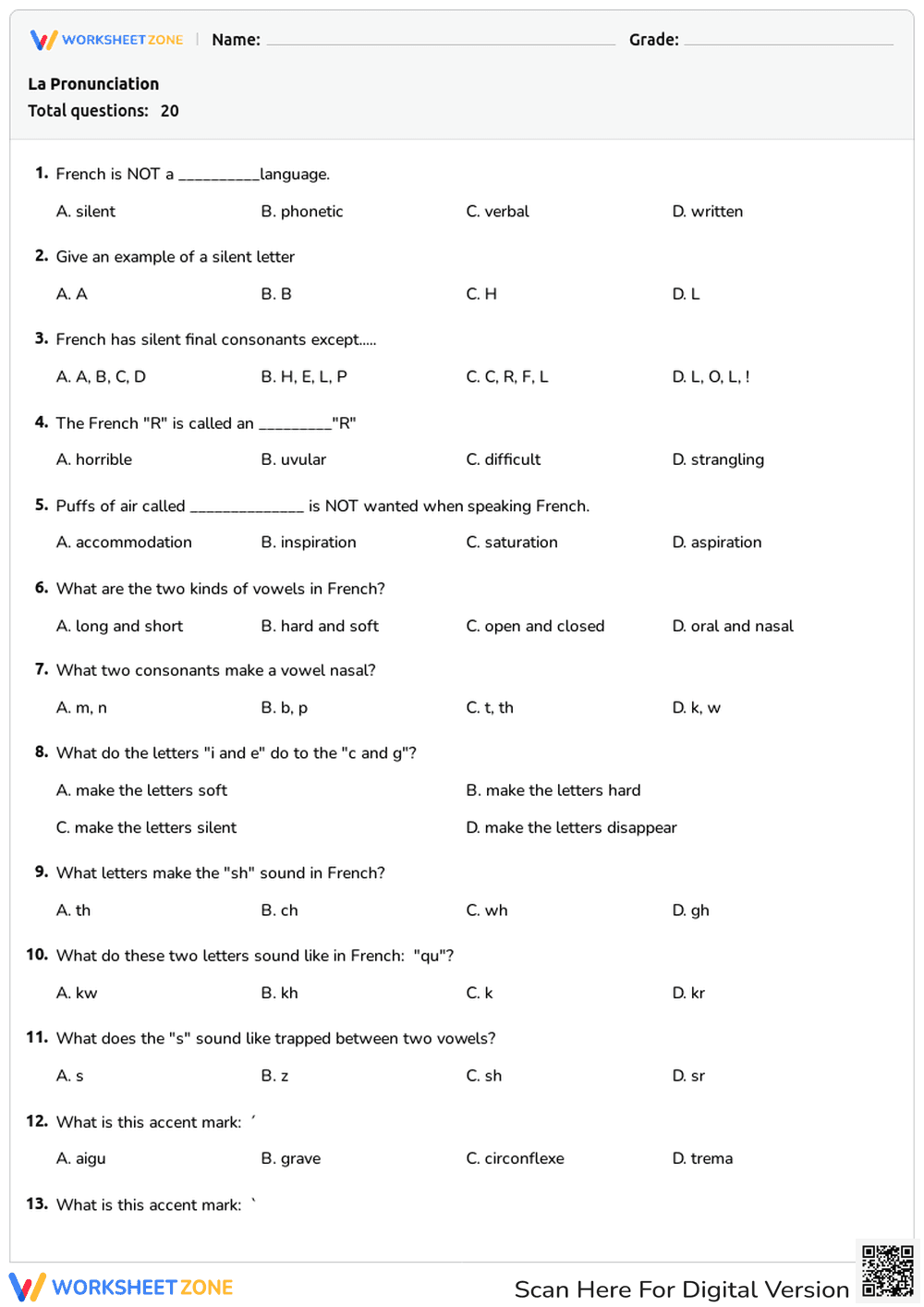


French Pronunciation Quiz | Grade 4 Essential Worksheet
Paste this activity's link or code into your existing LMS (Google Classroom, Canvas, Teams, Schoology, Moodle, etc.).
Students can open and work on the activity right away, with no student login required.
You'll still be able to track student progress and results from your teacher account.
This Grade 4 French pronunciation worksheet provides a comprehensive review of phonetic rules, helping students master the complexities of silent letters, accents, and vowel sounds. By engaging with 20 targeted multiple-choice questions, learners develop a foundational understanding of how French words are constructed and spoken, leading to improved oral proficiency and reading fluency.
At a Glance
- Grade: 4 · Subject: ELA / Phonics
- Standard:
CCSS.ELA-LITERACY.RF.4.3— Know and apply grade-level phonics and word analysis skills in decoding words- Skill Focus: French Phonetic Rules
- Format: 2 pages · 20 problems · Answer key included · PDF
- Best For: Introductory French lessons or phonics enrichment
- Time: 15–25 minutes
What's Inside
The resource consists of a two-page quiz featuring 20 multiple-choice questions. It covers critical linguistic concepts including the uvular "R," nasal vowels, soft "c" and "g" rules, and specific accent marks like aigu, grave, and cédille. The layout is clean and professional, providing ample space for students to circle their answers, with a clear header for name and grade.
Zero-Prep Workflow
This worksheet is designed for immediate classroom implementation. Teachers can print the two-page PDF in less than 1 minute, distribute it to the class in seconds, and use the provided answer key for a rapid 5-minute review session. It serves as an ideal sub plan or a quick formative assessment to gauge student understanding of introductory French phonology without any additional teacher setup.
Standards Alignment
The primary standard addressed is `CCSS.ELA-LITERACY.RF.4.3`, which requires students to know and apply grade-level phonics and word analysis skills. While focused on French, the exercise strengthens general linguistic awareness and decoding strategies. Both standard codes can be copied directly into lesson plans, IEP goals, or district curriculum mapping tools.
How to Use It
Use this worksheet as a summative assessment after a unit on French sounds or as a guided practice activity during direct instruction. For formative assessment, observe students as they identify the "sh" sound or nasal consonants to identify common misconceptions in letter-sound correspondence. Completion typically takes 20 minutes, making it a perfect mid-lesson check.
Who It's For
This resource is tailored for Grade 4 students beginning their journey into foreign language acquisition or ELA students exploring comparative linguistics. It is particularly effective for visual learners who benefit from seeing accent marks and phonetic patterns in writing. Pair this with an audio recording of the terms for a multi-sensory learning experience.
According to the RAND AIRS 2024 report, structured phonetic practice is essential for developing decoding automaticity in both primary and secondary languages. This worksheet targets `CCSS.ELA-LITERACY.RF.4.3` by isolating 20 specific phonetic variables, such as silent final consonants and elision, which are often stumbling blocks for English-speaking learners. Research from Fisher & Frey (2014) emphasizes that multiple-choice assessments, when paired with immediate feedback, significantly reinforce the retention of linguistic conventions. By focusing on the plain-English skill of identifying letter-sound correspondences and accent functions, this resource provides the repetition necessary for mastery. The inclusion of specific linguistic terms like "uvular" and "liaison" ensures that students are not just guessing but are building a technical vocabulary that supports long-term language proficiency and cross-linguistic transfer.


