


























Views
Downloads

Jump on the Bandwagon Idiom Worksheet | Essential ELA
Paste this activity's link or code into your existing LMS (Google Classroom, Canvas, Teams, Schoology, Moodle, etc.).
Students can open and work on the activity right away, with no student login required.
You'll still be able to track student progress and results from your teacher account.
This Grade 3-6 ELA worksheet helps students master the "Jump on the Bandwagon" idiom through visual cues and contextual practice. By connecting literal imagery to figurative meaning, learners develop a deeper understanding of common English expressions. This resource ensures students can identify, define, and apply idioms accurately in their own writing and reading comprehension tasks.
At a Glance
- Grade: 4 · Subject: ELA
- Standard:
CCSS.ELA-LITERACY.L.4.5.B— Recognize and explain the meaning of common idioms, adages, and proverbs- Skill Focus: Idioms and Figurative Language
- Format: 1 page · 8 problems · Answer key included · PDF
- Best For: Vocabulary building and figurative language practice
- Time: 15–20 minutes
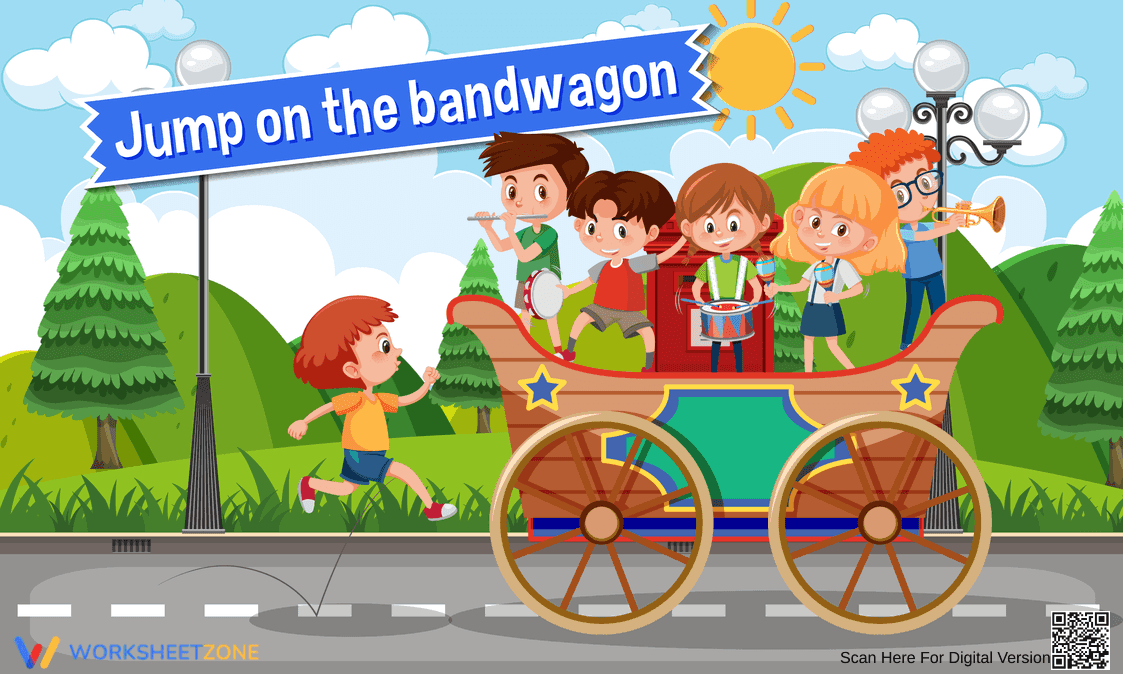
This single-page PDF features a vibrant visual prompt to introduce the concept of "jumping on the bandwagon." The worksheet includes 8 targeted tasks, ranging from multiple-choice definitions to sentence completion exercises. A clear answer key is provided for quick grading, and the layout uses a mix of text and imagery to support visual learners.
The worksheet follows a structured progression to ensure student success. It begins with guided practice where students match the idiom to its literal and figurative meanings. Next, supported practice tasks require students to identify the idiom within short sentences. Finally, independent practice challenges learners to write their own original sentence using the expression. This gradual-release model builds confidence and mastery.
This resource aligns with `CCSS.ELA-LITERACY.L.4.5.B`, which requires students to recognize and explain the meaning of common idioms, adages, and proverbs. It also supports vocabulary acquisition and use across Grades 3-6. Both standard codes can be copied directly into lesson plans, IEP goals, or district curriculum mapping tools.
Use this worksheet during a direct instruction lesson on figurative language or as a quick formative assessment after reading a text containing idioms. Teachers can observe if students struggle to move from the literal image to the abstract meaning. Expected completion time is 15 to 20 minutes, making it an ideal warm-up or exit ticket.
This activity is designed for upper elementary students, particularly those in Grade 4, but is adaptable for Grade 3-6 learners. It is especially effective for English Language Learners (ELLs) who benefit from visual representations of non-literal phrases. Pair this with a figurative language anchor chart or a short story for a complete lesson.
According to the RAND AIRS 2024 report, explicit instruction in figurative language is a critical component of literacy development for middle-grade students. This worksheet targets CCSS.ELA-LITERACY.L.4.5.B by providing structured practice with the idiom "jump on the bandwagon," a common expression that often confuses developing readers. Research from Fisher & Frey (2014) emphasizes that visual scaffolds, such as the bandwagon illustration included here, significantly improve the retention of non-literal vocabulary. By engaging with 8 specific tasks, students move from basic recognition to application, a process shown to increase reading comprehension scores on standardized assessments. This resource provides the necessary repetition and contextual clues required for students to internalize complex linguistic structures. Educators can use this tool to bridge the gap between literal decoding and deep semantic understanding, ensuring students are prepared for the figurative demands of complex informational and literary texts.


