


























Views
Downloads

Summer Seasons Worksheet | Essential Science Activity
Paste this activity's link or code into your existing LMS (Google Classroom, Canvas, Teams, Schoology, Moodle, etc.).
Students can open and work on the activity right away, with no student login required.
You'll still be able to track student progress and results from your teacher account.
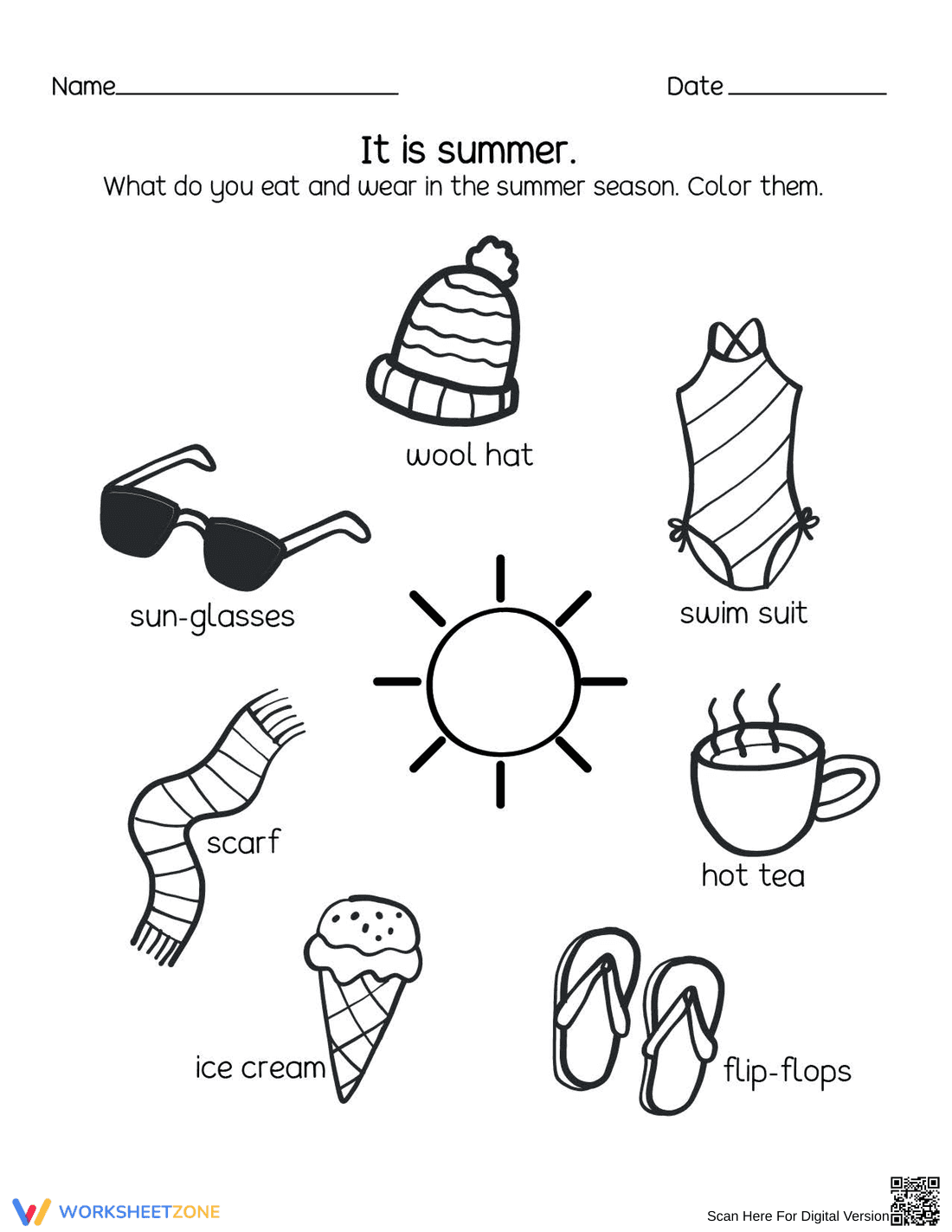
This Kindergarten science worksheet helps students identify and categorize objects associated with the summer season. By selecting specific items to color, learners demonstrate their understanding of how weather patterns influence human behavior and choices. This activity provides a clear student outcome: the ability to distinguish between seasonal characteristics through visual recognition and classification.
At a Glance
- Grade: Kindergarten · Subject: Science
- Standard:
K-ESS2-1— Use observations of local weather to describe patterns over time- Skill Focus: Seasonal identification
- Format: 1 page · 7 problems · Answer key included · PDF
- Best For: Morning work or weather units
- Time: 10–15 minutes
Inside this resource, you will find a focused, one-page activity featuring seven distinct illustrations. Each item, from a wool hat to a swim suit, is clearly labeled to support early literacy alongside scientific inquiry. The worksheet includes a simple instruction set and a dedicated space for student names and dates. A complete answer key is provided to allow for quick grading or student self-correction during center rotations.
Zero-Prep Workflow
The zero-prep workflow for this resource is designed for efficiency. First, print the single-page PDF (30 seconds). Second, distribute the worksheets during your weather unit (1 minute). Third, review the completed coloring tasks to assess student understanding of seasonal choices (1 minute). Total teacher preparation time is under 3 minutes, making this an ideal solution for emergency sub plans or transition periods.
Standards Alignment
This resource is primarily aligned with K-ESS2-1: "Use and share observations of local weather conditions to describe patterns over time." By identifying what people wear and eat during summer, students are observing and reporting on the patterns of the warmest season. Both standard codes can be copied directly into lesson plans, IEP goals, or district curriculum mapping tools.
How to Use It
Use this worksheet as a formative assessment after a group discussion about the four seasons. It works exceptionally well as a "hook" at the start of a weather unit to gauge prior knowledge. Teachers should observe whether students correctly identify the "distractor" items, such as the wool hat or hot tea, which provides immediate insight into their grasp of temperature-related concepts. Completion typically takes 12 minutes.
Who It's For
This activity is designed for Kindergarten and Grade 1 students, including English Language Learners who benefit from the clear visual cues and labels. It pairs naturally with a classroom weather chart or a read-aloud book about summer vacations. The simple layout ensures that students with fine motor challenges can focus on the conceptual task of selection rather than complex drawing.
According to research by Fisher & Frey (2014), visual categorization tasks like this summer seasons worksheet serve as vital scaffolds for early learners. By connecting abstract concepts like "climate" to concrete objects such as sunglasses and ice cream, students build the schema necessary for more complex scientific inquiry. This resource aligns with NGSS K-ESS2-1, which requires students to use observations to describe weather patterns. Studies from the NAEP suggest that early exposure to seasonal cycles through interactive, low-stakes activities improves long-term retention of Earth science fundamentals. This 1-page printable provides a structured environment for students to demonstrate their understanding of seasonal changes without the cognitive load of heavy text. It is an effective tool for formative assessment in early childhood classrooms, ensuring that foundational weather concepts are mastered before progressing to more advanced meteorological studies.


