


























Views
Downloads
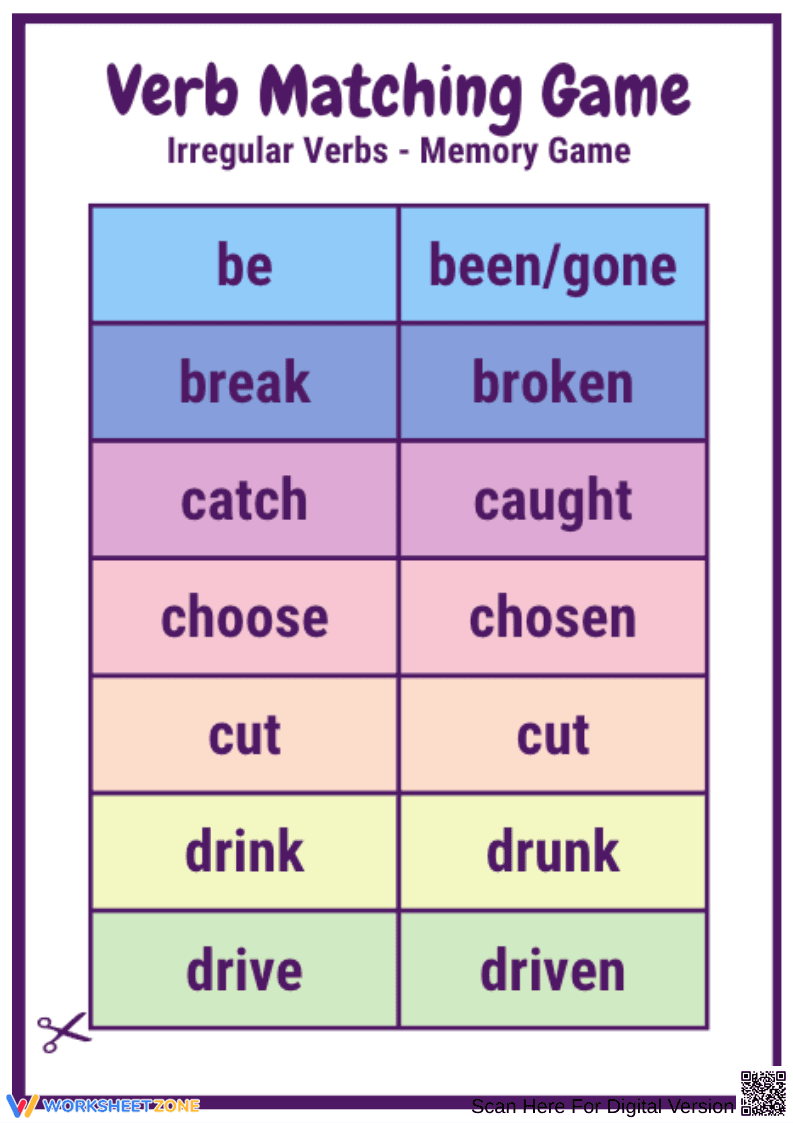

Grade 3 Irregular Verbs — Printable No-Prep Worksheet
Paste this activity's link or code into your existing LMS (Google Classroom, Canvas, Teams, Schoology, Moodle, etc.).
Students can open and work on the activity right away, with no student login required.
You'll still be able to track student progress and results from your teacher account.
This printable irregular verbs matching game helps students master past tense verb forms through hands-on practice. By pairing base verbs with their irregular past participles, learners build essential grammar skills and improve reading fluency. The interactive memory game format keeps students engaged while reinforcing core language mechanics.
At a Glance
- Grade: 3 · Subject: ELA
- Standard:
CCSS.ELA-LITERACY.L.3.1.D— Form and use irregular verbs- Skill Focus: Irregular past tense verbs
- Format: 1 page · 7 matching pairs · PDF
- Best For: Literacy centers and review
- Time: 10–15 minutes
This single-page resource features a ready-to-cut memory game with 14 individual cards. Students match seven base verbs (such as "break" and "catch") to their corresponding irregular past participles ("broken" and "caught"). The clear, color-coded design provides visual scaffolding, making it easy for young learners to organize the pieces and focus entirely on the grammar concepts without confusing layouts.
Designed for immediate classroom implementation, this activity requires minimal teacher preparation:
- Print (1 minute): Generate the single-page PDF for each student or center group.
- Distribute (2 minutes): Hand out the sheets along with scissors for students to cut out their own game cards.
- Review (5 minutes): Students play the memory matching game independently or with a partner, reinforcing verb forms through repetition.
Total teacher prep time is under two minutes, making this an excellent option for quick literacy centers, morning work, or emergency sub plans.
This activity aligns directly with CCSS.ELA-LITERACY.L.3.1.D: Form and use regular and irregular verbs. It also supports broader language progression by helping students recognize variations in standard English conventions. Both standard codes can be copied directly into lesson plans, IEP goals, or district curriculum mapping tools.
Deploy this matching game during guided reading rotations as an independent literacy center. Students can play a classic memory game by placing all cards face down and flipping two at a time to find a base-to-past-participle match. Alternatively, use it as a quick formative assessment after direct instruction on irregular verbs. Observe students as they match the pairs; hesitation or incorrect pairings will quickly reveal which specific verb forms require reteaching. The activity typically takes 10 to 15 minutes to complete.
This resource is ideal for third-grade students mastering foundational grammar rules, as well as fourth and fifth graders needing targeted review of irregular past tense verbs. The hands-on, tactile nature of the game provides excellent differentiation for kinesthetic learners and English Language Learners (ELLs) who benefit from manipulating physical cards rather than completing traditional worksheets. Pair this game with a grammar anchor chart displaying common irregular verb patterns for maximum impact.
Mastering irregular verb forms is a critical component of early language acquisition and reading comprehension. According to Fisher & Frey (2014), interactive and tactile learning strategies significantly increase student retention of complex grammar rules compared to passive worksheet completion. This resource directly targets CCSS.ELA-LITERACY.L.3.1.D by requiring students to actively form and use irregular verbs through a structured matching process. By transforming rote memorization into a hands-on memory game, educators can lower the affective filter and encourage repeated practice. The visual and kinesthetic elements of the activity support diverse learning profiles, ensuring that foundational language mechanics are solidified. Regular engagement with these specific verb transformations builds the automaticity necessary for fluent reading and writing, bridging the gap between isolated grammar instruction and applied literacy skills in the elementary classroom.


