


























Views
Downloads


Insects Vocabulary Worksheet | Grade 1-3 Essential
Paste this activity's link or code into your existing LMS (Google Classroom, Canvas, Teams, Schoology, Moodle, etc.).
Students can open and work on the activity right away, with no student login required.
You'll still be able to track student progress and results from your teacher account.
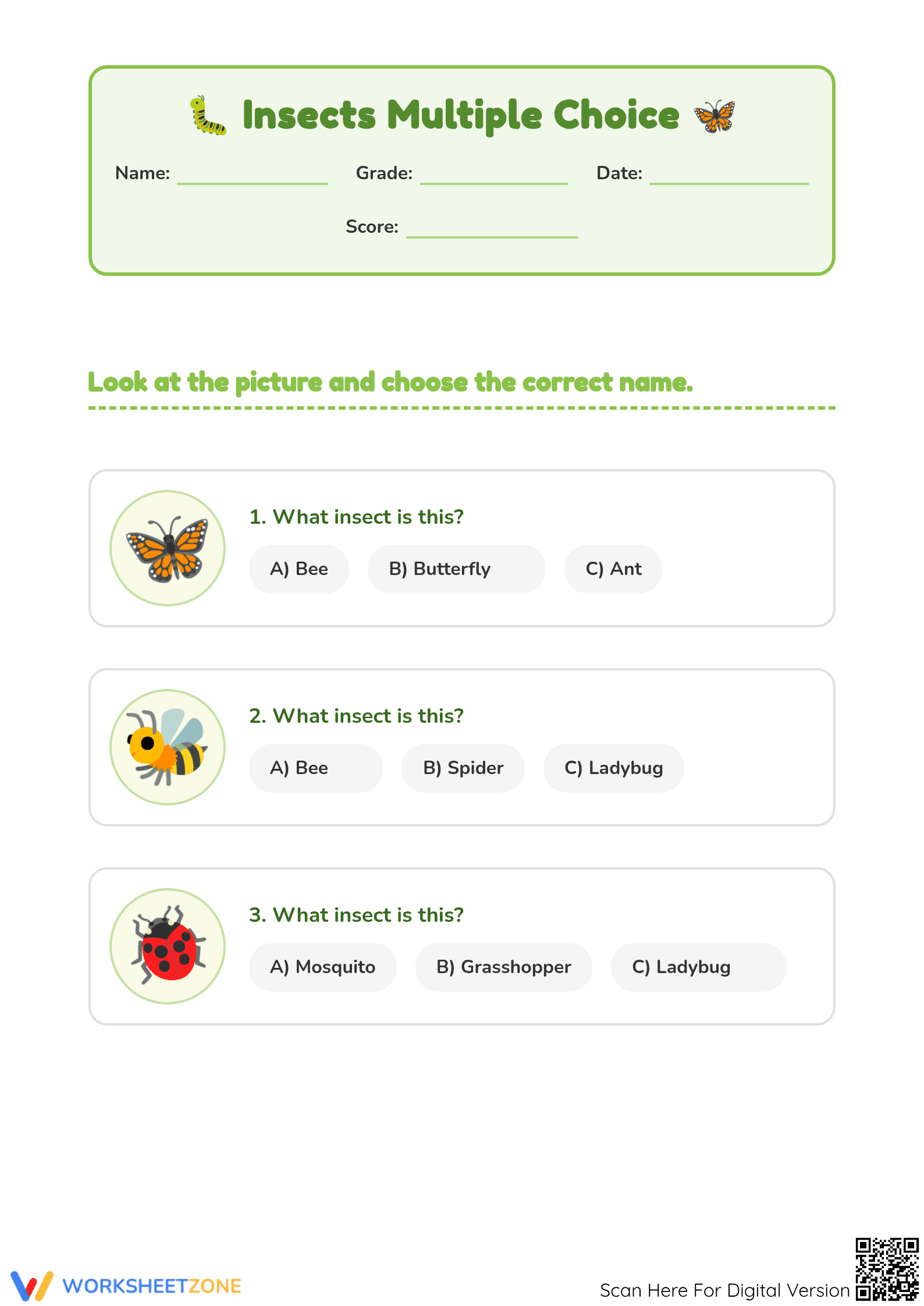
This Grade 1-3 insect vocabulary worksheet helps students identify common garden creatures through visual cues and multiple-choice selection. By matching high-quality illustrations with correct terminology, learners build essential word recognition skills and scientific literacy. It is an ideal resource for early readers and English Language Learners to practice noun identification.
At a Glance
- Grade: 1-3 · Subject: ELA / ESL
- Standard:
CCSS.ELA-LITERACY.L.1.5— Sort common objects into categories to gain a sense of word meanings- Skill Focus: Insect Identification & Vocabulary
- Format: 3 pages · 10 problems · Answer key included · PDF
- Best For: ESL support and morning work
- Time: 10–15 minutes
What's Inside
The packet contains 3 pages featuring 10 distinct multiple-choice questions. Each question presents a clear, colorful illustration of an insect, such as a butterfly, bee, or ladybug, alongside three text-based options. A comprehensive answer key is included to facilitate student self-correction or rapid teacher grading, ensuring students receive immediate feedback on their identification accuracy.
Zero-Prep Workflow
- Print: Generate the 3-page PDF in under 1 minute for your entire class.
- Distribute: Hand out the sheets for a 10-minute independent activity or warm-up.
- Review: Use the provided answer key for a 30-second check or peer-grading session.
This resource requires zero additional materials or setup, making it an excellent choice for emergency sub plans or transition periods.
Standards Alignment
The primary standard addressed is CCSS.ELA-LITERACY.L.1.5. This standard requires students to demonstrate understanding of word relationships and nuances in word meanings. By identifying specific insects within the broader category of "bugs," students refine their categorical thinking and technical vocabulary. Both standard codes can be copied directly into lesson plans, IEP goals, or district curriculum mapping tools.
How to Use It
Use this as a formative assessment after a science lesson on living things or as a vocabulary builder for ESL students. Assign it during independent center rotations to observe if students can distinguish between similar-looking insects like bees and mosquitoes. Completion typically takes 10 to 15 minutes depending on the student's reading level.
Who It's For
This worksheet is tailored for first through third-grade students, particularly those needing visual support for vocabulary acquisition. It pairs naturally with an insect-themed anchor chart or a non-fiction reading passage about garden habitats. It is especially effective for students in Tier 2 vocabulary intervention groups.
This 10-task assessment aligns with CCSS.ELA-LITERACY.L.1.5, focusing on foundational vocabulary acquisition through visual-to-text matching. Research from Fisher & Frey (2014) emphasizes that the use of non-linguistic representations, such as the colorful insect illustrations provided here, significantly enhances word retention for early readers and English Language Learners. By providing immediate feedback through the included answer key, the worksheet supports the gradual release of responsibility model. The structured multiple-choice format reduces cognitive load, allowing students to focus specifically on the phonological and semantic differences between insect names like "beetle" and "butterfly." This resource serves as a reliable tool for tracking progress in Tier 1 vocabulary instruction or as a targeted intervention for students struggling with categorization. It provides a clear data point for educators monitoring mastery of basic life science terminology within the ELA framework, ensuring students meet grade-level expectations for word recognition.


