


























Views
Downloads
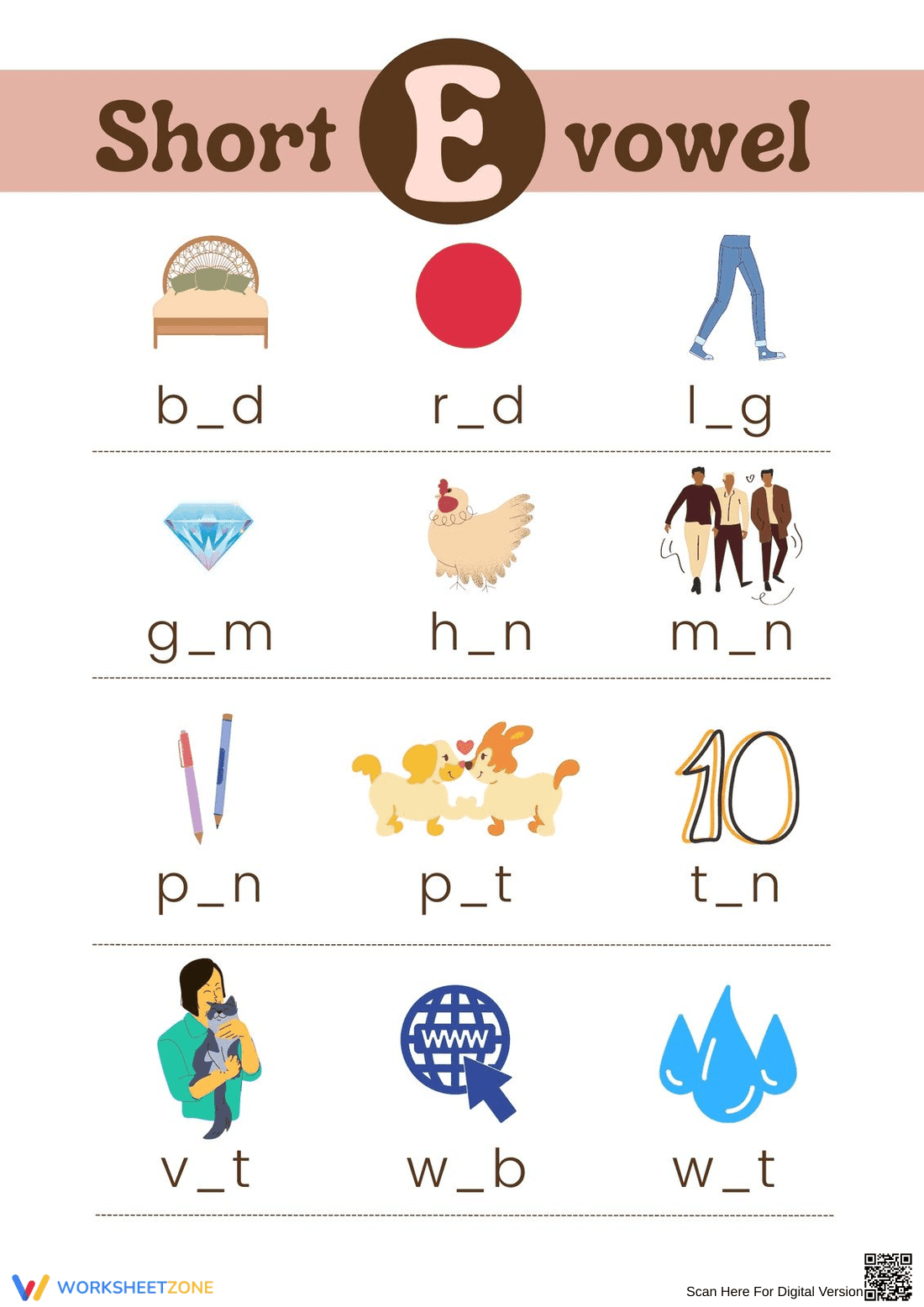

Grade 1 Short E Vowels — Printable No-Prep Worksheet
Paste this activity's link or code into your existing LMS (Google Classroom, Canvas, Teams, Schoology, Moodle, etc.).
Students can open and work on the activity right away, with no student login required.
You'll still be able to track student progress and results from your teacher account.
This early literacy worksheet provides targeted practice with short E vowel sounds to help young readers build foundational decoding skills. Students identify the missing medial vowel in familiar CVC words, strengthening their phonemic awareness and spelling accuracy through clear visual cues and straightforward fill-in-the-blank exercises.
At a Glance
- Grade: 1 · Subject: ELA
- Standard:
CCSS.ELA-LITERACY.RF.1.3.B— Decode regularly spelled one-syllable words- Skill Focus: Short E Vowel Sounds
- Format: 1 page · 12 problems · Answer key included · PDF
- Best For: Independent phonics practice
- Time: 10–15 minutes
Inside this resource, educators will find a single-page activity featuring twelve distinct image-based problems. Each task presents a colorful, easily recognizable illustration—such as a bed, red circle, leg, or hen—paired with a partially spelled CVC word missing its middle letter. Students must write the letter 'e' on the provided line to complete the word. A complete answer key is included to facilitate quick grading or allow for peer review.
This resource is designed for immediate classroom implementation with a streamlined workflow:
- Print (1 minute): Simply download the PDF and print the required number of copies. The high-contrast design ensures clear reproduction in both color and grayscale.
- Distribute (1 minute): Hand out the sheets during morning work, literacy centers, or as a quick transition activity.
- Review (3 minutes): Go over the answers collectively or use the included key for rapid assessment.
With a total teacher prep time of under two minutes, this worksheet is an excellent addition to any emergency sub plan or last-minute phonics review session.
This activity is directly aligned with CCSS.ELA-LITERACY.RF.1.3.B, requiring students to decode regularly spelled one-syllable words. By focusing on the medial short vowel sound, it also supports phoneme isolation and spelling conventions for early readers. Both standard codes can be copied directly into lesson plans, IEP goals, or district curriculum mapping tools.
Teachers can deploy this worksheet during literacy centers as an independent reinforcement task after direct instruction on short vowel sounds. Alternatively, it serves as an effective formative assessment tool; by observing how quickly students identify the missing vowel, educators can gauge their phonemic awareness and readiness for more complex vowel teams. Expect students to complete this activity within a 10 to 15-minute timeframe.
This material is primarily designed for first-grade students mastering basic CVC words, though it is equally beneficial for kindergarteners needing enrichment or second graders requiring foundational phonics intervention. To support diverse learners, teachers might pair this worksheet with a short vowel anchor chart or physical letter tiles to provide tactile scaffolding before writing.
Mastering medial vowel sounds is a critical milestone in early childhood literacy development. According to a recent Fisher & Frey (2014) analysis on foundational reading skills, explicit and repeated practice with specific phonemes significantly improves long-term decoding fluency and overall reading comprehension. This targeted resource addresses that exact instructional need by focusing heavily on the short E sound within familiar, everyday CVC structures. By aligning directly with CCSS.ELA-LITERACY.RF.1.3.B, which emphasizes the crucial ability to decode regularly spelled one-syllable words, the worksheet ensures students are building strong, evidence-based reading habits. The clear visual supports paired with targeted spelling tasks actively reduce cognitive load, allowing young learners to isolate and internalize the specific vowel sound effectively without frustration. Consistent engagement with this type of structured phonics practice helps solidify the essential letter-sound correspondences necessary for independent reading success across all primary grade levels.


