


























Views
Downloads


Short Vowel E Printable Worksheet | Grade 1 Phonics
Paste this activity's link or code into your existing LMS (Google Classroom, Canvas, Teams, Schoology, Moodle, etc.).
Students can open and work on the activity right away, with no student login required.
You'll still be able to track student progress and results from your teacher account.
This foundational phonics worksheet helps early readers master the short vowel "e" sound through targeted, multi-modal practice. By isolating the short "e" phoneme in familiar CVC words, students build essential decoding and spelling skills necessary for reading fluency and independent word recognition.
At a Glance
- Grade: 1 · Subject: ELA
- Standard:
CCSS.ELA-LITERACY.RF.K.3.B— Associate short sounds with common vowel spellings- Skill Focus: Short Vowel E
- Format: 2 pages · 19 problems · Answer key included · PDF
- Best For: Independent practice
- Time: 15–20 minutes
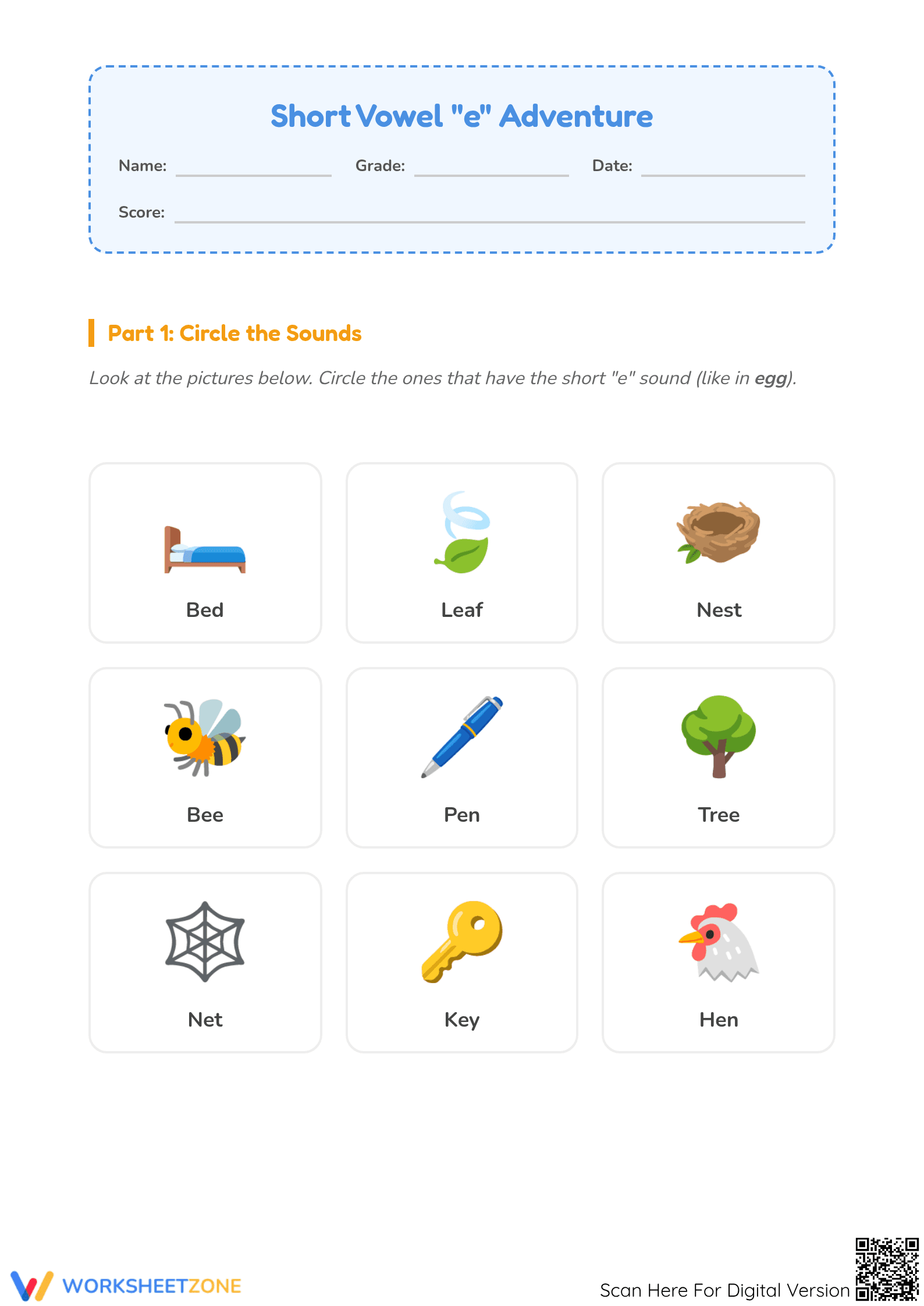
This two-page printable resource features three distinct activity types designed to reinforce phonemic awareness and spelling. Students will find a visual sound-recognition task, a missing-letter spelling activity, and a picture-to-word matching section. The clear layout includes familiar vocabulary words like "bed," "net," and "hen," accompanied by engaging illustrations. A complete answer key is provided for quick grading.
- Guided practice: Part 1 introduces 9 picture prompts where students must identify and circle only the images containing the short "e" sound, isolating the phoneme auditorily.
- Supported practice: Part 2 transitions to spelling with 6 fill-in-the-blank CVC words, requiring learners to write the missing vowel "e" to complete the word.
- Independent practice: Part 3 challenges students with 4 word-to-picture matching tasks, testing their ability to read the whole word and connect it to its meaning.
This gradual-release structure follows an effective I Do, We Do, You Do model for phonics mastery.
Aligned to primary standard CCSS.ELA-LITERACY.RF.K.3.B: Associate the long and short sounds with the common spellings (graphemes) for the five major vowels. It also supports early first-grade decoding expectations. Both standard codes can be copied directly into lesson plans, IEP goals, or district curriculum mapping tools.
This worksheet is highly effective as a follow-up activity immediately after direct instruction on the short "e" sound. Teachers can also assign it as morning work or place it in a literacy center for independent review. While students complete the picture-matching section, teachers can conduct quick formative assessments by asking them to read the words aloud, checking for accurate vowel pronunciation. Expect students to complete the tasks in 15 to 20 minutes.
Designed primarily for Kindergarten and first-grade students, this resource is also excellent for English Language Learners (ELLs) who benefit from the strong visual supports paired with vocabulary. For differentiation, teachers can provide a CVC word anchor chart for students needing extra scaffolding. It pairs perfectly with decodable reading passages focusing on short vowel families.
Mastering foundational phonics skills, specifically associating short sounds with common vowel spellings as outlined in CCSS.ELA-LITERACY.RF.K.3.B, is a critical milestone in early literacy development. According to the RAND AIRS 2024 report on reading acquisition, explicit and systematic instruction in phoneme-grapheme mapping significantly accelerates decoding proficiency in early elementary students. When learners engage in multi-modal activities—such as identifying sounds from pictures, writing missing letters, and matching words to visual representations—they strengthen the neural pathways required for automatic word recognition. This targeted practice with the short vowel "e" ensures students move beyond rote memorization to true phonemic application. By providing structured, visually supported exercises, educators can effectively bridge the gap between auditory sound recognition and written expression, laying a robust foundation for future reading comprehension and spelling accuracy.


