


























Views
Downloads

Loud and Soft Sounds Worksheet | Essential Grade 1 Science
Paste this activity's link or code into your existing LMS (Google Classroom, Canvas, Teams, Schoology, Moodle, etc.).
Students can open and work on the activity right away, with no student login required.
You'll still be able to track student progress and results from your teacher account.
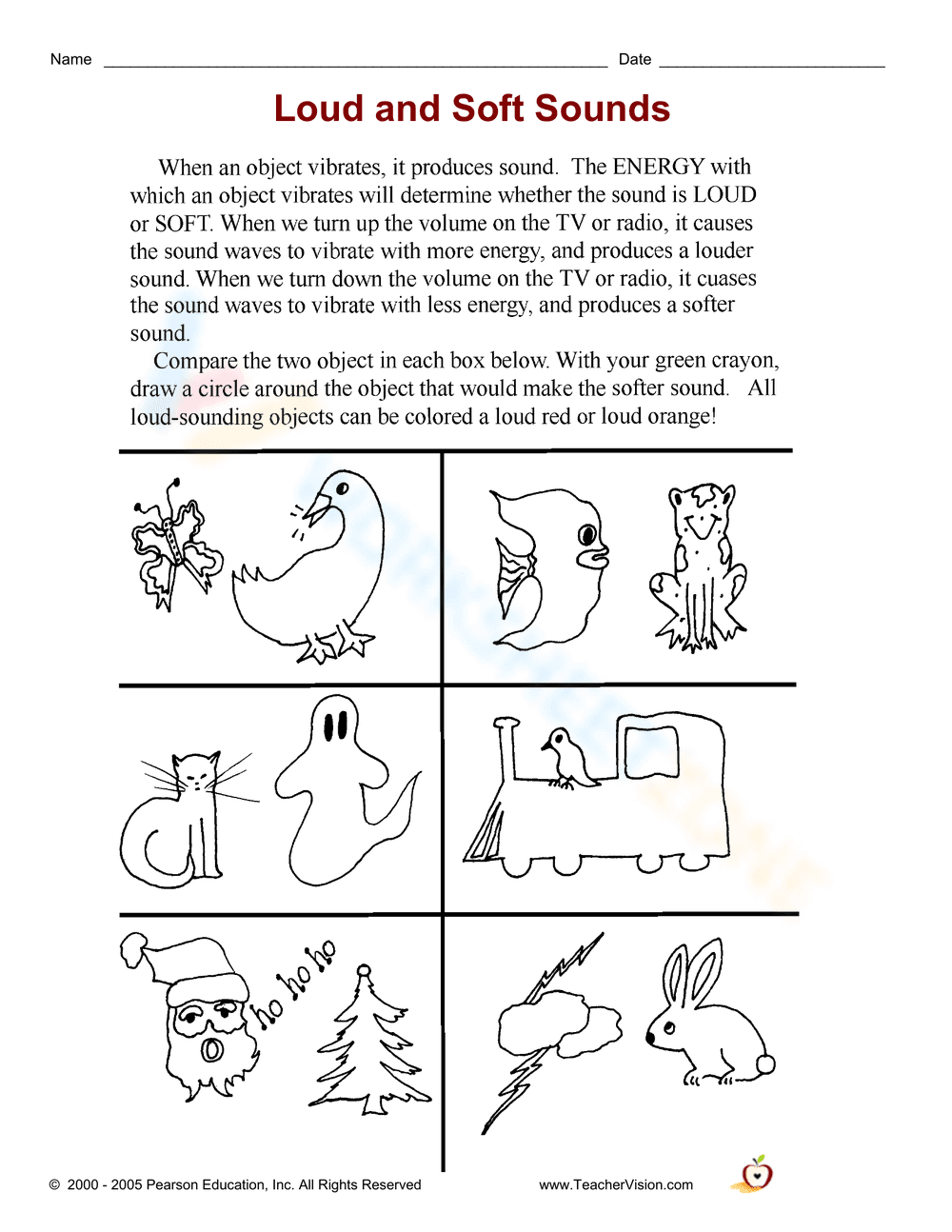
This Grade 1 science worksheet helps students master the concept of volume by identifying loud and soft sounds. By comparing familiar objects, learners develop a foundational understanding of how vibration energy relates to sound intensity. It provides a clear, visual way for young scientists to categorize auditory experiences and build scientific vocabulary.
At a Glance
- Grade: 1 · Subject: Science
- Standard:
1-PS4-1— Plan and conduct investigations to show that vibrating materials make sound.- Skill Focus: Volume discrimination (Loud vs. Soft)
- Format: 1 page · 6 problems · Answer key included · PDF
- Best For: Introduction to energy and sound units
- Time: 15–20 minutes
What's Inside
The resource features a concise introductory text explaining the relationship between vibration energy and volume. Below the text, students find 6 comparison boxes containing pairs of hand-drawn illustrations, such as a butterfly versus a bird or a ghost versus a cat. The 1-page layout includes specific coloring instructions to engage tactile learners and reinforce the distinction between loud and soft auditory outputs.
Zero-Prep Workflow
- Print: Generate the PDF and print copies for your roster in under 1 minute.
- Distribute: Hand out the sheets with a 30-second explanation of the green and red coloring key.
- Review: Use the included answer key to check student comparisons in less than 5 minutes.
Total teacher preparation time is under 2 minutes, making it an ideal choice for morning work, science centers, or emergency sub plans.
Standards Alignment
This worksheet aligns with 1-PS4-1: Plan and conduct investigations to provide evidence that vibrating materials can make sound and that sound can make materials vibrate. This activity supports the understanding that energy levels in vibrations dictate the resulting volume. Both standard codes can be copied directly into lesson plans, IEP goals, or district curriculum mapping tools.
How to Use It
Use this worksheet during the "Explore" phase of a 5E lesson on energy. After a brief demonstration of loud and soft instruments, assign the sheet to check for individual understanding. It also serves as a quick formative assessment; observe if students correctly identify the "softer" sound in the more ambiguous pairs, like the ghost and the cat, to gauge their reasoning. Expected completion time is 15 to 20 minutes.
Who It's For
This resource is tailored for first-grade students but is appropriate for kindergarten enrichment or second-grade review. It is particularly effective for English Language Learners (ELLs) due to the heavy reliance on visual cues and simple vocabulary. Pair this with a physical "sound walk" around the school or a digital soundboard for a complete sensory lesson.
According to the RAND AIRS 2024 report on early childhood science literacy, visual categorization tasks are fundamental in developing the cognitive frameworks necessary for physical science mastery. This worksheet aligns with the 1-PS4-1 standard by requiring students to distinguish between sound intensities, a precursor to understanding wave energy. By identifying loud and soft sounds through 6 targeted comparison tasks, students build the vocabulary needed to describe physical phenomena. Research from Fisher & Frey (2014) emphasizes that combining text-based explanations with visual identification supports the gradual release of responsibility. This 1-page resource provides the necessary scaffolding for Grade 1 learners to transition from observation to classification. It ensures that the core concept of sound energy is accessible and measurable within a standard 20-minute instructional block, facilitating data-driven instruction in primary science classrooms. This focused approach helps teachers document student progress toward mastery of energy concepts effectively.


