


























Views
Downloads



Easter Egg Reading Worksheet | Grade 2 Essential
Paste this activity's link or code into your existing LMS (Google Classroom, Canvas, Teams, Schoology, Moodle, etc.).
Students can open and work on the activity right away, with no student login required.
You'll still be able to track student progress and results from your teacher account.
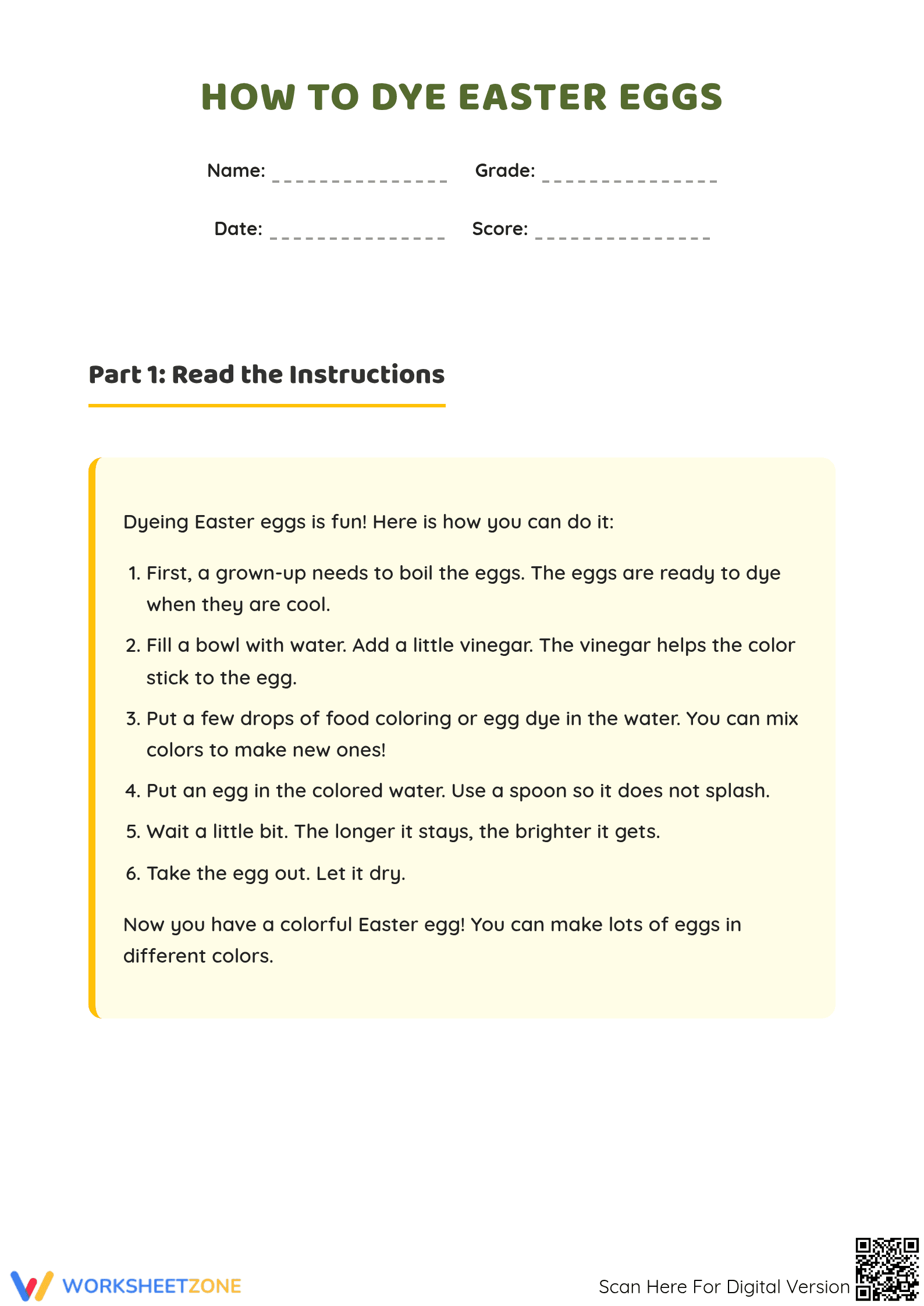
This procedural reading comprehension worksheet helps students master the sequence of technical steps through the engaging context of dyeing Easter eggs. By analyzing a six-step instructional text, learners develop the ability to identify key details and explain the logic behind specific actions. It provides a structured path toward informational text mastery.
At a Glance
- Grade: 2 · Subject: ELA Reading
- Standard:
CCSS.ELA-LITERACY.RI.2.3— Describe the connection between steps in technical procedures in a text- Skill Focus: Procedural Sequence & Comprehension
- Format: 5 pages · 16 problems · Answer key included · PDF
- Best For: Independent practice or holiday literacy centers
- Time: 20–30 minutes
What's Inside
The packet contains five comprehensive pages designed for clarity and student engagement. It begins with a clear, numbered procedural passage detailing the egg-dyeing process. Following the text, students encounter four open-response questions, six True/False statements to verify facts, and six fill-in-the-blank sentences to reinforce vocabulary and sequence. A complete answer key is provided for rapid grading.
Zero-Prep Workflow
- Print: Select the five-page PDF and print enough copies for your roster in under 30 seconds.
- Distribute: Hand out the packets during your ELA block; the self-explanatory layout requires zero teacher introduction.
- Review: Use the included answer key to check for understanding in less than one minute per student. This resource is an ideal grab-and-go option for substitute folders.
Standards Alignment
The primary focus is CCSS.ELA-LITERACY.RI.2.3, which requires students to describe the connection between a series of steps in technical procedures. By answering questions about why vinegar is used or why eggs must dry, students demonstrate a deep understanding of cause and effect within a process. Both standard codes can be copied directly into lesson plans, IEP goals, or district curriculum mapping tools.
How to Use It
Use this worksheet during the independent practice phase of a lesson after teaching signal words like "first," "next," and "finally." It also serves as an excellent formative assessment to gauge if students can locate specific evidence within a numbered list. Expect most second-grade students to complete the full 16-task sequence within 25 minutes.
Who It's For
This resource is tailored for general education second-grade students, though the clear formatting makes it accessible for Grade 3 review or Grade 1 enrichment. It pairs naturally with a classroom demonstration of egg dyeing or an anchor chart focused on procedural transition words.
According to the RAND AIRS 2024 report on elementary literacy, procedural text fluency is a critical predictor of later success in technical reading and scientific inquiry. This worksheet addresses this need by requiring students to interact with the text through multiple modalities, including open-ended inquiry and cloze reading. By focusing on CCSS.ELA-LITERACY.RI.2.3, the resource ensures that students are not merely decoding words but are actively constructing a mental model of a multi-step process. Research from Fisher & Frey (2014) emphasizes that scaffolded informational texts, like this 16-task Easter egg guide, allow students to practice evidence-based answering in a low-stakes, high-interest environment. This alignment with evidence-based practices supports the development of rigorous reading habits that translate across various informational genres, ensuring that Grade 2 learners meet year-end proficiency benchmarks for informational text complexity and procedural understanding.


