


























Views
Downloads

Complete Fiction Comprehension Printable | Grade 3 ELA
Paste this activity's link or code into your existing LMS (Google Classroom, Canvas, Teams, Schoology, Moodle, etc.).
Students can open and work on the activity right away, with no student login required.
You'll still be able to track student progress and results from your teacher account.
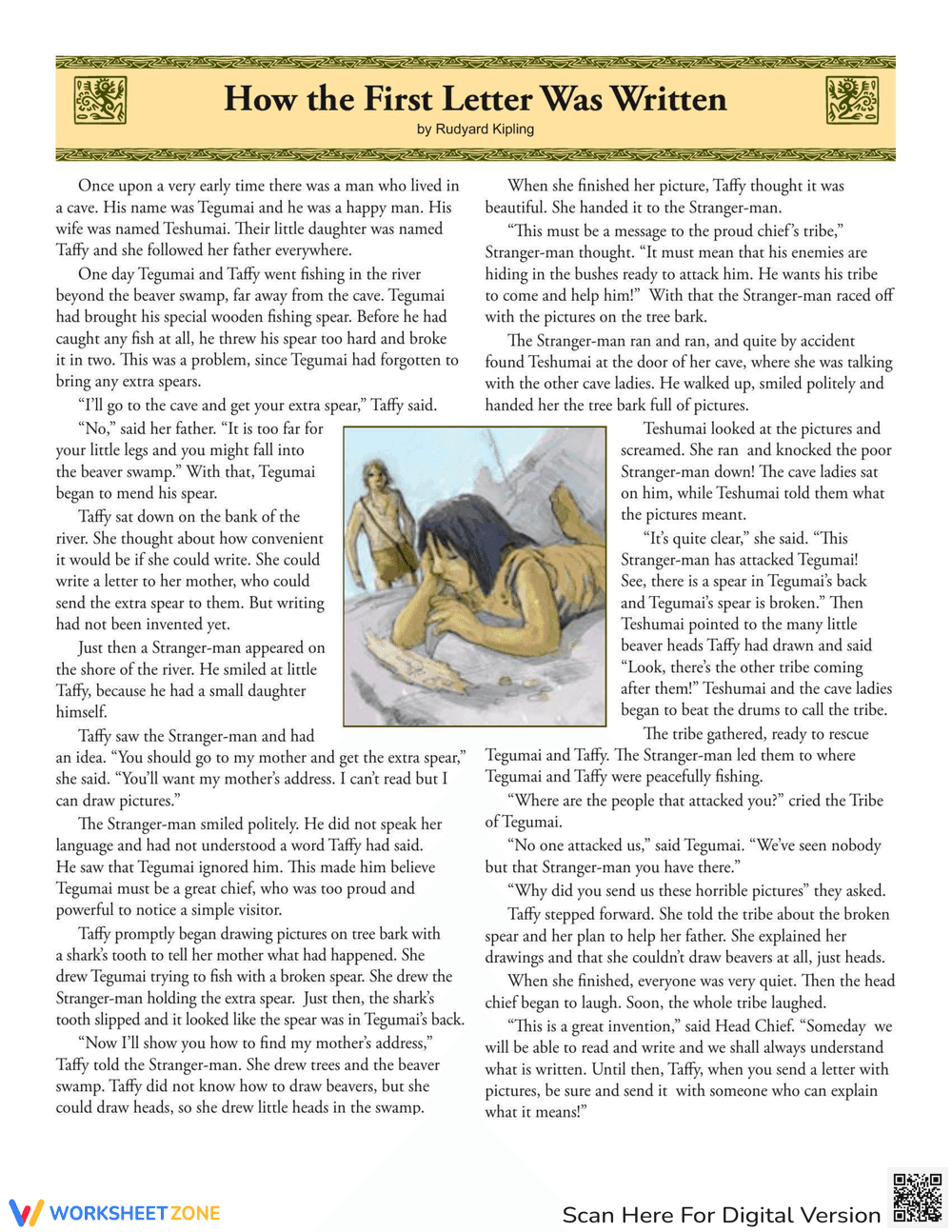
This Grade 3 fiction comprehension worksheet builds close-reading skills through Rudyard Kipling's story How the First Letter Was Written, guiding students to cite story details, interpret vocabulary, and respond to text across 20 structured tasks on 4 pages.
At a Glance
- Grade: 3 · Subject: ELA / Fiction Reading Comprehension
- Standard:
CCSS.ELA-LITERACY.RL.3.1— Ask and answer questions to show understanding, citing text evidence- Skill Focus: Story details, vocabulary in context, text-based questioning
- Format: 4 pages · 20 problems · Answer key included · PDF
- Best For: Independent practice after read-aloud
- Time: 30–45 minutes
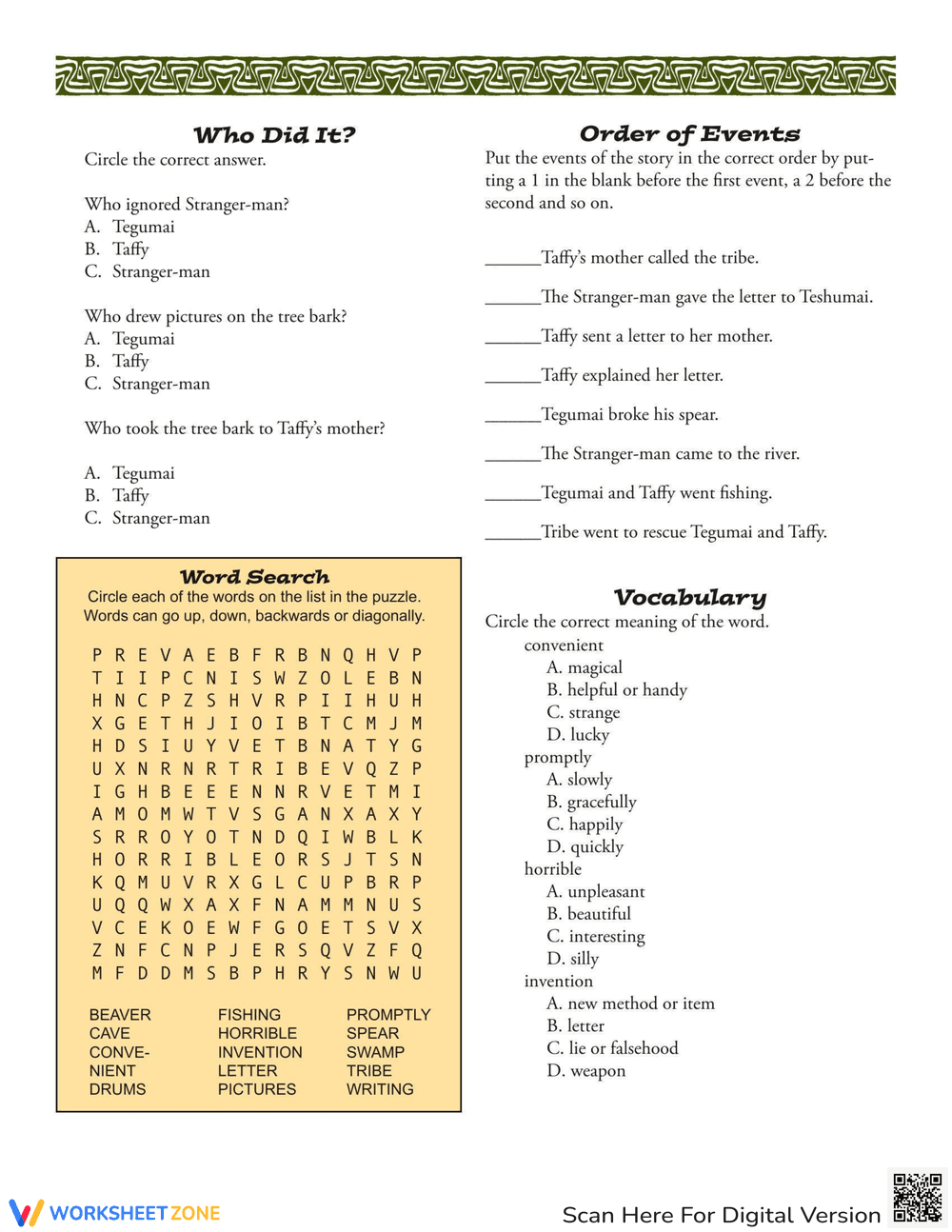
Four pages cover multiple task types: multiple-choice comprehension questions, fill-in-the-blank vocabulary items, matching story elements, a word search puzzle, and coloring pages tied to story scenes. Answer key covers all scored items. No additional materials required.
- Guided practice: 6 multiple-choice questions with four answer options each — students select the best text-supported answer, reducing open-ended demand while building evidence habits.
- Supported practice: 8 fill-in-the-blank and matching items — sentence frames and word banks reduce retrieval load so students focus on meaning and story sequence.
- Independent practice: 6 open-response and word-search tasks — students locate and record story vocabulary without scaffolds, demonstrating transfer. Coloring pages extend engagement without additional cognitive load.
Task sequence follows a gradual-release model: teacher-modeled close reading (I Do) feeds into guided group work on multiple-choice items (We Do), then students complete vocabulary and word-search sections independently (You Do).
Primary standard: CCSS.ELA-LITERACY.RL.3.1 — Ask and answer questions to demonstrate understanding of a text, referring explicitly to the text as the basis for the answers. Supporting standard RF.3.4.A addresses reading on-level prose with purpose and understanding; RF.3.4.C targets using context to confirm or self-correct word recognition. Both standard codes can be copied directly into lesson plans, IEP goals, or district curriculum mapping tools.
Use before direct instruction as a pre-reading activation tool — assign the vocabulary matching section only (10 minutes) to surface prior knowledge. Use after instruction as a full independent-practice check (30–45 minutes). Formative tip: scan fill-in-the-blank responses first; students who default to near-verbatim copying without paraphrase need additional modeling of text-to-own-words transfer.
Designed for Grade 3 general-education classrooms reading on-level fiction. Students who need additional support benefit from the built-in word bank and sentence frames; advanced readers can be directed to write a one-sentence justification for each multiple-choice answer. Pairs naturally with a read-aloud of the original Kipling text or a story-elements anchor chart covering character, setting, and problem-solution.
This worksheet targets CCSS.ELA-LITERACY.RL.3.1, the Grade 3 standard requiring students to ask and answer questions about a literary text by citing explicit textual evidence. According to NAEP 2022 data, only 33% of Grade 4 students perform at or above the Proficient level in reading, underscoring the need for structured, text-dependent practice at Grade 3. Fisher & Frey (2014) identify text-dependent questioning as a high-leverage routine that accelerates literal and inferential comprehension gains when applied consistently across fiction and informational genres. This 4-page, 20-task worksheet operationalizes that routine through scaffolded question types — multiple choice, fill-in-the-blank, matching — before releasing students to independent vocabulary work, providing a complete practice arc aligned to RL.3.1 and RF.3.4.


