


























Views
Downloads

Printable Counting Circles Worksheet for Kindergarten
Paste this activity's link or code into your existing LMS (Google Classroom, Canvas, Teams, Schoology, Moodle, etc.).
Students can open and work on the activity right away, with no student login required.
You'll still be able to track student progress and results from your teacher account.
Mastering Basic Geometry and Cardinality
Mastering basic geometry and counting is a foundational skill for early learners. This two-page worksheet provides an engaging way for Kindergarten students to identify and count circles of various sizes and colors. By blending shape recognition with cardinality, it ensures students build confidence in their mathematical abilities and spatial reasoning before moving to complex concepts.
At a Glance
- Grade: Kindergarten · Subject: Math
- Standard:
K.CC.B.5— Count to tell the number of objects in a scattered arrangement- Skill Focus: Circle identification and cardinality
- Format: 2 pages · 4 tasks · Answer key included · PDF
- Best For: Independent practice or center activities
- Time: 10–15 minutes
What's Inside
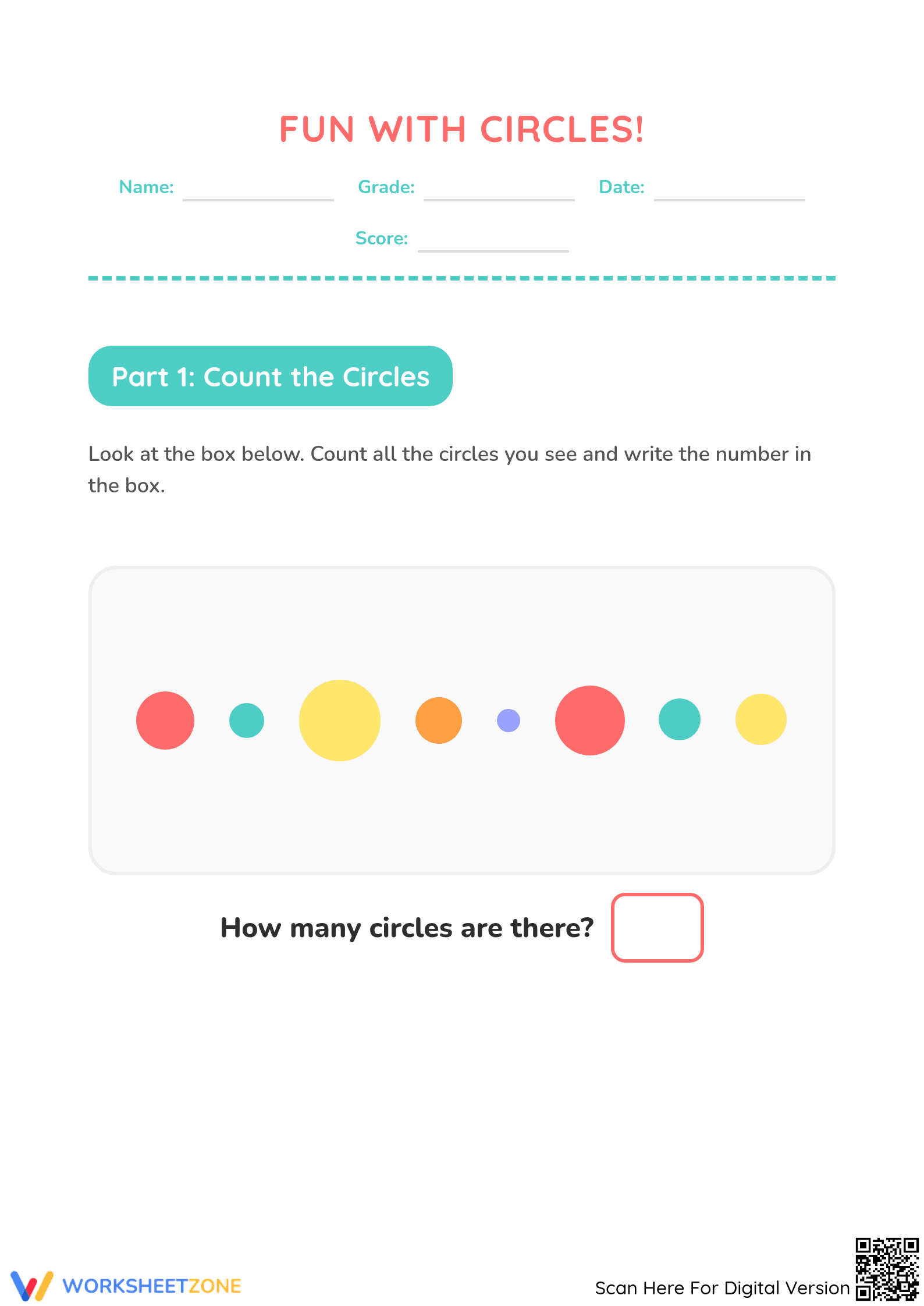
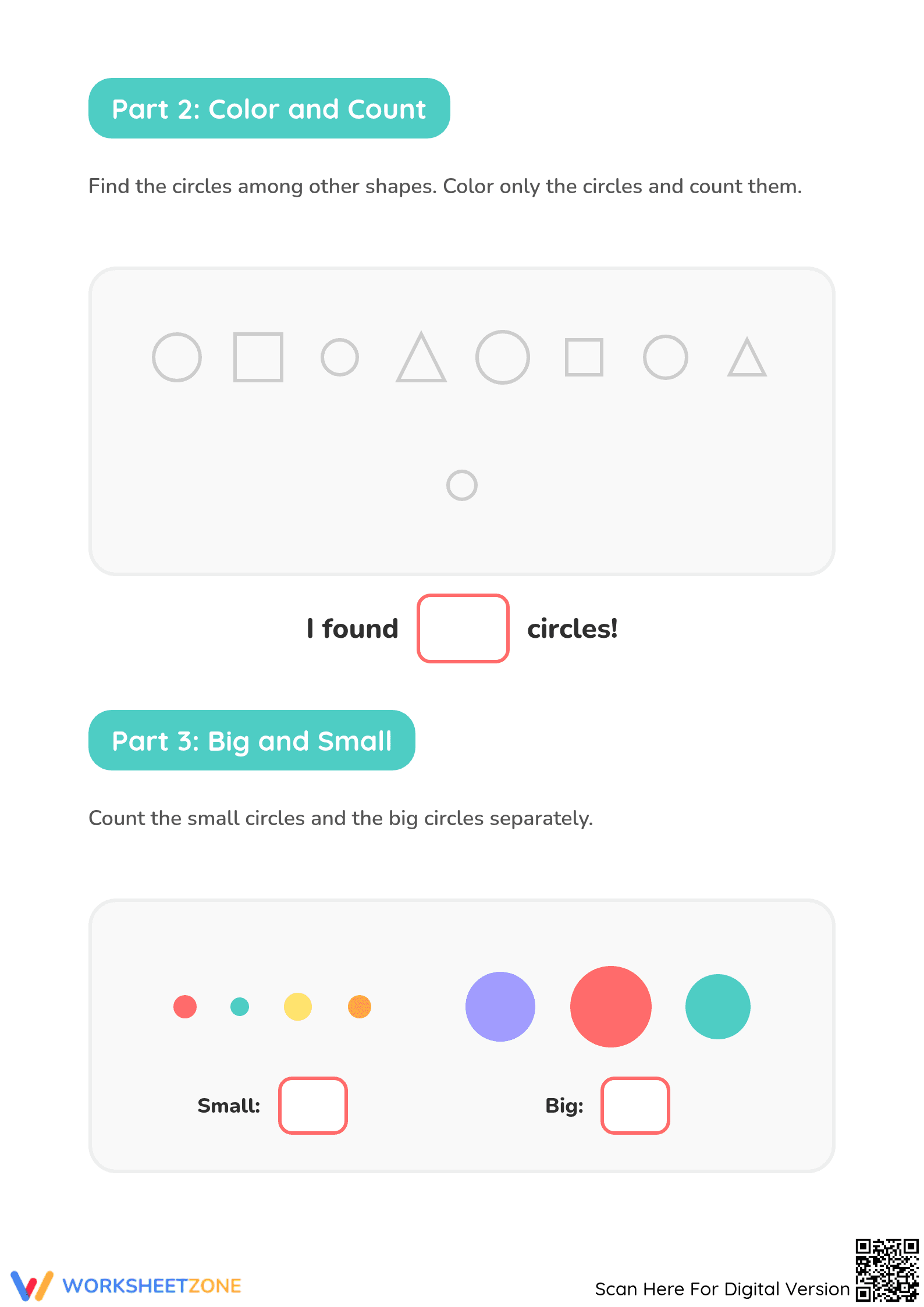
This PDF resource contains two pages divided into three distinct parts. Part one asks students to count a horizontal line of colorful circles to determine a total. Part two requires students to find and color circles hidden among other geometric shapes like squares and triangles, reinforcing discrimination skills. Part three focuses on size differentiation, asking students to count small and big circles separately. A full answer key is provided.
Zero-Prep Workflow
This resource is designed for immediate classroom integration with zero teacher setup. First, print the two-page PDF for your class (30 seconds). Second, distribute the worksheets along with crayons for the coloring portion of the second task (1 minute). Third, review the answers as a whole group using the provided answer key for quick grading and feedback (2 minutes). It is an ideal solution for emergency sub plans.
Standards Alignment
The primary standard addressed is `K.CC.B.5`: "Count to tell how many! Given a number from 1–20, count out that many objects." It also aligns with `K.G.A.2`: "Correctly name shapes regardless of their orientations or overall size." These standards bridge the gap between abstract number concepts and physical geometry. Both standard codes can be copied directly into lesson plans, IEP goals, or district curriculum mapping tools.
How to Use It
Use this during your geometry unit as a formative assessment to see which students can distinguish circles from other polygons. An observation tip: watch if students "touch-count" the objects to ensure one-to-one correspondence rather than guessing. Alternatively, place it in a math center where students can work independently to reinforce shape recognition and counting skills during small-group rotations. Expected completion time is roughly twelve minutes.
Who It's For
This worksheet is perfect for Kindergarten students who are exploring 2D shapes and numbers up to ten. It also serves as a remedial tool for first graders needing extra practice with cardinality. For differentiation, the varied sizes in the final part challenge students to focus on specific attributes, making it a natural pairing for a shape-hunt lesson or direct instruction session.
According to the RAND AIRS 2024 report on early childhood numeracy, the integration of geometric recognition with cardinality is a critical predictor of later success in elementary mathematics. This Kindergarten circles worksheet specifically targets this intersection by requiring students to isolate a single shape attribute—the curve of a circle—from a set of distractors before applying counting principles. Research from Fisher & Frey (2014) emphasizes the importance of visual scaffolding in early math, which this resource provides through high-contrast colors and distinct spatial arrangements. By addressing CCSS.MATH.CONTENT.K.CC.B.5 and K.G.A.2, the worksheet ensures that learners develop the necessary one-to-one correspondence and spatial reasoning required for more complex arithmetic. The 2-page format allows for a gradual increase in cognitive load, starting with simple counting and moving toward attribute-based categorization. This structured approach aligns with evidence-based practices for developing mathematical fluency in young children.


