




























Views
Downloads

Grade 4 Animal Research — Printable No-Prep Worksheet

Paste this activity's link or code into your existing LMS (Google Classroom, Canvas, Teams, Schoology, Moodle, etc.).
Students can open and work on the activity right away, with no student login required.
You'll still be able to track student progress and results from your teacher account.
This animal research graphic organizer worksheet structures student inquiry into habitats, diet, and physical traits. Fourth-grade students gather facts from informational texts and categorize findings into clear visual maps. Using this note-taking tool, learners develop essential research habits and synthesize complex science concepts into concise summaries.
At a Glance
- Grade: 4 · Subject: Science & ELA
- Standard:
CCSS.ELA-LITERACY.W.4.7— Conduct short research projects that build knowledge through investigation- Skill Focus: Animal research graphic organizer
- Format: 1 page · 10 prompts · Open-ended research · PDF
- Best For: Independent science research projects
- Time: 30–45 minutes
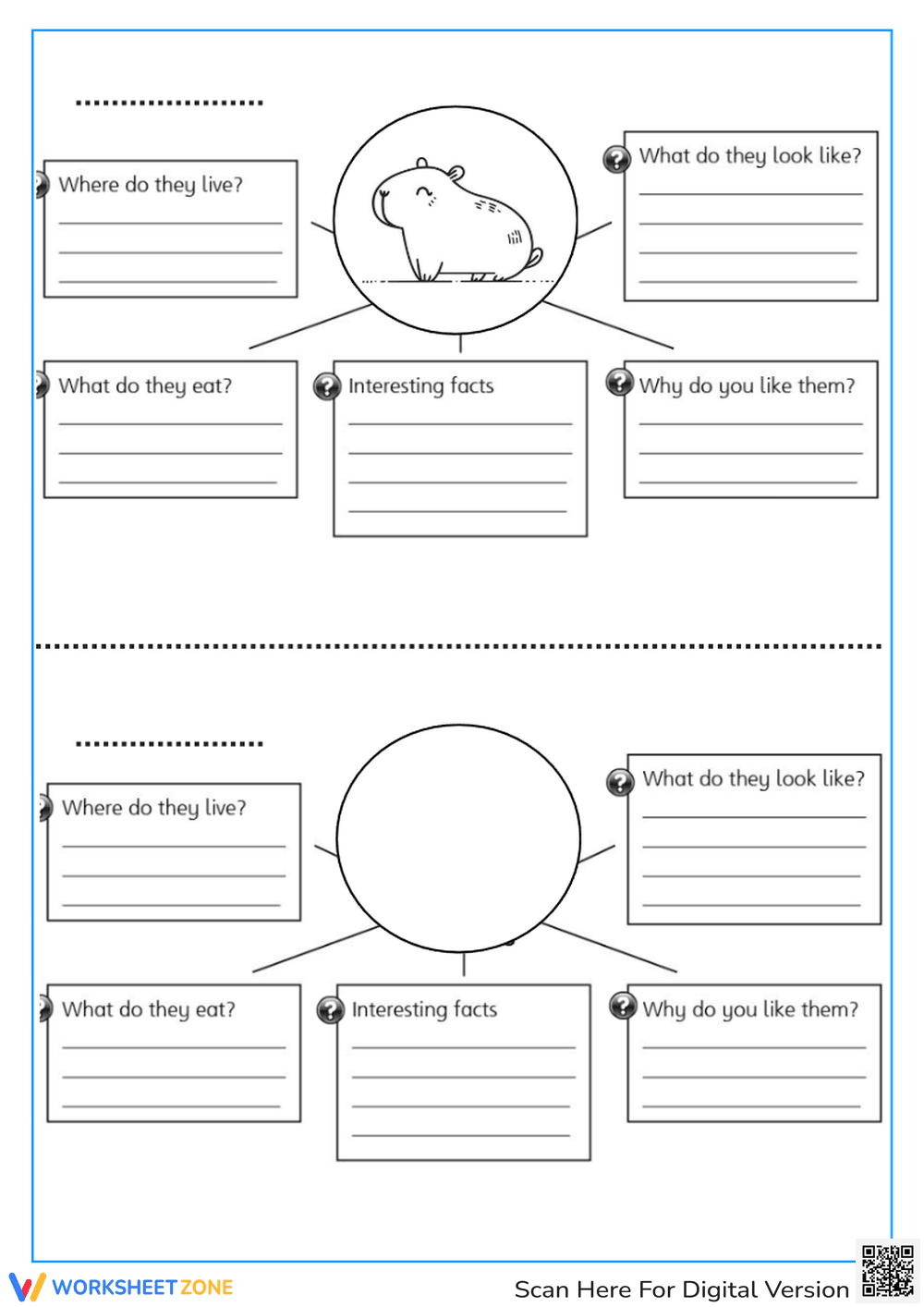
This one-page worksheet features two graphic organizer templates containing 10 structured prompt boxes. The top half provides a capybara research web, prompting students to identify habitat, diet, appearance, interesting facts, and personal reflections. The bottom half offers an identical blank template where students research any animal of their choice. Because this resource supports open-ended inquiry, an answer key is not required.
Zero-Prep Workflow
This worksheet is designed for immediate classroom implementation, requiring under two minutes of teacher preparation time. It serves as an excellent substitute teacher plan or independent learning station.
- Print (30 seconds): Generate copies of the single-page PDF file for the class without complex packet assembly.
- Distribute (30 seconds): Hand out the graphic organizer alongside classroom library books or digital reading devices.
- Review (60 seconds): Explain the five prompt categories using the capybara example before students begin independent research.
Standards Alignment
This resource aligns with primary standard CCSS.ELA-LITERACY.W.4.7, requiring students to conduct short research projects that build knowledge through investigation. Additionally, it supports CCSS.ELA-LITERACY.W.4.8 by guiding students to gather relevant information from print and digital sources, take notes, and categorize information. Both standard codes can be copied directly into lesson plans, IEP goals, or district curriculum mapping tools.
How to Use It
Teachers can deploy this graphic organizer during direct instruction in science units to help students structure reading notes. Alternatively, it functions effectively after direct instruction as an independent extension project. As a formative assessment observation tip, teachers should monitor students to ensure they write concise bullet points rather than copying complete sentences directly from texts. Expected completion time ranges from 30 to 45 minutes.
Who It's For
This worksheet serves fourth-grade students in general education and inclusion settings. For differentiation, teachers can support emerging readers by pairing the organizer with pre-highlighted reading passages or an anchor chart demonstrating how to locate key facts. Advanced learners can utilize the blank template to investigate a second animal from the same biome.
Effective elementary research instruction requires structured note-taking frameworks that reduce cognitive overload while students navigate informational texts. This worksheet supports CCSS.ELA-LITERACY.W.4.7 by providing a clear visual architecture for students to conduct short research projects and categorize facts about animal biology. According to Fisher & Frey (2014), utilizing graphic organizers during foundational research tasks significantly improves student reading comprehension and information retention by making abstract text structures visually explicit. By segmenting inquiry into distinct categories like diet and habitat, this tool scaffolds note-taking and prevents verbatim copying. Students develop essential academic literacy skills as they transition from guided inquiry with the capybara model to independent investigation using the blank template. This systematic approach ensures robust knowledge acquisition across science and language arts curricula.


